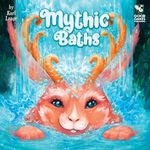

by Karl Lange
/pic9407111.jpg)
Origin Story
In March 2020 I was lucky enough to meet the company that held the Studio Ghibli licence for North America at GAMA Expo – I asked them if they would be interested in games designed around the Ghibli movies and they said they would love to see what I could do.
My wife had introduced me to the Ghibli classics like Totoro, Kiki’s Delivery Service, Howl’s Moving Castle, and Spirited Away a few years prior and I had instantly fell in love with them.
Once returning to Australia, and with lots of newfound time from COVID lockdowns, I set to work coming up with concepts for many of the titles. One idea I settled on was a game inspired by the bathhouse in Spirited Away where players are employees collecting ingredient tickets to make baths for spirits, cleaning the dirty baths once the spirits leave, and managers providing assistance to players via special abilities.
After four months of design and multiple playtests a week, I pitched the game back to the company I’d met at GAMA. Spoiler alert, although the publisher loved the game, due to licensing it was not to be. At that point I decided to keep working on the game and try my hand at self publishing.
Jumping back to the start, how did the design progress?
A lot of inspiration was taken from the movie. I set to re-watching the bath scenes to really understand how the baths worked.
Players would collect bath tickets with ingredients to satisfy the spirits’ wants. I started with five spirit types and five ingredient types. The bath tickets with ingredients were long rectangles in the movie which led me to have two ingredients on most, and some with some singles. This deck makeup led to the idea that players could overpay spirits ingredients to complete a treatment but would receive amber for giving spirits exactly what they wanted, creating an interesting dynamic of playing for efficiency vs accuracy. This tension is fundamental to the design and has survived every iteration.
The spirits themselves needed to start dirty and become clean, this was accomplished by using both sides of the card (dirty with their requirements, and clean with only the points shown on the back). Spirits had between three and six ingredients, with the harder spirits worth more points.
The other interesting dynamic was the cleaning the baths. After a spirit left, the bath should be dirty – achieved again by flipping the card over to a dirty side – and need to be cleaned before another spirit could enter.
/pic9647749.png)
An early prototype of what became Mythic Baths
As with a lot of my family-weight games, I tend to favour quick turns with a single action. So to incentivise cleaning the baths, I decided that all dirty baths would be cleaned at once. This action would earn you one amber per bath cleaned (as with Chihiro finding gold on the bottom of the bath from Noface) and fill the tableau with new spirits from the deck. As you can only take one action a turn, this gives the next player a full set of spirits to clean so the decision on how long to wait / how many dirty baths became a core balance in the game.
These core elements remained basically unchanged with balancing of points and resources over the coming iterations.
/pic9647764.png)
The managers, who add modifications to the basic rules (like event cards in other games) had many more changes, predominantly in how they entered and exited the bath house. In the early versions, the managers were simply shuffled in with the guests and once X managers were drawn the game ended. This ending was too random as the game length could be very long or very short, and managers could be in for only one round. After that they were added into the manager deck at regular intervals. This was in place for a time but was still not perfect and had more setup than I liked for game of this weight.
After many more iterations, I decided to detach the managers from the guests, and attach them to the ingredient deck, with a new manager appearing each time the deck ran out and was reshuffled. This kept managers in play for longer, but players may only see two managers throughout the game. From there they jumped to when the baths were cleaned, with a new manager starting after each time the ‘clean the baths’ action was taken. This worked relatively well with managers staying out long enough to be useful, and generally not cycling away too quickly so it was kept for the time being – more on managers later.
The last element with many, many changes was what happened when you collected sets of creatures. At the start, players scored additional points at the end of the game for pairs and sets of one of each creature. This worked well at lower player counts, but in 4- and 5-player games players finish with six creatures not leaving much room for set scoring which was not the feeling I wanted at the end of the game.
/pic9647769.png)
Mythic Baths at PAX Aus Collaboratory 2023.After many months of testing and feedback I decided to add an extra element to the game which replaced the set scoring – gaining favor from the creatures. Once you completed a pair of creatures you could choose to take that creature’s special action, a set of 1 of each would let you choose any creature’s action.
This added an engine building-like element to the game, giving it a much better arc overall, but still had similar issues at higher player counts. More on this later also!
Another element that came into play part way through the design was the reserve mechanic, as often I would have a player express they wanted to ‘lock in’ a creature they were aiming to complete, giving them more certainty at the cost of a turn.
Interestingly, once introduced this was one of the most divisive actions, with about half playtesters thinking it was the strongest action, and the other half thinking that it was useless, often debating with each other in the feedback sessions – to me, this said it was working perfectly as it allowed for many play styles.
At this point, I was confident that I had a good game and moved to finding an artist.
Art Direction of the Game
Deciding on how to theme the game was a tough decision. I had originally thought to use generic spirits, but after some consideration and consultation from others in the Australian tabletop industry, I decided to make the game its own and use mythical creatures from all over the world. I set to researching mythical creatures from around the world for an art brief and looking for an artist in a cute whimsical style.
The creatures I settled on were:
• Jackalope – a half jackrabbit half antelope from North American folk law
• Tatzelwurm – a half cat half snake from south central Europe
• Cerberus – three-headed dog from Greek mythology
• Sea-lion – half lion, half fish from the Philippines heraldry
• Owlbear – half owl, half bear from fantasy tropes
I spent many hours looking for artists on deviant art and art station before seeing some of Emily Hancock‘s art on the game Gift of Tulips. I remembered we had actually met at GAMA in 2020 and I hurriedly hunted down her business card to reach out.
Emily’s cute animal drawings and vibrant plant drawings would fit perfectly in the world I was creating bringing color and life to the game so I jumped at the opportunity to work with her on the game.
As soon as Emily’s sketches started to come through, I knew I’d made the right choice as her creatures were adorable.
/pic9647780.png)
Part of the brief was to have various clean and dirty elements that I could add to the creatures to make each image in the game unique – Emily did an amazing job making each creature look different while keeping everything coherent.
For the managers, I asked Emily for a diverse range of characters and let her creativity lead the art for eight of the ten characters with amazing results. The last two characters were to be of my wife and myself.
/pic9647782.png)
Look ma! I’m in a game!
But wait, you said you were going to self publish the game?!
You are correct dear reader, that was my original plan until Good Games Publishing expressed interest after playing at Pax Aus Collaboratory 2023. The game fit well into their catalogue and they liked how Emily’s art was progressing, so the deal was made.
One big advantage of having a publisher on board was the additional development put into the game by Kim Brebach.
One of the first changes was to increase the frequency of being able to use the creature favors. To do this, we changed the favors from abilities that would trigger on sets, to a token you would earn if you used your nourish token (reserve action). These become a one-time use that you can use on any turn giving more flexibility, with the tokens refreshing each time any player completes another of the same creature. This change kept players more engaged out of turn while allowing players to go for breadth (collecting each creature to get all the actions) or depth (to trigger the same action multiple times).
/pic9647806.jpg)
Favour tokens and reference card.
Kim is also a huge fan of Japanese culture and Spirited Away so we leaned into the theme, changing the highest value creatures into troublesome guests. These creatures have global negative effects that restrict play to all players in some way and were designed to be the opposites of the same creatures favor action.
To bring in the sense of staff rushing around to remove the troublesome guests while trying to keep the other guests happy, we added a semi-cooperative element where players can partially complete troublesome guests, earning amber (points) for the ingredients you contribute. Alternatively, you might just ignore them and let someone else focus on them, or you may try to complete them entirely yourself, scoring big points. This allowed us to change how the managers functioned too, having the managers change when a new troublesome guests enters (the previous floor manager making a swift exit when they see trouble approaching!). This brings all the upkeep into one step (flip baths, welcome guests, change manager if a troublesome guest arrives) keeping the majority of the turns flowing fast around the table.
/pic9647801.png)
Who’s a troublesome little puppy?
It was a great experience designing and art directing the game and I am so happy with how everything has turned out, I want to end on one of my favorite comments on the game from many players over the years that
Mythic Baths was released at UKGE 2026 and is now available around the world!
Tell us how can we improve this post?