
/pic9603317.jpg)
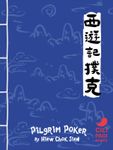
Pilgrim Poker is named so because the setting is Journey to the West, the Chinese classic novel. The characters are transported to a modern setting. They are on the first leg of their pilgrimage, taking the train to Dunhuang. Guess what they are bringing on this trip? Pilgrim Poker of course! Five years ago when I started working on this game, it was very different. It certainly was an unexpected journey for me.
/pic9603315.jpg)
The core idea in Pilgrim Poker is that everyone gets one card and holds it up facing forward. You can see everyone else’s card, but not your own. Based on this, you need to bet on whether you are going to win. Only the highest card will win. The game was inspired by Hanabi and Kobayakawa. In Hanabi, you can’t see your own cards. There are other games using this concept, like Pikoko and Luz. In Kobayakawa, you do just one round of betting, to decide whether you’re in or out. Very minimalistic, but the decision-making can be tricky. Pilgrim Poker was initially called Saikoyu, which is “psycho you” modified to sound Japanese, a nod to both the games which inspired it.
/pic9717737.jpg)
The first prototype had Malaysian fruits and four suits
In the first version of the game, after cards are drawn and held up, you take turns naming a bet amount. This is done for only one round. After everyone has named an amount, the bet which everyone must place into the pool is the second highest named amount. The reason for this is if most people think one particular player will win, they can all name a low amount, so that even if that single player names a high amount, he won’t be able to win much. This is done in turn order as opposed to simultaneously because whenever a player names an amount, it is a clue to the other players. A player who names a low amount is likely seeing a high card. If you don’t see any high card, then you might be holding that high card.
There are some special cards which modify the core rules. Anyone holding the 10 wins or loses double. 10 is strong, but it is not the strongest. The numbers go from 1 to 13. Getting 10 is good, but it will be painful if you lose to an even higher number. If the 4 is in play, it is the smallest card which wins instead. When you hold the 4 and you see that everyone has high cards, you might think there is no hope of winning, but you would be wrong. If anyone holds the 8, it turns all odd numbers to zero. That means the 8 beats 9, 11 and 13. It only loses to 10 and 12. These cards add a twist to the game. You have to think carefully as you observe the actions and expressions of your opponents.
/pic9448717.jpg)
Playtesting session
The Control Problem: Players Feel There Is Little Control
One big problem I had was players feeling helpless. When two players feel confident (or desperate) enough to want to name a high bet amount, you will be forced to put in a large bet, even when you are pretty sure you will lose it. This feels bad. I didn’t want to add more rules to handle such a feel-bad situation. I thought maybe that should just be what the game was. But still, I had a nagging feeling this wouldn’t work. I was stuck for a long time, and I had to set the game aside. It took more than two years for me to revisit the game. I am glad I did, because I had an idea that helped to move this design forward. Well, it wasn’t exactly my idea. It was just poker. I applied the poker mechanism to the game.
Everyone must commit to an ante. During a round, it is possible to raise, and when anyone raises, you can decide to fold, sacrificing your ante. This is simple, and most people understand this, because most people know a little about poker. By using a tried-and-true mechanism, I not only solved my problem about the feeling of control, I also made the game more intuitive to learn.
/pic9717736.jpg)
Prototype in play
The Information Problem: How Much Information Is Enough?
When a round starts, you have no idea what your card is. I want to make sure there are ways for you to get clues. Your opponents can’t and won’t tell you, but I want to make sure their actions will give you hints. Or there are things you can do to try to get information. One mechanism I introduced for the purpose of helping players gain information was the Side Bet. Making a Side Bet means challenging another player to a duel. You state a bet amount. If your target agrees, you resolve this at the end of the round. If your target declines, he must pay you half the bet amount immediately. As you can see, this is a chance for you to bluff and intimidate an opponent into giving you money. Of course, if you happen to be holding the 1, this will backfire, and everyone will laugh at you. The Side Bet action gives information. Normally the player with the lowest card will be targeted. If you are being targeted, you probably have a low card. The bet amount named is also a clue. If you are being targeted but the bet amount is low, then maybe your card isn’t too low.
Here is one hilarious situation that I came across when playtesting. One player was the target of a Side Bet, but he saw that another player had a lowly 2. Since the active player did not target the 2 and targeted him instead, he knew he probably had an even smaller card, the 1. Throughout my playtesting, it was moments of realisation like this which truly tickled the players.
Another funny situation was the player holding the 4 confidently issuing a Side Bet to the lowly 1. When 4 is in play, the lowly 1 becomes the strongest card. The active player didn’t know he had a 4, well, at least until the other players started giggling.
/pic9717735.jpg)
Game prototype
The Existential Problem: Isn’t This Just Indian Poker?
I found out rather late in my development journey that there is already a public domain game very similar to Pilgrim Poker called Indian Poker. Indian Poker is not widely known in Malaysia where I live, so I had no idea there is such a thing. It was depressing to find out what I had been working on was something someone else had already made. Eventually I decided to still proceed with the project. Pilgrim Poker is not exactly Indian Poker, due to the special characters and also the action cards. So I felt I still had something new to offer.
/pic9448718.jpg)
The Theme Problem: Why Journey to the West?
I must admit, Pilgrim Poker has a pasted on theme. This is a mechanism-first game. I did not start with any theme. Most of the other games I have published under the Cili Padi Games brand have fairy tale themes – Snow White, Ali Baba and Pinocchio. This time I thought why not pick a Chinese fairy tale. I chose Journey to the West because it is a story every Chinese knows, and many non-Chinese too. A familiar theme will attract attention, make the play experience more enjoyable, and also make learning the game a little easier. I do feel a little guilty because Journey to the West is supposed to be about Buddhism, and here I am with a gambling game…
/pic9717727.jpg)
The final pilgrimage team in the game
There are many characters in Journey to the West, so I had more than enough source material to use. The pilgrimage team consists of four main characters, Master Tang Sanzang, eldest disciple Sun Wukong the Monkey King, second disciple Zhu Bajie (Pigsy), and junior disciple Sha Wujing (Sandy). Among the number cards, only three of them – 4, 8 and 10 – have special powers. That means I had to exclude Sha Wujing and move him to one of the action cards. Strictly speaking the pilgrimage team has five members, the fifth one being the horse. That horse is not just any horse. He is a dragon prince. I did not include him at all, since most people think of the team as just those four.
10 became Sun Wukong, because he is the strongest fighter. 4 became Zhu Bajie. Zhu Bajie is often depicted as the greedy and lustful one. His flaws remind us that we are just human.
/pic9717728.jpg)
Other characters in the game
For regular number cards (i.e. other than 4, 8 and 10) my original idea was to put some generic minor demon character. Some minions. My artist Edwin Chong suggested the Bull Demon King. Now the Bull Demon King is certainly no minor character. He is a big shot demon. I loved how Edwin turned him into a tired modern day salaryman, carrying a laptop bag and standing in the train. In Pilgrim Poker when you initiate a Side Bet, that’s an act of aggression. I thought Red Boy would be most fitting. He is the fiery character in the story. In many chapters, it was the Goddess of Mercy (Guan Yin) who came to save the day, when the pilgrimage team got really stuck. So I put her on the Change Card action card. This is a card that can completely turn things around. Halfway through a round, you can discard your card and draw a new one.
/pic9600930.jpg)
Pilgrim Poker was released in Malaysia in August 2026. It started as “Saikoyu”, and now it has a theme of Journey to the West, which in Japanese is “Saiyuki”. If this game ever gets a Japanese edition, it might be called Saiyuki Poker.
/pic9717729.jpg)
Finally, the end product
/pic9717731.jpg)
Game components
/pic9717732.jpg)
Action cards
/pic9717733.jpg)
Number cards
/pic9717734.jpg)
Start player card (night side)
/pic9717730.jpg)
94 coins
Game page at Cili Padi Games website: https://www.cilipadigames.com/pilgrimpoker
Tell us how can we improve this post?