
by Justin Bell
/pic9637526.jpg)
One morning this past February, I was standing on a scale in my bathroom, doing my normal routine of knocking out the weigh-in before getting the kids ready for school. The number that came back wasn’t to my liking, the third or fourth or tenth week in a row where it was not to my liking. After I helped get the kids on their way, I dropped about $100 on a 12-month subscription to the Weight Watchers app to start tracking my meals and committed to a goal of losing at least 20, and ideally 30, pounds by the end of the summer.
As of this posting, I’ve lost 25 pounds, and assuming I stay on track with continuing to build better eating habits, I should cross the weight-loss finish line soon. But I think a lot about that day in February; I just hit a breaking point, and I got so angry when I saw the scale that fateful morning that it pushed for immediate action.
A similar thing happened this week, across three consecutive nights of gaming where players sent me to the breaking point. This article is both a love letter to some of the recent changes I’ve observed from publishers, and some interesting opportunities for players.
/pic9637532.jpg)
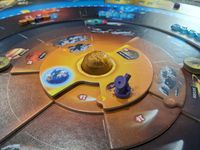
Last Monday, my review crew and I had the chance to play our first game of Entropy, the new Board&Dice release designed by Tommaso Battista, Simone Luciani, and Nestore Mangone. The game doesn’t have much video content on the interwebs yet, so I taught the game live to a group for this four-player game.
Teaching a game on site and in person to any group of players is typically a minefield, a minefield that gets progressively more dangerous as a game’s complexity rises.
I’m still scarred by the experience I had watching a person try to teach me Feudum almost six years ago. I see in my Logged Play notes that the teach took 80 minutes, for a game that ultimately took only a little longer than that to actually play. When you see a game’s Complexity Rating land in the 4.5-and-above range, it usually means you are in for quite a sit as you try to learn a game.
Entropy is certainly not that—I think the game’s complexity rating here on BGG will land in the 3.5-ish range once you, the people, begin to share your thoughts in volume—and it took only about 25 minutes to explain the game’s core concepts, main actions, and end-game scoring conditions.
But one thing was key during my Entropy teach, a hallmark of how far we have come as a community: I taught the entire game from the included player aid cards, and asked players to follow along from the aid, in part because everyone had their own. (My only gripe with publishers for this article: please, please, please include one player aid for each player! Competitive gamers don’t have a “share” gene! This is why they like competitive games! One player aid per box is not going to cut it, people!!)
With our teach complete and our snack bowls filled—it was a Kit Kat “Bunnies” night, alongside zero-calorie sodas, a selection of bottom-shelf bourbons, and the Kirkland Signature Kettle Brand Krinkle Cut “Pink Salt” potato chip night, because Costco recently decided that the words “Himalayan Salt” were simply too difficult for a standard American consumer to comprehend—we got to work playing the game. But something interesting happened as we began play:
Everything I had just taught, from the basic movement of a player’s worker pawn, to how actions worked, to scoring conditions, to limitations of components that can be placed on a player’s planets, quietly left the brains of these usually reliable players, almost as if I had taught the game in Dutch, but everyone at the table pretended they spoke fluent Dutch as they nodded along during the teach.
“Hey, sorry about this, but before I move…I know you said that I can move up to three spaces, but in which direction?”
“If you look at the ‘On Your Turn’ portion of the player aid,” I began, “that’s where it shows the rules for movement.” (There are also chevrons on the board that point in a clockwise direction near each space, and we will come back to this.) The text on the player aid: “Movement: move 1-3 spaces clockwise. Finish on either outer or inner space.”
“When I take the Create Life action, I see the icon that means I have to drop the matching action marker there to take the action, so I’m good there. But how many cards can I discard to take the place of icons I am missing from my planet-star combo to play a card?”
“If you look at the ‘Actions’ area of the player aid, on the side that has the major actions—yep, that side—you’ll see that you can discard one other card with one of the four icons you are missing to play the card you want. And don’t forget about the part you see in that same section of the aid: each planet can only accommodate three life cards.”
Although my basement gaming lair is pretty chilly during the summer when the air conditioning kicks in, I could feel my temperature rising a beat. Oh, another question:
“I’m trying to understand the icons for my Focus cards.” (In Entropy, each player gets their own asymmetric, lettered set (A, B, C, or D) of bonuses, which power each of the game’s three major actions. Think of this like the Experiment boards in Nucleum, where players can upgrade some of the standard actions they take to earn additional bonuses.) “What does this first symbol mean?”
“I don’t know, but I also can’t see your Focus cards from where I’m sitting,” I commented. “What does your player aid say for the set of Focus cards you have?”
“Oh, right, thanks, I forgot that was on the back of the ‘On Your Turn’ player aid card. Looks like I get…”
This continued for the majority of our experience, although like all games, the rules began to settle in for everyone—myself included—by the end of our first game. And, I can’t fault human nature: it’s simply easier to ask the rules guru at the table a thousand questions, since they know the game better than everyone else does. You’ve done it, I’ve done it, we’ve all done it…although, I take listening to a teach very seriously, because I teach so often myself.
The problem with this is the play experience for the rules explainer. I have been a vocal supporter of not only thanking your tabletop teacher for spending the time to both learn a game and be willing to teach it thoroughly to new players, but also acknowledging that it is so difficult to both teach a game and enjoy playing that same game.
That’s not because the game is new to the teacher, assuming this is their first time playing it. That’s because the learners at the table don’t take the time to consider all the tools available to them while playing, and being able to answer 75-100% of the questions that can be answered. That starts with the player aid.
Some of you know that I write an article each year on Meeple Mountain summarizing not only the best and worst games I played in a year, but also summarizes my thoughts on the stuff we really care about: the best rules for deciding a first player, the best individual components, the best dice. One of the categories is best player aid, and I love how far player aids have come over the last 3-4 years as highly complex games get summarized on a sheet or double-sided cards.
Recent titles such as SETI: Search for Extraterrestrial Intelligence, Galactic Cruise, Covenant, Arcs, Salton Sea, the Perseverance games, and La Pâtisserie Rococo provide excellent player aids, sometimes with little cues such as specific rulebook page numbers where a player can get more info even when the aid isn’t enough. (The aid for SETI is the gold standard in this category.)
Some of my favorite games of the last few years didn’t have a player aid, such as Clinic: Deluxe Edition and Railway Boom, but I can get over that if there are strong visual cues and a sort of board-based player aid on the main play area. Clinic has one of the best in the business, and Railway Boom does a great job with the information loaded into the auction area on the bottom third of the board. Sometimes, even a game’s player boards have enough turn action and clean-up/maintenance information to get by.
All of this provided information is great…but only if players bother to read the aid or look for other visual cues around the play area.
I’m certainly biased because I teach a lot of games, and I know how hard it can be for a person to spend a lot of time on the front end to get to know the game well enough to be comfortable teaching that game to others. It’s a lot! But players need to own their share of the investment. I’ve just spent 10, 30, 80 minutes teaching you the game…could you do me a favor, and simply listen??? Could you first look at the player aid before asking me another question, a question that may have just been answered because another player asked the exact same question two turns ago???
/pic9637535.jpg)
Over the next two days, I did another play of Nippon: Zaibatsu (with the upcoming Genro expansion) and a second multiplayer game of Entropy with two new players at a game night with a strategy gaming group in downtown Chicago. Many of the same things popped up, with questions about some of the game basics that could have been answered by the player aid, had a player acknowledged its existence first. (Kudos, as well, to the makers of the excellent “Player Handbook” included in Nippon: Zaibatsu, another game that can be taught from the player aid.)
By the end of that third straight day of beginning multiple responses with the prompt “if you look at the player aid…”, I snapped. (OK, you’re right: “snapped” for me is pretty light in the scheme of things. I happily went about my evening and watched the wild ending of the fourth game of the NBA Finals later that night…then immediately began to write this column.)
I’ve been thinking about ways to solve my own problems. Do I need to be more forceful with players as they consider their questions? Like my buddy John, should I start mining the Files area on BGG for every game in my collection that doesn’t have a player aid, so that I can start printing my own? (Thanks, BGG community; some of you have made great aids from scratch, particularly for older titles.) Where possible, should I send out PDFs of the player aid files in advance, so that players can have those handy on their phones while they study up on a new game?
Publishers have begun to do their part. And the drum I beat is not just tied to these medium or heavy-weight strategy games…because I say it every week: every single game needs a player aid. UNO needs a player aid just like SETI does. That’s because new players forget rules all the time. Heck, I forget a rule or two all the time with games I’ve been playing for years. Now that most games have player aids, we as a gaming community need to level up…and review those player aids when we have questions about a rule.
That’s the least we can do, right?
Tell us how can we improve this post?