
by Justin Bell
Some of you are familiar with The Dusty Euro Series that I craft over at Meeple Mountain: one-off reviews of Euros that are at least 10 years old at the time the article goes up.
I’m lucky to know a lot of players who love to dig into the crates to dust off classics from time to time.
Every so often, I not only play a single older title for game night, but a few all at the same time. I will write about those nights here and discuss the good times shared at the table. I know some players are obsessed with “the cult of the new”, but there are thousands of “old”, great games out there and I will use this platform to ensure people keep getting all kinds of games to the table.
Enjoy!
/pic9599857.jpg)
My man Dan recently celebrated a birthday by hosting game night at his place. While the chatter leading up to the night was tied to some of Dan’s favorite games, such as Marco Polo II: In the Service of the Khan, Caylus, and Lost Ruins of Arnak, Dan claimed that he was open to playing almost anything, as long as folks could make the quick trip to his house.
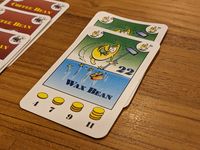
After we worked through some pizza, Oreo Double Stuf cookies, Dot’s Pretzels, and something that looked like it was healthy (I am told the word I’m looking for is “carrots”), we broke out the bourbon and got to work. Dan’s birthday turned out to be a party of six, so we decided on Uwe Rosenberg’s 1997 negotiation classic Bohnanza to start the night.
Bohnanza is one of those old games that I think a lot of people have heard of, but I don’t think a lot of players—particularly younger players or those who are newer to the hobby—have run out and tried. You can find copies online and I’ve seen copies in stores, particularly hobby stores that have a used game area, but it’s rare that I see Bohnanza used as a “gateway” game for new players like other titles typically used in those circumstances.
That’s a shame, because while I’ve only played the game twice, I came away from this recent play thinking the same thing as some of the other people at the table that night: Bohnanza might be the designer’s best work, and it is absolutely the most straightforward Rosenberg design that I have tried.
Bohnanza is a negotiation game, where prospective bean planters use cards to plant beans into one of two “fields” (simply two empty spaces in front of a player) to earn coins…most coins wins. On a turn, a player must play one or two cards from the “front” of their hand (right or left, but a player must decide this at the beginning of the game and they can never rearrange the cards in their hand), to either continue a matching set of beans from their fields, or wipe a set to create a new field.
Depending on the number of cards in a player’s set—and depending on the number of that bean type in the entire deck, which makes some beans more rare than others—they can wipe a set with enough copies to convert some of those cards into coins, with each converted bean equal to one victory point. After playing cards, a player draws two cards from the top of the deck, flips them for all players to see, then (usually) adds those cards to their own fields if they match before opening negotiation for card trades with their opponents.
It is this last point that makes Bohnanza highly group dependent. Dan is a part of my Wednesday gaming group, with a lot of jokers who talk as much or more smack than I do (hard, but possible), and who prefer the yelling and screaming portions of any game night. Spoiler alert: Bohnanza has a lot of those moments, particularly when players are jockeying for one more blue bean, or trying to negotiate black-eyed bean “futures” by making empty promises for favors later in the game (favors that are absolutely not binding), or yelling because someone’s earlier promise for red beans resulted in that player throwing said red beans into the discard pile to make way for a new set on her next turn.
(Yes, that last part happened to me. Yes, I’m still angry about it, despite the fact that another player and I shared the victory thanks to a matching number of coins and leftover cards remaining in hand. Grudges run deep!)
Bohnanza does run a bit long for my tastes. Our six-player game went for about 70 minutes, mainly because all six of us yelled as much as we could to convince other players that each of us had “the best offer”, every single turn. That’s a LOT of negotiating. But still…
“I think this is the best game ever made,” one player said when we were wrapping up. That player, a game designer himself, got a couple nods from others at the table.
It also reminded me of something else I think about when I’m writing game reviews: when prospective game designers (or even established ones) play games like Bohnanza and they, themselves, are designing a negotiation game, do they think about the fact that making a game as good, or better, than Bohnanza should be the inspiration to make something great?
It’s a fascinating thought.
/pic9599866.jpg)
The second game of the night was the second edition of Camel Up, released in 2018, although the original came out in 2014, ensuring that it qualified for inclusion in this article. (In our play group, Camel Up 2E is known as “the version of Camel Up with box cover art that reads Camel Up, not Camel Cup.” Long-time players know what I am talking about!)
For a few years after the first edition of the game was released, one of the Wednesday night guys would always start the night with Camel Up, because it can accommodate up to eight players and we always had a couple folks showing up late. This also meant that I came to despise Camel Up for a period of time; good or bad, I just don’t want to play the exact same game every time I come to game night!
Camel Up, like Bohnanza, is also a yelling and screaming game. One player, who had played Hot Streak but was seeing Camel Up for the first time, listened to the teach and wondered “did Camel Up rip off Hot Streak?”
“No,” someone said, since Camel Up came out first. “But you are going to get some Hot Streak vibes for sure, especially when camels start going in the wrong direction.”
That’s because the second edition of Camel Up has the same shenanigans as the first edition—dice, camels, a random assortment of ways camels can move forward by moving on their own versus riding on the backs of other camels, betting on camels to finish first or last in both a round or the entire race—plus two new camels, one black and one white, that are moving BACKWARDS all game long.
When a forward-moving camel lands on a backwards-moving camel, that might mean that the pony you thought was certain to win might get carried three spots backwards on multiple turns, throwing an already precarious situation into further disarray. Oh, and did I mention that in the second edition version, there are six dice in the pyramid dice shaker (one for each of the five normal camels, then one die for both the white and black camels) but only five dice are rolled in each leg of the race??
The winner of our play of Camel Up guessed on his very first action of the entire game which camel would finish the race first…and he was right, winning by the difference his total gave him by guessing earlier than anyone else, three points. Camel Up is a gambling game through and through, and having NOT played it for years made it all the more enjoyable.
/pic9599871.jpg)
At this point, one of the guys in the group desperately wanted to get his copy of the also-old, also-brilliant Reiner Knizia game Samurai to the table, so we broke into two groups of three. It was about 9:30 PM on a school night, so my dreams of Dan picking Marco Polo II were off the table. Still, I wanted to honor the birthday boy with one last play.
“I’m good for another hour or so,” I said. “I’ll play whatever you want.”
“How about Puerto Rico?” he asked. Two of us raised our hands to join him; I hadn’t played Puerto Rico in a couple years, at least not “IRL.” (I play the Puerto Rico app all the time, plus I’m more of a San Juan guy than a Puerto Rico guy; San Juan plays faster and serves as a solid filler in my home while scratching most of the same itch.)
Puerto Rico is no stranger to you, the fine people who read our content, as a former #1 overall slot holder and a member of BGG’s Hall of Fame. (Shameless plug: I’m one of the folks featured in the video.) But I swear I say this every time I play Puerto Rico, even when I play it by myself on the app or online on Board Game Arena:
Why doesn’t Puerto Rico hit the table more often?
The other guy at our three-person table hadn’t played Puerto Rico in so long that he needed a full teach…eight, maybe nine minutes later, we were good to go. The production of the original game is gloriously basic; I don’t believe in using cardboard money, so it was both a personal insult and a genuine hoot to distribute coins that felt thinner than notepad paper. Setup was done in a flash, especially with three of us, and we were up and running quickly.
Puerto Rico, like Race for the Galaxy and other games that feature the hallmarks that made them so innovative “back in the day”, uses the nuances of the active player advantage or “privilege” to such great effect. Just picking a role each turn—especially the ones that had just enough coins piled on from previous-round neglect to make them attractive—was a joy, picking up the physical role tiles to kick off a new set of actions.
I went hard on the Settler action and quarry tiles, piling up four quarry tiles in what felt like a blink of an eye, making Builder actions really cheap later once I got enough colonists in place. One player went big on production and market benefits, and was the only player to participate in the coffee and tobacco markets. Another player decided early on that he needed his own boat for shipping, so he bought a Wharf tile then piled up a nice array of corn, sugar, and indigo fields to create a handsome shipping empire.
Turns were moving quickly, just the way I like it. I got to socialize my terrible British accent by saying “well ‘allo, Guvna!” every time we passed the Governor tile, dictating the new first player for a fresh round of actions. Taking turns that benefited only me was also a joy, a joy shared each time another player did it to the rest of us. (Curse you, Dan, for taking those three coins on the Trader tile and selling the final item to the Goods Market, closing the rest of us out of making money that turn!)
Scores were close at the end: 52, 47, 47. But I was happy to see the birthday boy go out a winner. I blamed myself for tossing a bunch of corn into the ocean—bad craftsman and captain timing, and haven’t we all been there?—but I can fix those problems another day.
In the meantime, I got to bask in the glory of enjoying old games with friends. I’m excited to hear about some of the classics all of you got to the table over the holiday weekend!
Tell us how can we improve this post?