
by Justin Bell
/pic9857713.jpg)
Usually, I play games four days a week. Mondays, with my review crew; Wednesdays, with a group in Chicago I’ve known for years; Fridays with my wife; the occasional Saturdays with a group that gets together for a few hours in the afternoon. (I play games with the kids almost every day, so I’m not short on opportunities to chuck those dice.)
Working through multiple plays of review copies occupies much of my week, but on Wednesdays I usually play games from the personal collections of both myself and others. Three weeks ago, I hosted the Wednesday play session, and as the host, I got 3-4 “main” games ready to play by refreshing myself on the rules, a set that also ranged by player count that included Orléans, Coimbra, and Railroad Tiles. There was no chance we would play them all, but I like to be prepared…you just never know.
I also prep a couple of small box games when I host, shorter games like card games and party games that we can squeeze in with a few extra minutes.
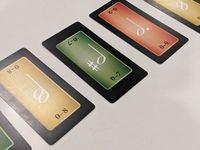
On that night, my small box game of choice was Xylotar, the trick-taking game designed by Chris Wray that reimplements his original game Magic Trick. Xylotar hadn’t hit the table all year, so the dust was blowing around a bit in its section of the closet.
We wrapped up our game of Orléans, a five-player game that ran long. A couple guys from my table were cool doing something for about 20 minutes before heading home…and that’s when I met eyes with my copy of Xylotar.
Hello, old friend.
/pic9857714.jpg)
There’s a moment during the Xylotar teach—a moment that occurs AFTER players ask why the cover features a polar bear named Bobby McColdsnap deviously staring at a rainbow-colored xylophone synthesizer guitar, creating what is easily the richest backstory for any trick-taking game ever made—where I get to see the sparkle in the eyes of other players. It’s the same glint that I, myself, get every time I play the first of Xylotar’s three rounds.
“…so, after you organize the card values in your hand from high to low, tuck the ‘High Note’ card on the left-most side of your cards…then pass your entire hand to the person on your left,” I said. “Then take your newly-passed hand and fan out the cards face down in a line in front of you. That’s correct: you don’t know the exact value of the cards in your hand.”
Oh, we have something here, the player’s faces seem to say.
That’s before they get to see the magic of the bidding system, quickly understanding how to carve out what kind of hand they have, and finding ways to hit their bid exactly to score five bonus points in a round.
Like all 3,700 trick-taking games released each year (a rough estimate), Xylotar is a trick-taking game with a twist. But it’s a blast. It’s a trick-taking game that plays 3-5 players, and I most prefer it at the max player count. It’s got cards with musical notes as suits, suits that range in total cards, and despite the fact that my big hands struggle to shuffle those cards, fanning them out to then learn that I have a terrible scoring hand for the round gets me all fired up to hit a bid of zero.
Xylotar is a game that I seem to fall in love with all over again every time I get it to the table. Part of that is because I love it, a fresh reminder of why I continue to occasionally push it to the table. And, part of it is because I love the reaction of other players when they try it.
“That first round…hmm. I liked that one a lot,” said one player following my most recent play.
“The bidding system is really cool,” said another.
Part of the attraction with Xylotar is that it is not a game everyone knows. “Hello, old friend” is likely not a line one uses when they whip out Terraforming Mars or Hot Streak or Jenga or a game that hobbyists likely know. Xylotar currently holds down spot 4,450 on BGG’s list of the top-ranked games in the database. If you are lucky, you had the chance to see someone from Bézier’s marketing team dancing around their booth at a convention in a polar bear suit.
This gives Xylotar a bit of cachet; it’s a discovery for many players. My favorite moment when breaking out games like this comes when someone pulls up a game’s shopping listing on their phone and buys a copy while they are still at the table.
“Thanks for showing me Xylotar; I think my ____ [insert name of partner, gaming group, or roommate here] will like that, so I just grabbed a copy!”
/pic9857715.jpg)
Rediscovering the games that you already own is such a thrill.
Each time I play Hansa Teutonica, I find myself admiring its genius, even though I don’t choose to play it very often. I only seem to think about playing Concordia when I have to table something for six players, then we play it and find everyone musing about how we “need to play Concordia more often”, then we don’t. This really hits home every time I play an average (or worse!) game that was released earlier this year, and that inspires me to play similar games I liked more that were released five, eight, 20 years ago.
When I look for that older game, I utter the same line almost every single time when I peek into my game closet: “Hello, old friend.” The game was always great, but I neglected it for so long that I simply forgot how good I felt each time I got it to the table.
Just a few days ago, this happened again, when a friend suggested Shackleton Base: A Journey to the Moon for game night. I jumped at the chance. Even though I’ve played Shackleton Base and its expansion four times this year and it sits prominently on a shelf right in my eyeline at home, playing “Shack Town” with only the base game made me utter, out loud, “hello, old friend” to everyone in the room when I arrived at my friend’s house to find the game set up on the table.
Teaching the corporation rules got me all excited, as we discussed the corporation actions of Moon Mining, Sky Watch and To Mars. Drafting shuttles for resources, workers, and turn order felt like putting on that old, comfy, ratty sweater you wear when you are doing work around the house. I sipped bourbon and laughed like Santa as we worked our way through round-end maintenance and claiming workers from the crater. As I evacuated a laboratory from the crater using the To Mars corporation action, I thought back to previous plays featuring my favorite corporation combinations.
Even during my second or third turn of the first round, I knew it wasn’t about scoring the most points…I was already a winner because I was nestled in the warmth of a board game that brings me joy. That’s why we play, right?
Tell us how can we improve this post?