
by Karl Lange
Welcome to The Jailbreak – a cooperative deduction game for 2-4 players where your perspective and clever communication are key to your escape!
When we were thinking back through the design and development of this game we realised the game had three very distinct almost independent phases of work completed throughout its life. Given this process, we thought it would be fun to frame this diary as questions from each of us to the others to give you all a sense of how the game progressed and evolved through each person’s unique input on The Jailbreak!
An Idea is Born: Co-Designer Joel Kennedy
[heading]Can you give us an overview of the game?[/heading]
In The Jailbreak 2-4 players must work together, using double-sided tool tiles to make their great escape!
The game is a mixture of puzzle solving, deduction and different perspectives. Use the right tool, in the right place and the right orientation to defeat each challenge. Can you complete all 44 levels?
[heading]When did you start working on the game?[/heading]
I put together the first prototype all the way back in April, 2021. This game started its life as a solo design. Over the following eight months I tested and refined the game, before submitting it to the Cardboard Edison in January 2022 (under the name Double Jeopardy) – where it was selected as a finalist.
It was the first time I had entered that competition and it was pleasing to have such a promising result. It gave me a lot of confidence to not only continue to pursue this design, but also designing games in general.
The game was signed with Adam’s Apple Games, LLC in 2025 and will be released at SPIEL Essen this year (2026).
[heading]Where did the original idea for The Jailbreak come from? [/heading]
I love seeking out designs that take something fundamental about games and flip them on their head. To do this, I often write out lists of all of the basic assumptions that I have about games – and then wonder how I could challenge those assumptions.
On this occasion (sometime in April 2021) one of the things I wrote down was the fact that cards have a front side and a back side.
It made me wonder what would happen if cards had two front sides.
At the time, it was just an abstract idea. I pondered on it a little and wrote it down, but I didn’t have much else to go on.
It was about a week later, whilst pairing a very large pile of socks, that I was suddenly struck with the urge to make a game about socks. Something felt interesting to me about the idea of a game where the cards were simply depictions of socks – and players needed to work together to find each sock’s pair card.
Inspired by the theme I began putting together a deck of cards for a game called Odd Socks.
And as I did, the thought bubble of double-sided cards re-appeared to me. Given the light-hearted theme and the unknown element of how to play with double sided cards, I decided to merge the two ideas into one.
Here’s what the first version looked like:
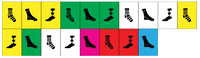
Initially the socks came in three different types (striped, solid and checkered) and six different colours. That meant 18 unique sock designs. 18 cards meant 36 faces, which meant exactly one pair of each type.
Why 18 cards? Initially I thought that if the game worked I could enter into one of Button Shys’ 18 card contests. And more generally, I am a fan of games with a small footprint (no pun intended). And it would be remiss of me to not mention the influence the game Love Letter has had on me.
[heading]How did the design progress through the testing process?[/heading]
From the very first test I knew that I had something worth pursuing.
The game was jam-packed with moments of dramatic irony. You would see the cards you needed on the back of someone else’s hand… but would you be able to effectively let them know about it? Would they accidentally play that card using the card’s other face first? This game felt puzzly and there was already some great tension at the table.
But something wasn’t quite right.
For the first test, I had constructed the deck such that there was no obvious connection between the two sides of each card. I had felt that I didn’t want players to be able to infer what was on the reverse side of their cards, but rather force them to rely on the clues from the other players to figure it all out.
In that first test, my long time friend and collaborator Matt Gleeson suggested that the game would work better if the two sides of the cards were connected – such that you could deduce something about the reverse side by looking at its front.
He was absolutely right and so I set about working out how to construct the deck such that the two sides were connected in some way. The solution was in having each card face tell you information about what was not on its reverse side. For example, if you were looking at a stripy yellow sock then the back of the card would not be yellow and not be stripy.
The next challenge was in figuring out how the players would be allowed to interact with one another.
I have played Hanabi quite a bit and it was clear to me this game shared some key DNA with it. As a result, I was keen to explore some different ways for the players to give clues.
The first, most logical option was to let players ‘flip’ a card – so they would now see its reverse face – and everyone else would see what they had been looking at. This mechanism was introduced very early on and became a cornerstone of the design. The card flip was always such a fun “aha!” moment at the table. To me it always felt like a little magic trick – that yellow stripy sock in your hand is now a solid blue sock. Ta-da!
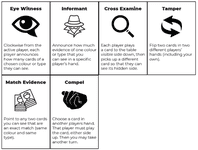
Above: An example of some of the early Action tiles players could use. At this stage the game had changed to a theme about Detectives investigating a crime. The actions in the final game are simpler than these. The Compel action exists in the final game almost exactly as it is here. The other actions shown here did not survive until the final version.
Early on – a week or two after the first few tests – I was doing a solo test of the game on Tabletop Simulator. Between each turn I would click to change my seat at the table, so I would then see things from the next player’s perspective. The thing that struck me was just how different every player’s perspective at the table actually was. Each player was looking at the same game – but seeing something different.
I wanted to lean really hard into that element of the game and that’s when I had the idea for clues that took into consideration all of the cards a player could see – both on the fronts of their own cards and the backs of other players cards. A player would announce, for example, “I can see four blue cards” and the other players needed to cross-check that information against what they could see.
This achieved exactly what I wanted, as it clearly highlighted to the players just how different each other’s perspectives were. It was the ‘whack of the side of the head’ I wanted players to experience.
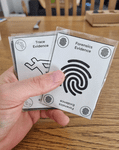
(As an aside, the book ‘A Whack on the Side of the Head’ is one of my favourite books on creative thinking – I highly recommend it).
The game was coming together nicely, until I hit a road bump of a different kind – a technical challenge, unrelated to the game itself. Earlier I mentioned I was testing the game in Tabletop Simulator (TTS). April 2021 was smack bang in the middle of the covid pandemic and, living in Melbourne, we were living in hard lockdown for most of that year.
Testing online was the only option available to many of us during this time.
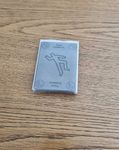
The challenge was that in TTS the custom card component has two defined sides – a ‘front’ and a ‘back.’ When I uploaded the cards I had to define which was the front and which was the back (that part was fine). However, when a card is in a player’s hand (a special ‘zone’ in TTS) it is hardcoded that the player in that seat sees the card ‘front’ and each other player sees the card ‘back.’
This meant when you flipped a card in a player’s hand – it would change the face that player could see – but not the face that others at the table could see. Other players would still simply see the image of the cards back – which made the game unplayable.
It took me several weeks to find a workaround, before I discovered card states. In the mod I set up each card to have two states: The first was a copy of the card showing A/B as the front/back and the second was the same card showing B/A as the front/back.
Now when a player flipped a card they would instead click on it and select to change the card’s state. It was a little bit clunky, but it did work, and the game was playable again.
By March 2022, I began doing a lot of testing in real life with my wife Sarah – who was a tremendous help with getting the game to where it is today.
By this time I had decided the game should have a modular set of challenge cards.
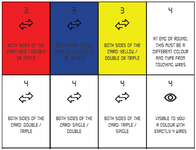
Above: An early draft of the ‘challenge’ cards that players would be working to complete. At this particular time I was also dabbling with a theme of defusing a bomb (I do like to try on different themes to a game!) Many of the initial concepts have survived until the final game – although they were simplified and streamlined.
In June 2022, my friend Karl Lange, who had been helping playtest the game, approached me about being more involved with it – and I enthusiastically agreed. In particular, Karl had some great ideas about creating a campaign for the game and I knew he would do a great job.
Karl took ownership of designing the game’s 44 level campaign. He also added a compelling narrative structure to the game alongside some important tweaks to the way the player actions worked.
Since this game, Karl and I have worked on several other games together (one of which is coming out next year – watch this space!)
[heading]Were there any designs that inspired the design?[/heading]
Certainly Hanabi was an inspiration as mentioned.
Another inspiration was Hanamikoji. The action tiles in that game directly inspired the shared action tiles used in The Jailbreak.
The Crew was also an inspiration, especially in the sense that it had inspired me to want to work on more co-operative games and also a campaign-driven game.
[heading]How much of the original prototype survived to the final product? [/heading]
The game’s primary components and gameplay are mostly unchanged, although in the finished product they have been upgraded to tiles drawn from a bag (an update I’m very excited by).
The publisher – Adams Apple Games – has also added some extra tokens to make the final levels even more challenging which is a really great touch. Adam has been a fantastic asset for the game. He has been a pleasure to work with and seeing him put his own flair and design prowess into this game has been an inspiration for me.
The Teenage Years: Co-Designer Karl Lange
[heading]What drew you to want to be part of the game?[/heading]
I have known Joel for many years initially from Melbourne Incubator playtest meetups, then multiple times per week online through covid lockdowns, and always admire his ability to just throw new idea after new idea into a game. I often have a very product focused view when I work on games and when I first saw what became The Jailbreak I was immediately excited by the core of the double sided cards with a different state on each side.
When I first saw the game, it was two players only and had a mission system more akin to The Crew where you would draw cards to get different, random puzzles to solve. I know Joel and his wife Sarah play a lot of co-op deduction games, so are very very good at them. My first feedback on the design was if the difficulty could be toned way down to introduce players to the system and then ramp up the difficulty as players progress, and if he thought the design could accommodate four players.
After some back and fourth with feedback and changes implemented by Joel, I asked if I could come on as a bigger part of the game.
I could see this becoming a great game, taking Joel’s current ideas and really diving deep and exploring what this core system would allow. I pitched a concept where we have missions of increasing difficulty, used to gently onboard players into the unique deduction of the game then give them some serious challenges once they understand the system.
From there I basically took over the game, working on it for about a year, with meetings every few months with Joel to show him my progress and direction.
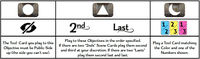
Above: the starting three decks of Escape Cards in my original prototype – Circles, Squares, and Crescent – Alarms, Padlocks, and Cameras in the final version. These introduce three core levers of the game – playing cards from the side you can’t see, playing cards in a certain order, and playing a specific card.
[heading]Tell us about how you approached designing the campaign mode for the game?[/heading]
A lot of the work was around creating a smooth introduction and onboarding of new players into the game.
First step was expanding the set of what became the Escape Cards. I started by dividing the cards into six decks, each deck having variations of the same or similar objectives, each introducing a slightly more complex rule – this gave me six levers to introduce but kept each game unique from the last.
In my master spreadsheet™ I then assigned each deck a complexity value. I could then make new missions and have the spreadsheet calculate how difficult they were in relation to the other missions already created. From here I set to creating the 44 missions in the game, slowly introducing cards from new decks, new abilities for players, additional cards to increase the challenge overall, making sure each level was slightly harder than the last. This took many iterations to get correct, and many discussions with playtesters asking “did that level feel harder than the previous? or the other way around“.
There were many changes to the complexity values, the makeup of the decks, and the costs on the actions (Whispers Cards in the final game) to make sure everything felt right.
Another element I wanted to introduce was grouping missions into a play session – one thing I felt was lacking in The Crew was a defined end point – should you play only one mission? Or all the missions? Finding the ‘right time’ to pause always felt like a negotiation with the other players. This led to being able to have each session (what became Days in the final game) being able to share mechanical similarities, while increasing the challenge for the players, and having larger elements introduced at the start of each day.
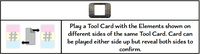
Above: Prototype of the Square Escape Cards – Hand in the final version. This introduces the challenge of knowing what is on both sides of a card.
[heading]What is one of the key challenges you faced working on this game?[/heading]
There were a few challenges, mostly around ensuring players had a firm grasp of the game before they even began playing.
Making sure players understood the makeup of the deck of Tool Tiles and how the double sided nature of them worked (that there are three colours, and three symbols in the game, and the colour and symbol on the back of a Tool must be different from what you can see).
A big part of getting the game humming smoothly overall was getting the terminology and icons on the cards clear. This was much harder than anticipated and there were many iterations of front / back, seen / unseen, open / closed, etc. We finally settled on Public / Private with public being the side everyone else can currently see, and private being the side only you can currently see. The icons remained mostly unchanged to the final version of the game.
[heading]What’s the moment in a play of this game you most want people to experience?[/heading]
My favorite moment when watching people play any game is when the strategy clicks in their head and you see their eyes light up – making players feel smart as they work out how to solve each new challenge. My hope with how the Escape and Whisper cards are introduced throughout the game, is that players will continually be rewarded with that feeling each session for their first run through of the game.
[heading]What is your favourite part about working with another designer?[/heading]
I probably experienced this less in The Jailbreak than some other co-designs due to the more segmented design process, but being able to go back and fourth with someone who has as much buy in to the game as you do is fantastic! Seeing their passion, and having it intertwined with your ideas and vice versa is just a really neat way to design, and I think you get a much better product, much faster than working on a game alone.
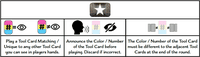
Above: Prototype of the Star Escape Cards – Wall in the final version. This is my favorite deck, introducing some chaos to the missions. All these cards allow any card to be played to them, but you can easily corner yourself if you don’t consider the more restrictive objectives first! This deck went through the most changes to make sure all the cards were roughly the same difficulty, and were all well understood by players.
[heading]Are you working on any other designs together? What can you tell us about them?[/heading]
In addition to working on The Jailbreak, Joel and I have quite a few other games in the works, with one other game signed together. Interestingly most of our other co-designs are also cooperative games. We have co-operative games with pick and pass drafting; sliding tiles from your perspective; and deduction using coloured glasses!
Older and Wiser: Adam’s Apple Games, LLC – Adam Rehberg
[heading]What drew you to the game when you first saw it?[/heading]
I was instantly drawn to the concept because I thought it might contain some of the magic that I felt when I first learned Hanabi. In fact, the concept had me so interested that I immediately asked for a print and play because I knew the designers were from Australia and was assembling the prototype by hand within hours of receiving the pitch email.
[heading]What did you change from when you signed the design to the final product?[/heading]
The gameplay was super rock solid when we first tried it, so the development turned out to be pretty minor, but here is a list of the things we focused on:
– One of the main hiccups that needed solving was the method of distributing tools to each player. The pitch came with a deck box that helped obfuscate hidden information when drawing tools each round, and a method of randomizing that required a combination of shuffling and flipping cards underneath the table to preset the deck box. This is the type of player experience that would cause me to keep this game shelved more often than not, so this was the most important thing to solve. We tried some off-the-wall 3D-printed solutions and then eventually landed on a very simple and familiar solution, a bag with tiles.
– After plugging the logbook into the final graphic design template, we noticed there were some pages that had some blank space. This was a result of the game getting harder requiring more escape cards, but not introducing anything new. We used this blank space as an opportunity to sprinkle some additional thematic challenges and threats in the form of tokens to keep each mission fresh.
– Lastly, we spent some time on the insert to right-size the box and ensure good setup and storage experiences to make the game as easy to get into as possible.
[heading]Can you give us some thoughts around the theme and art direction of the game?[/heading]

Left to right: Artist Zak, co-designer Karl, and publisher Adam at Jailbreak public announcement – Gen Con 2026
One of our biggest decisions was whether to retheme this game or not. Internally, we bounced around on a few different theme ideas and eventually decided to invert the theme from a cooperative series heists (breaking in) to a cooperative escape (breaking out). With The Jailbreak, we knew we wanted a striking art style and chose to lean into one of the core game mechanisms to influence this style. The game system utilizes three icons across three colors to achieve imperfect information, so we naturally we chose three strongly thematic colors to bring the theme to life. Other than that, we really just let Zak Eidsvoog cook as the artist and graphic design lead, because we know he’s very talented at both.
[heading]Who will this game appeal to the most? [/heading]
This game will appeal to people who like unpuzzling imperfect information with some moments of logic and some of luck. We think players familiar with Hanabi, The Crew, and The Gang could easily fall in love with The Jailbreak. Additionally, The Jailbreak plays extremely well at all player counts, including two-players which we’re excited about as a must-have differentiator from the previously mentioned titles.
[heading]When and where will people be able to get the game?[/heading]
The English Edition of The Jailbreak launched at SPIEL Essen ’26 with release to the US via FLGS from October 31st, and Australia and New Zealand through Ark Angel Games late 2026. Keep your eyes peeled for more news and dates which we cannot yet say!
Tell us how can we improve this post?