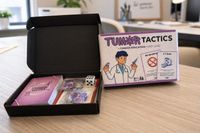
Designer Diary: Tumor Tactics, or Turning Cancer Biology into Playable Decisions

by Daniel Zhang
/pic9764515.jpg)
By Daniel Zhang, CEO and Lead Designer of Tumor Tactics
When I was nine, my grandmother was diagnosed with stage 3 pancreatic cancer. For months, I watched her move in and out of hospitals while treatments that were supposed to help her also seemed to make her weaker. I knew words like chemotherapy, but knowing the word and understanding what it meant were two very different things. Why would medicine make someone lose their hair? Why could a treatment hurt healthy parts of the body while still helping a patient? Why would doctors choose one treatment instead of another?
Years later, when my family encountered cancer again, those questions came back. By then I knew considerably more biology, but I started thinking about how strange it was that a subject could affect a kid’s family so directly and still feel completely inaccessible to them. My co-designer Zachary Tou had grown up playing strategy card games like Pokémon and Yu-Gi-Oh!, and we eventually started asking a pretty unusual design question: Could we turn real cancer treatment into a strategy game without making the science inaccurate, the subject insensitive, or the game miserable to play?
The project was originally called “CellQuest”, and we started with a small group of friends, shared Google Docs full of half-finished ideas, rough cards, and a lot more confidence than game-design experience. The goal sounded simple: take cancer biology and make it something kids could learn by playing rather than memorizing from a textbook. Actually doing that turned out to require us to rebuild the game again and again.
Our First Mistake Was Trying to Put All of Biology Into the Game
Biology is not naturally game-shaped. It does not come with turns, victory conditions, damage values, or neatly balanced cards, so our first instinct was to translate biological concepts almost one-to-one into familiar card-game mechanics. Mutations became threats. Treatments became defenses. Healthy cells became lives. Scans let you look ahead in the deck. If there was an interesting biological concept, we wanted a card for it.
Some of our earliest mutation ideas were genuinely wild. A frameshift mutation could disable another card. Gene amplification could double an effect. A deletion could make a threat harder to stop. Another early idea gave players healthy-cell cards such as hair, skin, and lung cells, then made treatments carry side effects. Chemotherapy might stop the cancer, for example, but cost the player a hair-cell card. The biological reasoning was there: cancer damages the body, but some treatments can damage healthy tissue too.
The problem was that every piece of science seemed to demand another rule. Mutation needed one system. Treatment needed another. Side effects needed another. Cancer progression needed another. Then we wanted screening, metastasis, resistance, immune evasion, and research. We were slowly building a biology simulator instead of a card game. The more scientifically ambitious we became, the harder it was for anyone to actually play. Eventually we realized that a mechanic does not become educational just because it represents something scientific. If a player spends the entire game trying to remember rules, the biology disappears anyway. We started asking a harsher question about every idea: Does this scientific concept create an interesting decision? If the answer was no, being accurate was not enough to save it.
/pic9764516.png)
Then We Realized We Did Not Even Know What Kind of Game We Were Making
For a surprisingly long time, we could not decide whether Tumor Tactics should be cooperative or competitive. One major prototype was completely cooperative. Players represented different parts of the body or different medical roles and worked together to survive increasingly difficult stages of cancer. At one point we experimented with organ roles such as the lungs, heart, and immune system, each with different abilities. Another version had players progressing together through Stage I, Stage II, and Stage III cancer decks.
Thematically, cooperation worked. Cancer care involves teams, and nobody had to do anything uncomfortable like deliberately giving another player’s patient cancer. Mechanically, though, some versions became too defensive. Players were mostly waiting for the game to produce a problem and then responding to it. We worried that once a group understood the optimal response, there was not enough reason to play differently the next time.
So we explored competition, which immediately created the opposite problem. Competition was fun, but what did “attacking” another player mean in a game about cancer? Making their tumor worse? Giving their patient a mutation? Even if the mechanic worked, the theme felt wrong. During an early game-design consultation, we were pushed toward a compromise: rather than having players harm one another, have multiple doctors or teams race to cure their own patients. Competition could come from solving the medical problem faster, not from making somebody else’s illness worse.
That basic idea eventually became the foundation of the current game. Every player is a doctor managing their own patient and trying to cure the same three tumor types: lung, colorectal, and skin. You are competing, but your primary opponent is your own patient’s disease. Other players can affect the table through Utility cards and shared Events, but you are not winning by giving someone cancer. You are winning by making better decisions about the cancer already in front of you.
/pic9764517.jpg)
The Mechanic We Liked Enough to Keep Fixing, Until We Finally Killed It
One of our longest-running early systems was something we called cancer siphoning. An untreated tumor would remain in front of a player and continuously drain cards or health. The larger the tumor became, the more resources it siphoned away. We liked the idea because it created pressure: ignoring cancer should be costly, and a growing tumor should become harder to manage.
Playtesting quickly exposed the problem. Our internal notes literally say, “cancer siphoning was confusing,” followed by another issue: “players die too quickly.” Keeping track of which tumors were siphoning, how much each one removed, when the loss happened, and how that interacted with everything else was annoying for us and much worse for younger players. If somebody drew a difficult cancer early, the game could also collapse before they had a meaningful chance to respond.
We tried to repair the system before admitting the system itself was the problem. We changed starting hand sizes, reduced cancer counts, adjusted how much health tumors drained, and tested different stage structures. Eventually we stopped asking how to improve siphoning and instead asked what it was supposed to accomplish. The answer was simple: we wanted players to feel that waiting makes cancer harder to treat.
There was a much cleaner way to do that. In the current game, tumors have visible HP and stages. If you draw another Cancer card corresponding to a tumor that is still active, that tumor advances a stage and gains HP. Later stages also make treatments increasingly uncertain: Stage 1 treatments succeed automatically, while Stages 2 through 4 require progressively harder die rolls. A failed treatment deals no damage, the card is still discarded, and the tumor regains HP.
That teaches the same underlying idea without requiring players to maintain a miniature accounting department. A player who leaves a tumor alone long enough will eventually discover that the treatment they were saving is now much less reliable. We do not need to stop the game and explain that earlier-stage cancers are generally easier to treat. The player feels the difference through the rules.
The Best Science Became the Decisions, Not the Card Text
Once we started simplifying, we realized that the game’s strongest educational moments came from very ordinary-looking rules. One of the most important is that players can normally play only one Tactic card per turn. Earlier versions occasionally let players unload multiple treatments at once, which made turns feel powerful but destroyed most of the prioritization. If you can solve every visible problem immediately, there is no real reason to choose.
Limiting treatment actions changes that. If I have several active tumors, I have to decide which problem matters most right now. Do I finish the almost-cured tumor? Do I focus on the tumor that has already advanced? Do I use a flexible treatment now, or save a more specialized card for later? After making that choice, I still have to draw a card, which might advance a tumor I neglected or even bring back one I previously cured.
Treatment design went through a similar simplification. Early prototypes gave many cards elaborate unique abilities because we wanted every treatment to feel scientifically distinct. That created variety, but it also created a lot of text and memorization. We eventually moved toward a cleaner idea: different actions should create different tradeoffs, but players should be able to understand those tradeoffs without rereading the rulebook every turn.
That is why treatment specificity matters. Some cards are most useful against particular cancer types, while broader treatments provide flexibility. Stage also affects how dependable a treatment is. The most powerful-looking card in your hand is therefore not automatically the best card to play. Its value depends on the tumor, its stage, your other options, and what you think you can afford to leave untreated.
Uncertainty became another important part of that system. One of our early playtest conversations began when somebody challenged why an immunotherapy card took effect immediately, as though a real treatment outcome were guaranteed the second it was selected. We experimented with delayed effects, but keeping track of different timers created exactly the kind of complexity we were trying to remove. Eventually, dice gave us a simpler abstraction. They obviously do not simulate oncology, but they communicate something important: making a medically reasonable decision does not guarantee a successful outcome.
During one of our later student workshops, a fifth grader watched a treatment roll and asked, “So the die roll is like whether the chemo actually works?” That question was more valuable to me than having another paragraph about chemotherapy printed on the card. He had inferred the idea from playing.
Most of Our Good Mechanics Started as Problems
Several systems in Tumor Tactics grew from trying to stop players from finding one obvious strategy. Treatment resistance was one of our early experiments. We tested ideas where repeatedly relying on the same treatment type could eventually make that strategy less effective, reflecting the real challenge of tumors developing resistance. Mutation modifiers similarly introduced uncertainty by changing how cancer behaved from game to game.
Not every one of those mechanics survived in its original form. Resistance, in particular, went through multiple versions rather than becoming a permanent standalone system. But the design problem survived: the game should not reward playing the same strongest card over and over. In the current version, staging, treatment specificity, relapse, Utilities, and Events help create that pressure without requiring another complicated subsystem.
Events became especially useful because they gave us somewhere to put chaos without making every card complicated. At one point, nearly every card had a special exception. Eventually we concentrated unusual table-wide effects into a dedicated Event category. The normal turn stays readable: play a Tactic, play a Utility, draw a card. Then an Event can temporarily change the situation for everyone. A cancer that was cured may return later. A shared Event can alter what players are allowed to do. Utilities let players plan ahead, manipulate information, or interfere tactically.
That separation helped us make the game both simpler and more replayable. Cancer and Tactic cards carry the central medical decisions. Utilities reward strategy. Events make sure a plan cannot be followed mechanically every game. We did not need every biological concept to receive its own permanent rule.
/pic9764518.jpg)
Kids Are Ruthless Playtesters
The biggest improvement came when we stopped designing almost entirely around ourselves and started putting the game in front of elementary and middle school students. Kids are extremely efficient game-design critics because they have no reason to pretend something is interesting. If the terminology is confusing, they stop reading. If turns take too long, they start talking to somebody else. If one card is clearly stronger than the rest, they find it and exploit it. If a rule takes three minutes to explain, you probably do not have a rule yet.
/pic9764519.jpg)
Those sessions forced us to keep reducing unnecessary complexity, but they also produced moments that convinced us not to oversimplify the science itself. At one elementary workshop, a fourth grader spent several minutes looking through his options before choosing targeted therapy for a specific tumor. When I asked why, he explained that chemotherapy could affect healthy cells while targeted therapy was aimed more specifically at the cancer. Then he looked at me and asked, “So why don’t doctors just use this all the time?”
That question opened a discussion about why not every cancer has the same targetable features, why therapies do not work equally well for every patient, and why broader treatments are sometimes still necessary. What mattered was that nobody had prompted him with a worksheet question asking for the “advantages and disadvantages of targeted therapy.” The game had created a decision. The decision exposed a tradeoff. The tradeoff made him ask why.
That became the clearest explanation I have found for what we are trying to do. Educational games can easily become quizzes wearing costumes: answer the biology question correctly and you earn a point. We wanted the opposite. The player should need the biology because it helps explain the game state they are already trying to solve.
Playtesting also showed us where that philosophy could go too far. Some of our scientific vocabulary was simply too difficult for younger players. Terms such as carcinogen, metastasis, and immunotherapy could become barriers before a student even reached the underlying idea. Instead of removing those terms entirely, we began simplifying descriptions and developing supporting explanations so students could learn the real vocabulary without needing prior biology knowledge.
What Survived
The current Tumor Tactics is a 72-card strategy game for 2–4 players ages eight and up. Each player begins as a doctor treating lung, colorectal, and skin tumors. Turns are deliberately short: play up to one Tactic, play up to one Utility, then draw. Cancer cards can advance active tumors or cause cured cancers to relapse. Higher-stage tumors become increasingly difficult to treat, and Events can temporarily affect the whole table. The first doctor who gets all three tumors into their Cured pile at the same time wins.
That description is much simpler than almost every version that came before it, which is probably the best evidence that the design improved. Over the course of development, we experimented with healthy-cell lives, mutation/defuse systems, cooperative organs, multiple stage decks, cancer siphoning, research mechanics, resistance systems, different health models, different victory conditions, different player roles, and multiple ways of representing treatment uncertainty. Some of those ideas were genuinely interesting. They just did not all belong in the same game.
The finished artwork and game materials were also created manually by our team without generative AI. Even the visual design followed the same process as the mechanics: remove anything that stopped a player from immediately seeing what matters. A card for a ten-year-old cannot look like a miniature oncology textbook.
This summer, an ASCB COMPASS Outreach Grant supported a five-workshop Tumor Tactics series reaching 150 San Diego students, and 95% of participating students improved their score on a short cancer-biology assessment from before to after the workshop. We have also brought the game to more than 1,000 students at the San Diego County Fair and distributed decks through Scripps and Rady Children’s Hospital.
/pic9764520.png)
Those numbers are useful evidence that the project has moved beyond our kitchen table, but the moments I remember are still the individual questions: the student frustrated that a tumor advanced before he could treat it, the fifth grader realizing what the die represented, and the fourth grader demanding to know why doctors could not simply use targeted therapy on everybody.
When we began CellQuest, I thought our job was to fit as much accurate science as possible into a deck of cards. Now I think that was the wrong goal. Information printed on a card is still just information. The more interesting challenge is designing a system where that information explains something the player already cares about.
A player understands why advanced cancer is difficult because the tumor they neglected has become harder to treat. They understand specificity because a useful card does not work equally well against every tumor. They understand uncertainty because the treatment they planned around can fail. They understand prioritization because they cannot fix every problem in one turn. They start asking about tradeoffs because the game has made those tradeoffs matter to them.
Tumor Tactics is far more polished now than the first collection of chaotic documents and paper prototypes, but we still treat it as something that can improve. We continue to collect feedback from students, teachers, healthcare professionals, and cancer-support organizations. There are still cards whose wording can become clearer, terminology that needs better explanation, and situations where the balance can change.
The best revisions have usually begun the same way: somebody looks at a mechanic we are proud of and asks, “Why does it work like that?” Sometimes we have a strong biological answer. Sometimes we have a strong gameplay answer. The dangerous moments are when we realize we have neither. Those are usually the rules worth changing.
Tumor Tactics began with questions I had as a kid trying to understand what was happening to someone I loved. Designing it has left me with a different question: If a player can understand a difficult idea by making the decision themselves, how much do we actually need to simplify the idea?
We are still figuring that out one playtest at a time.
You can learn more about Tumor Tactics and download the rulebook at playtumortactics.com, or follow us on Instagram at @playtumortactics
Tell us how can we improve this post?