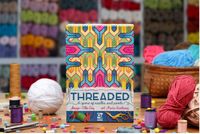

by Ellie Dix
/pic9499385.jpg)
The Theme
My granny made a medallion patter green and pink bargello cushion in the 1980s. She had it in her granny flat, where I often escaped to during my childhood. A few years ago, I realised I was spending too much time on my computer. Double-screening in the evenings. Working too much. So, I decided to take myself in hand and find a hobby that would pull me away from the screen. I came across a bargello-style craft kit to make a cushion, and the moment I saw it, I felt immediately drawn. It was like my granny guiding me towards it.
What started as one cushion has become something of an obsession. It was only a matter of time before this world crept into my game design.
/pic9499361.jpg)
Me, with a bargello cushion I made…
Mechanical Inspiration
But Threadeddidn’t start to take shape until I came across one particular component. I played Shogun and fell completely in love with the cube tower. It’s a remarkable piece of kit – tactile, unpredictable, genuinely exciting – and yet it feels like a component that doesn’t appear in nearly enough games. I knew I wanted to scratch that itch. The question was: what would the cube tower be doing?
The answer came quite naturally once I had the theme in mind. The tower would be a thread factory. Whatever comes out of the tower on any given turn represents the over-production – the threads that spill off the factory floor and become available. You can’t predict exactly what you’ll get. You just load it up and see what emerges.
The second idea arrived alongside it: an ordered worker placement system. Each worker carries a number, and those numbers change from round to round. When a location is resolved, the worker with the lowest number goes first. The interesting tension comes from decision-making at placement. You might choose to assign a higher number to the Workshop, if you’re willing to gamble on going later in order to take a tapestry card further down the display row. High risk, potentially high reward.
/pic9499368.jpg)
The workers, who’s numbered days were numbered.
When Good Ideas Don’t Survive
In honesty, the original version of the ordered worker placement system was a bit of a mess.
The drafting process had three nested rules about which numbers you were allowed to take and in what order. It was involved, fiddly, and crucially it didn’t generate enough interesting decisions to justify all that overhead. The system as a whole was too clunky for the weight of game I was making and for the experience I was trying to craft. Playtesters were confused and simultaneously overwhelmed and underwhelmed. Overwhelmed by the amount of business and rules related to the numbered workers and underwhelmed by the decision space it afforded.
So, I cut it. In its place came a much simpler worker placement system: you queue at each location, and earlier arrivals have the benefit when the location resolves. The interesting decisions about timing are still there, just hopefully presented without the administrative burden.
/pic9499376.png)
Can you spot what made it and what didn’t?
I’ll confess there’s a version of that numbered system rattling around in my head where the timing of when your worker activates is the central puzzle. It just wasn’t right for this game.
As many designers often find – a core part of the original design for a game often doesn’t survive the development process. The cube tower made it. The ordered workers mechanism didn’t. It’s sometimes hard to abandon core ideas from the original design, but I’m constantly reminded that it’s important to do so.
The Puzzle
What has never changed, from the very first prototype to the published version, is the core puzzle. It has two interlocking layers.
The first is the needle puzzle. How do I arrange the threads on my needle so the right colours become available at exactly the right moment? You add threads only to the ends of your needle. You can only remove from the ends. Everything in the middle is locked in by what’s around it. Getting your threads into the wrong order is punishing, and planning ahead is deeply satisfying when it comes off.
/pic9499377.jpg)
The needle (grey foam object, with cubes), tested here in two-part form!
In the early versions, there was no basket, which give players additional storage and some flexibility to manage threads in the final version. Instead, your needle might hold twenty threads at once, and having one thread in the wrong position could be genuinely crippling. Some playtesters had a pretty bad experience of the game because they couldn’t manage the necessary advance planning with the timing of taking perfect tapestry cards. I experimented with various ways to ease the problem: allowing free discards so you could jettison a rogue thread from the middle of a promising sequence; shortening and splitting the needle into two parts that you could build on either side of; and a personal scraps pile that you could store things in, but that other players could raid. Eventually the needle shrunk and the personal basket found its shape.
/pic9499378.png)
A purse is a sort of like a small personal basket? Though this is more helpful for shops than thread.
The second layer is the scoring puzzle. Commission cards reward you for completing tapestries that meet their criteria. You can approach this either way: find commissions that complement each other and then hunt for tapestries to satisfy them, or take tapestry cards that appeal and work backwards to find commissions that reward your collection. Or of course, you can do a bit of both. The tapestry cards and commission cards themselves haven’t changed since the first prototype.
/pic9499380.png)
Tapestry and commission cards, in prototype and final form.
Shops and Destinations
The ordering of the shops (destinations for workers) shifted several times during development.
In earlier versions, the Bargain Box appeared before the Thread Shop. The logic was transparent: everything left in the thread shop at the end of a round would be added to the cube tower, so players knew exactly what they’d be competing over. It felt fair. But it removed the mystery, and with it, some of the tension and excitement. Now the Bargain Box comes after, you don’t quite know what the tower will produce, and that uncertainty makes every trip to it feel like an event.
One destination was added relatively late in development: a space that lets players pay to jump the queue at any of the other shops. It arrived because playtesting revealed that players sometimes felt their final workers had no good home. Once that space existed, that feeling disappeared. A small addition, but it made the whole system breathe better.
Working with Osprey
I pitched Threaded to Osprey three times. They passed twice.
Both times, they passed with real generosity – clear, specific feedback about what wasn’t working, and an open door to resubmit if I could address it. Some of the mechanical changes in the game exist because of those conversations. It’s normal to feel the sting of a rejection, but if a publisher has taken the time to play your game and tell you precisely what’s not landing, the only sensible response is to take that seriously and ask if they’d be willing to look again.
The third time, they signed the game. And since signing, they’ve been wonderful to work with. The development and production process has felt collaborative and considered. They’ve helped my original design to shine through rather than reshape it into something else.
Full Circle
My latest Bargello project was footstool I made for my mum – a thatched design that echoes the colours of her William Morris curtains. It takes patience and planning and you have to think about what goes where before you commit the needle.
/pic9499382.jpg)
That’s Threaded, really. The threads on your needle, the tapestries on the table, the commissions in your hand – all of it asking you to think three moves ahead, to hold your plan loosely enough to adapt, and to feel the particular satisfaction of a sequence coming together just as you intended.
My granny would have enjoyed it, I think.
/pic9499383.jpg)
Tell us how can we improve this post?