
by Scott Brady
/pic9496662.jpg)
I think this is the first time I will have two major releases of my games occur at the same convention. June marks my annual trek to Columbus for Origins Game Fair. Two years ago my co-design with Danielle Reynolds, Caution Signs, premiered there. Hues and Cues would have in 2020 hadn’t it been for the shutdown. Everything else I’ve made typically debuted in the fall or was silently released into retail whenever they were ready.
I talked about boop. Shuffle previously and am anxious to see how it is accepted by the typical abstract-loving public. It was technically released in May, but this will be the first convention it will be available for sale.
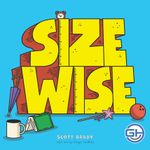
The other title is being flown in from China and will be available at Origins in limited quantities – I’m told only around 100 will be for sale. Size Wise from GameHead has been in development for some time and is proof of how game design can lead from one idea to another organically.
Concept
For quite some time I had been tossing around the idea of a game about measurements. We’ve all seen plenty of trivia games where you guess how tall something is or how much it weighs. I’m not a fan of this type of game because replayability could be an issue. Over time people will memorize the answers.
I’m much more a proponent of groupthink, like Hues and Cues, where the correct answer doesn’t matter. Scoring points is about how well you match up with what other players think. This means that even if you have the same challenge in a different game, the answers might be very different depending upon the other players’ perspective.
First Crack
I began working on a game I tentatively called “Size Matters”. That progressed to “On the Scale of…” and then the final prototype name, “Banana for Scale”. It featured a board with a grid going from one to one hundred. Cards featured questions in different measurement categories with questions like “In millimeters, how long is a centipede?” and “What are the odds of aliens landing on Earth by 2050?”.
/pic9607867.jpg)
Questions could have actual answers, like the average length of a centipede, or be opinion-based like the alien one. In both cases, points are scored if you matched the answer within a range of the active player. It didn’t matter about the size of the insect or whether aliens arrived or not!
It was while doing a little dev work on this game, trying to decide what the interface would be for the consumer that I thought of the situation where a fisherman is trying to describe the size of the fish they caught using their hands as measurement tools. I knew this type of description wouldn’t work for “Banana for Scale” as it was only about size and not predictions or any of the other categories. I still felt like there was something cool about those fish tales and how it could be used in a game.
Prototypes
The game itself turned out to be rather simple, which I was fine with. I’ve learned that simple sells. Mass-market consumers don’t want long rulebooks or teach. They just want to play. Using your hands to describe the size of something is natural and familiar. How would I control the game though if I allowed the players to hold their hands up and tried to compare them?
Plus, why would they even need to buy the game if we didn’t supply a unique experience with custom components!
The first, obvious answer to me was a measuring tape. I envisioned each player having a player-color measuring tape with no markings. I figured players would extend their tapes for the lengths they were estimating and hold them next to each other to compare. I purchased a lot from Amazon to play around with. It was then I discovered something important.
/pic9607866.jpg)
Cheap measuring tapes only click and hold in certain increments. The ones I bought extended in 1.5” segments. Traditional measuring tapes like what you might have in your garage are much more accurate…and expensive.
Second Attempt
I was struggling to figure out a way to implement the ideas of this game inexpensively yet still being unique and appealing. My mind went back to the fish analogy. That’s when I thought of a bobber on a fishing line.
A ball on a string – that would work! The clasps on a bobber would allow it to slide up and down the line and become a pseudo measuring device! Off to Amazon again to shop for bobbers.
What became difficult was that bobbers are designed for thin fishing lines. At best I could use color nylon string, but that is very thin and doesn’t come in easily differentiated colors. Neither do bobbers. They’re mostly neon yellow, neon orange or white. Not nearly enough for player colors.
Third Attempt
Bobbers were out. So were tape measures. My next idea was utilizing those little spring-loading things you see on backpacks or sweatshirts (see photo above). I’m sure they have an official name, but I have no idea what it is (editor’s note – spring cord locks). I managed to find a batch on Amazon to test. They didn’t hang consistently due to their odd shape and lack of weight, so comparing lengths was a bit of a chore. There was also the issue of the weight of string I was using.
Solution
Eventually, I somehow landed on shoestrings as they came in a broad range of colorful hues (see what I did there?!) and were very inexpensive. Because of the Amazon searches I had made for bobbers and balls, it magically recommended I look at beads. I found a set of ¾” diameter color beads that conveniently matched many of the shoestring colors! My hypothesis was that I could put the shoestring through the tiny bead hole and friction alone would hold it in place.
OSHA Violation
My theory was correct. Except the holes weren’t quite large enough. Using the bead holes as a pilot hole, I hand-drilled them to be larger, to the dismay of my wife who had already dialed “91” on the phone so she could complete the call to Emergency Dispatch quicker. Looking back, I admit it probably wasn’t the safest way I could have made them.
/pic9607877.jpg)
This is a case of the risk being worth the reward. They performed perfectly! I tied one end of the shoestring to a keyring and threaded the ball onto the other end. A tied knot would keep the ball from falling off and now I had player-colored measuring devices for each player!
Testing
I went through many scoring options, eventually landing on a player just not wanting to be in the extremes. Shortest and longest receive strikes. Everyone else is safe. Person with the fewest strikes wins!
Luckily, I had several design retreats, Protospiels and conventions on my schedule. “OutSized” (what I was calling it) was tested by dozens and dozens of players over the next few months. I was also able to curate a number of fun clue challenges thanks to playtester contributions. They are all mentioned in the rulebook!
Pitching
I was carrying both OutSized and Banana for Scale in my pitch bag at Pax Unplugged, mostly focused on the latter. I did show OutSized to a couple people once I got a better feel of the market and price point they were trying to hit. Paul Salomon from GameHead was one of those people. He didn’t jump right away but was obviously still thinking about it later as he followed up and told me about the company and what they were doing.
They are a newer publisher, but not new to the industry. GameHead is the publishing arm of GamerMats and they hired Paul (Honey Buzz) to act as inventor relations and developer. To his credit, the dev experience working with him has been one of the best I’ve experienced to date.
/pic9249439.jpg)
They were about to release their first six games (2025) and he was building out a slate of six potential 2026 titles. He saw the same simplicity and elegance in what I had made and committed to the game. It was now his job to turn my shoestrings and beads into something worth buying!
Done!
As you can see from the final product, he incorporated Schoolhouse Rocks styled artwork and one of the best laid out rulebooks I’ve ever been associated with! After testing a few different possible names for the game, we agreed on Size Wise.
/pic9496672.png)
I mentioned earlier that Size Wise will make its retail debut at Origins this month. While preparing for the show, GameHead was able to have the manufacturer make a giant-sized version to show off during demos! If the giant version is as popular as I think it will be, maybe you’ll see it available for purchase via crowdfunding! 😉It’s double the size with six foot strings! How big is a donkey?!
/pic9496664.jpg)
I’ll be at both Origins and Gen Con and would love to teach it to you myself! Come by booth #1908 at Origins to grab one of the first 100 advance copies! Expect a general release at Gen Con booth #1629! See you there!
NOTE TO ANY PUBLISHERS READING THIS! Banana for Scale is still available for licensing! 😉
Tell us how can we improve this post?