
/pic9341405.png)
When DV Games suggested that I write this designer diary for Raindrops, I hesitated… I started working on Raindrops in 2019, and I was afraid I might no longer be able to carefully retrace all the paths that brought it from there to here. But I decided to embrace the challenge, revisit my notes, photos, and memories, to share a little of how this game came to be. Think of this text as a patchwork quilt about the creative process, a passion for games, deep bonds of friendship, inspirations, and all the wonderful relationships we build around a gaming table.
Coming from a creative background (my career spans advertising, video, and animation production), I quickly realized that I wanted to explore board games as a means of expression. It all clicked for me after my daughter, Olívia, was born in 2017, and I began dedicating myself more seriously to the dream of designing games. Between 2019 and 2022, my game designer mode was in full swing, and I worked on multiple projects simultaneously. Inspired by a group of game designers from Rio de Janeiro who organized a playtesting group called Oficina do Playtest, I got in touch with them intending to replicate the experience in my hometown of Belo Horizonte.
/pic9679911.jpg)
Together with other designers, we started meeting weekly to test and develop our projects collectively. A few months later, we decided to launch an online edition of the event as well, making it possible for people from anywhere in the country to participate (especially those who might struggle to put together a local playtest group in a small town). Without us realizing it, this initiative became crucial during the COVID-19 pandemic, bringing together and supporting a large community of Brazilian designers through a particularly challenging time. Raindrops was one of the games I worked on the most during this period, going through dozens of playtests and iterations over the months, both in-person and online.
Cardboard Dreams
The idea for this game had been floating around in my head long before I realized I wanted to turn it into a board game. As a child, I loved connecting water droplets that condensed on a surface after the rain. There was something magical and deeply satisfying about pushing one droplet into another and watching them trickle down, pulling several more droplets along the way. Looking back, that was already a game in itself…
My first actual note, however, is brief and dates back to July 2019: an idea for a game about rain, using overlapping cards and some Mahjong-inspired mechanics. I remember putting together a few cards with a 2×6 grid of symbols and experimenting with hiding/revealing overlapping icons. Soon afterward, I cut the pieces into domino-shaped tiles, which quickly evolved into what would become the core experience of Raindrops.
/pic9680618.png)
Prototype and First Playtest at Oficina do Playtest
My next note already read as follows:
• 2×1 tiles form a grid.
• Players complete paths of matching colors within that grid (never moving upward).
• When a player completes a path, they collect all the tiles in it, and the remaining pieces “fall” to fill the empty spaces, like in Tetris. New tiles are then added.
From the very first prototype, Raindrops‘ core gameplay loop proved to be solid and never strayed far from the original concept, even though dozens of mechanic variations and refinements emerged throughout the ideation and development process. In the game, players observe patterns of raindrops on a windowpane and try to find the optimal descending path of connecting symbols. Then, they collect the connected tiles and use them to complete patterns shown on objective cards.
During those very first playtests with the windowpane, it quickly became clear that the most enjoyable part of the experience was watching and making the droplets slide along the tracks. That was the heart of the game. Identifying those interactions so early in the prototyping phase proved invaluable because, after the lockdown, my main playtesting space became the online groups. And tactile nuances like these are much harder to perceive and validate when working solely with a digital prototype.
/pic9680623.png)
Online Playtesting Days
Call it hyperfocus, escapism, or a survival strategy, but during the pandemic I worked tirelessly on my games. Every week I playtested, gathered feedback, and iterated on my designs. Here’s a snapshot of the very first digital version of the prototype, running on Tabletopia:
/pic9680626.png)
The main challenge at this stage was finding the right balance between collecting tiles on the windowpane board and completing patterns on the individual player boards. The two experiences felt disconnected and not particularly rewarding. The main board featured a mix of 2×1 and 1×1 tiles, which significantly slowed down the refill process between turns. Each player had two 2×4 building areas and competed over public objectives, displayed in the center of the table. Interestingly enough, this objective format (2×4) made its way back into the game near the end of its development cycle!
The next version introduced a major change: two types of objectives: public (3×3) and personal (polyominoes). An optional action was also added: before tracing their path, players could remove one tile from the board, adding an important strategic layer to the puzzle. The feedback confirmed that the game was moving in the right direction, allowing for more control and planning from one round to the next.
/pic9680629.png)
In the following iteration, wildcard symbols made their first appearance, enabling more route connections across the board. The interaction between public and personal objectives was also refined, allowing players to score partial points for public objectives completed by someone else. The game’s duration (determined by the number of tiles in the bag) was proving to be both consistent and satisfying for the players. I could tell the game was beginning to reach a more “stable” version as the feedback gradually shifted focus, moving away from structural concerns and towards usability and balance perceptions. As I continued making the necessary refinements, I also began preparing the first version of the rulebook, sell sheet, and pitch materials. I owe a special thanks here to Renato Simões and [user=lucaspasseti]Lucas Passeti [/user]for listening to my very first pitch, and providing me with valuable advice, giving me the first push toward seeking international publishing partners.
/pic9679903.png)
/pic9679790.jpg)
In the Foothills
With that came a major personal challenge. Up to that point in my life, I had never dared to express myself in any language other than Portuguese. Even though I was able to understand English well enough, I considered myself incapable of holding even a simple conversation with other people.
It was around July 2020 when we traveled to spend some time at the home of dear friends Dani, Chico, and Dudu in Ouro Branco. We had been isolated for months because of the pandemic and felt the need to reconnect, share our anxieties, make plans for the future, and help one another care for our children. We even put together a shared schedule to rotate between work, cooking, house chores, and playing with the kids.
Around that time, I started applying for the growing number of online speed pitching events that were beginning to appear. I also started taking English lessons, and to practice, we spent our evenings playing board games in English (some of our favorites, along with the occasional prototypes). As cheesy as that might have sounded at first, it helped me a lot. I’m deeply grateful to my friends for their kindness, support, and patience. Even though our lives eventually took us to opposite sides of the globe, I still feel that part of us remains in that time and place. Watching our kids laugh and play together in the backyard remains something beautiful and deeply inspiring. Thank you for those wonderful memories, my friends! 💞
/pic9680632.png)
The Pitching Circuit
/pic9679798.png)
Fortunately, the responses to my applications started coming in, and between July and November 2020, Raindrops was selected for several pitching events and publisher meetings. It was incredibly exciting to see the game begin to attract the interest of players and publishers alike! I’d like to sincerely thank the organizers of some of these events, namely Ian Parovel and Alain Fondrille (Board Date), Heather O’Neill (Metatopia Speed Pitching), and Jay Cormier and Sen-Foong Lim (The Pitch Project).
The Pitch Project was particularly meaningful. Not only because Raindrops became one of the 50 finalists out of more than 750 submissions, or because I had the opportunity to present it to more than 40 publishers, but because it created a remarkably democratic opportunity (especially for designers from the Global South, who often face greater barriers to participating in the industry’s major events). Sen and Jay shared an incredible amount of knowledge and advice on preparing sell sheets and pitches, as well as guidance on industry best practices, working with publishers, and publishing agreements. I even bothered Sen in his inbox a few times, and he was always incredibly generous and helpful in every interaction we had. Thank you again!
After these events, I had very promising conversations with at least four publishers. I’m deeply grateful to each of them for the opportunity and for the time they dedicated to evaluating whether the project would be a good fit for their catalogs. In the end, Raindrops found its home at DV Games, and we signed the publishing agreement in December 2020!
Development, Roadblocks, and More Development
The game’s initial production target was Gen Con 2022. I won’t go into every adjustment that followed in the production timeline, but I can say that the past five years have been particularly intense and unpredictable for the industry. In the aftermath of COVID, along came disruptions in global shipping, wars, inflation, tariffs… A really unfortunate series of events, to say the least. After all of that, I couldn’t be more happy to see the game finally being released at Gen Con 2026!
At DV Games, my main point of contact was Marta Ciaccasassi, an experienced game developer who led the project. She has overseen the publisher’s most recent major releases, including Bonsai, Koi, and Wonder Book. Marta always kept an open channel of communication, constantly sharing playtest discoveries, proposing alternatives, and openly discussing the trade-offs behind every major decision.
Raindrops entered active development in 2022, and the team’s priority was finding the ideal form factor for the central board. A lengthy period of research and development was dedicated to validating different materials, testing the weight and friction of the tiles, and ensuring they would slide smoothly while providing a satisfying player experience. At the same time, production costs, product positioning, and the environmental impact of the chosen materials all had to be carefully balanced. Multiple cardboard and plastic concepts were explored, and several prototypes were produced to evaluate the technical feasibility of the project.
/pic9680643.png)
/pic9679797.png)
Player tiles were still part of the game during the early stages of development, and the team experimented with some gameplay ideas centered around creating ascending paths on the board (while the falling tiles pushed them in the opposite direction). This led to several new theme investigations that happened between 2022 and 2023. Among them were koi fish swimming upstream in a river, a fantasy-oriented theme where spirits picked up snowflakes, a hot air balloon festival, and even a theme inspired by Georges Méliès’ pioneering film editing techniques.
As development progressed, discussions with distribution partners evolved, and the team gained a clearer understanding of how to position the game in the market, Raindrops gradually took on its final form in 2024. Several refinements were introduced to streamline gameplay and simplify maintenance between turns. Instead of competing over public objectives, players would now build directly on Memory cards of 5 different categories by placing tiles onto them. This change significantly improved readability and reduced analysis paralysis while solving the puzzle. The shared competition element was maintained in the form of the Cloud tokens, introducing a light set collection element to the game. Another important change was the removal of the 1×1 player tiles, ensuring that every tile in the display uses the same 2×1 format. When tracing a path, players now always begin from the top of the board. The 1×1 tiles remain in the game as Bonus tiles, helping players complete their Memory cards. The action of removing a tile from the windowpane before taking a turn was also expanded and refined. Players can now choose between three Special Actions: flip a tile, swap two horizontally adjacent tiles, or pick a tile and place it back at the top of the same column. These options provide plenty of room for players who enjoy setting up the perfect turn!
/pic9680664.png)
/pic9680661.png)
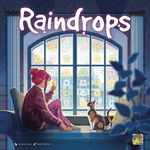
The final piece to complete this puzzle was the arrival of Andrea Guerrieri to create the game’s illustrations and graphic design. I was genuinely thrilled when I saw the first cover sketches he shared. I think he captured and translated the cozy atmosphere of the game beautifully, and I’m sure this box will be a hit with cat lovers everywhere! I can’t wait to see it on people’s shelves!
/pic9680667.png)
Youtube Video
By the time this game reaches players’ tables, nearly six years will have passed since signing the publishing agreement with DV Games, and seven since that first note in my notebook back in 2019. And how many raindrops have raced down the window since then…
I hope this game brings you wonderful moments and lasting memories around the table with your favorite people.
Thank you for reading, and happy gaming!
Fernando Cunha
Tell us how can we improve this post?