Designer Diary: Jure Grando – Turning a 17th-Century Vampire Legend into a Board Game

The question asked was: “Why don’t you make a game about Jure?”
I was asked this question in my car while driving near Kringa, Istria. (the place where the legend places Europe’s first vampire) I had known about the legend of Jure Grando for some 20 years by then… and after my first Balkan game, Propuh, was well accepted it sounded like a good idea.
It was! And it had a bunch of “problems” and opportunities attached!
Folklore in my region exists mostly in oral form, with only a few legends written down. This has proven to be a blessing in disguise! While this may be a historian’s nightmare, for designing a game it offers immense creative freedom, with just one responsibility: to keep the tone of the local folklore alive and avoid wandering into more standard fantasy themes and solutions.
The Jure Grando legend, however, is unusually well documented. In 1689, Johann Weikhard von Valvasor included the story in The Glory of the Duchy of Carniola, describing events said to have taken place in Kringa decades earlier. And that gave me something extremely useful for designing the game: a starting point – a name, a time, and a location.
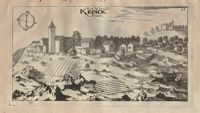
So. What is actually true? The truth is that Valvasor documented the legend.

The year was 1672 For generations, the people of Kringa have lived quiet lives among the forests and hills of central Istria. But strange events have begun to unsettle the village. Livestock disappear without explanation. Darkness gathers along forgotten paths. Doors are marked in the night by unseen hands, while a silent black cat watches from the shadows. The townsfolk know the old stories. They speak of Jure Grando, a man who died years ago yet refused to remain in his grave. They say he is a strigun, a restless horror that returns to prey upon the living.
Inspired by “The Glory of the Duchy of Carniola” written by Johann Weikhard von Valvasor
Now all I needed to do was design the game.
And initially it was meant to be a smaller and less ambitious project, not too heavy and following just the narrow path of the written legend.
“Jure Grando rises each night,
knocks on doors – people die,
the townsfolk gather,
find his grave,
and end his reign of terror”
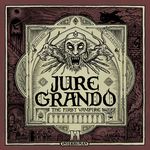
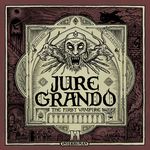
Simple and nice. And then my graphic designer, Zdravko, made the box cover design 😅
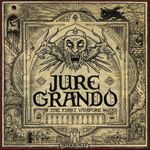
And it seemed like a shame to use this kind of design on a small box – don’t you agree?
And figurines would be nice as well 😂 – and here Nikolay Dimchev did his part!
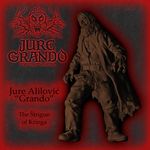
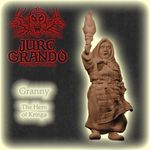
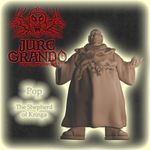
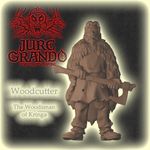
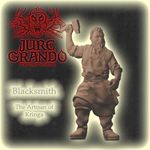
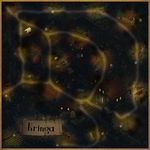
And at last Endi from Strigun Art made the map of Kringa.
And brought its characters to life!
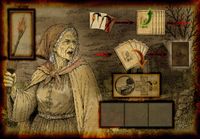
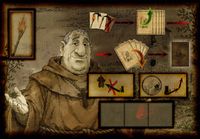
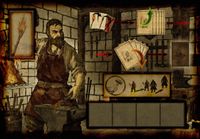
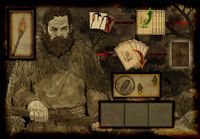
And as you can guess, this is where the simple little game stopped being simple. (or little)
The legend gave me a sequence of events:
Jure rises.
Jure knocks on doors.
People die.
The villagers find his grave.
They confront him.
That’s a story. But what do the players actually do? Should they fight Jure? How to make the combat mechanics? Collecting items? Inventory?
The problem was that once the game grew physically, my ideas for the gameplay grew with it. More locations. More characters. More things to do. Crafting. RPG elements. Player boards…
You know, all the things that obviously make a game better. They didn’t.
I had mechanisms. Too many mechanisms. But, I wanted to make a Folk-Horror game (well, not at the start but the idea grew on me). So I decided to focus on how I want the players to feel!
They will not be fantasy heroes, just ordinary townsfolk (and Granny). No superpowers. No holy weapons (even the hawthorn stake just keeps Jure at bay and cannot harm him). Just people trying to survive the night and prepare for the inevitable showdown with ancient knowledge, folklore, and a superstition or two. They need to prepare themselves, the town, and its inhabitants for the fight to come.
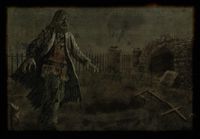
I want players to be afraid for their characters – ordinary folk faced with an ancient evil! And here comes the next problem. The legend of Jure Grando only gets me so far. Because the moment Jure comes on the board, he is an evil that can be faced or avoided. He is no longer a looming threat.
And the next solution! The local folklore is incredibly rich and varied, to the level that even neighbouring villages have different stories and superstitions.
SO Here comes the black cat – Jure’s demonic companion. In one much more recent oral version, Jure was remembered walking through Kringa with a dead sheep over one shoulder and a black cat over the other. Valvasor never mentioned the cat. But I really liked the cat.
So the cat enters the story!
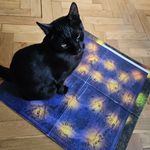
(my cat on an early board prototype)
And as cats tend to, it becomes the main protagonist of the first part! The cat also solved a group of problems that came from the fact that Jure comes just for the Endgame (a design choice to make him more Folk horror and less Usual horror).
But what will the cat do? Driven only by a few icons on the bottom of a Kringa card (Draft at the end of each player’s turn) it cannot be too complex.
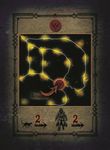
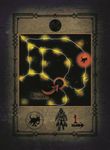
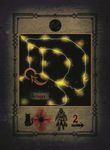
So now the cat moves, steals, and causes terror!
Moves – quite obvious: moves; less obvious: moves towards the closest player; if in doubt, towards the closest player with more items
Steals – this is the nasty one; the cat steals one item from the location or player and takes it to a random location (several games were lost to this)
Causes terror – well, a cat jumps on your back in the middle of the night while you are hunting for the vampire; if that does not cause terror, neither will a vampire 🙂
Now We Come to the Terror
Since there is no combat in the game and no hit points, health, or something similar, I needed something to keep the pressure and “punish players” This is TERROR – it does not hurt or injure, but the fear grips you and makes you incapable of acting!
Each time you get terror, you lose one of your actions – not permanently, just until you recover by resting, using garlic, or something of the kind.
This is not terribly punishing, but it tends to be cumulative, and pretty soon you end up with only one or two actions. Also, you cannot remove terror while in darkness!
Darkness

This is not the nice and quiet darkness when you can get some well-deserved rest and sleep. This is the darkness that extinguishes light, safety, and hope.
As the night goes on, the darkness will gradually creep in and steal your courage. Also, when the whole town goes dark, all hope is lost, and you lose the game even if Jure did not join the fight – so you have to be fast!!! To make things worse, when Jure does show up, he moves through areas of darkness instantly.
So darkenss it is a pretty nice pressure mechanism.
But players need a choice (I am a push-your-luck fan) And in our folklore we have a perfect thing just for that…
Crossroads – Where the Witches Meet, and Deals With the Devil Are Made!

In Jure Grando, the characters do neither of those things (sorry for the disappointment – maybe in another game) But crossroads are tricky – walk into them at night without a care in the world… and you might get something to worry about!!!
Entering crossroads can do a number of things to you! It might do nothing. It might summon the cat at your side (not a good thing). It might give you a decent scare (terror). Or it might extinguish the light, which is quite bad.
Can you avoid it? Yes, you can – by throwing a nice round stone in the crossroads! You just have to find it first!
Needless to say, if you waste a whole lot of time avoiding dangers, you have little chance of even making it far enough to face Jure Grando!
And… so on…
And this is pretty much how the rest of the game developed. Whenever I needed a solution, I first looked back at the legend, local folklore, and old superstitions. Garlic, red thread, hawthorn stakes, crossroads, stones… they were not added just because they looked thematic. They gave me ways to turn the folklore into actual game mechanisms. Of course, not everything worked. Quite a lot didn’t.
The game went through several versions, lost most of its RPG and crafting elements, gained and lost mechanisms, and was playtested over and over again.
A lot of it I have already forgotten – similar to the whims of oral tradition, I forget a lot too.
But somewhere along the way I finally understood what I wanted Jure Grando to be.
Not a game about fighting a vampire. A game about being afraid that the vampire is coming, and still holding your ground and doing your best! Not because you have a perfect plan and are confident you can win, but in spite of knowing that you probably can’t! And there are even a few ways to win the game after all the players have been eliminated. For me, that is the charm of folk horror!
And now, the GameFound campaign was successful (in 78 minutes).
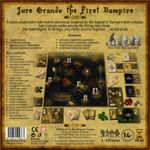
So Jure Grando the First Vampire was unleashed upon an unsuspecting world this October, first to our backers and at then at SPIEL as well! If you happen to stop by our booth at SPIEL, I hope you enjoyed a chat, a game, and maybe a drink (rakija).
Tell us how can we improve this post?