
/pic9551526.jpg)
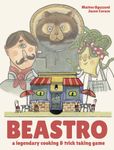
Beastro is a team-based, trick-taking game with hidden roles where you have to figure out who is on your team, outsmart the other players, and collect as many tricks as possible for your team. You play as a mythical Beast Chef that is trying to open (or burn to the ground) a new pop-up restaurant.
We self-published the game in 2025 and released it during the Indie Games Night Market at Pax Unplugged in November 2025 (shot out to Daniel Newman from Newmill Industries for the great initiative!). In this designer diary we will talk about the ancestry of the game, our design journey, and a little about the self-publishing experience.
Enjoy the read!
Ancestry
Beastro is the nephew of an Italian traditional trick-taking game called Briscola Chiamata traditionally called Briscola. In my hometown it’s called Amico del Giaguaro, in English “Jaguar’s Friend”, and I’m sure there are as many names for it as there are bell towers in Italy.
Briscola, is the name for the family of card games that “Jaguar’s Friend” belongs to. It is one of the most popular, if not the most popular, may-follow trick-taking game in Italy (must-follow games are more rare, but if you’re interested I suggest you start with Tressette).
/pic9203285.jpg)
This person is not playing Briscola, but a solitaire version
The game is played with a Spanish suit deck, in the regional design variant that you find in your region (we play with the Piacentine design in Emilia Romagna, pictured above), with ten cards for each of the four suits: Coins, Cups, Wands and Spades.
Briscola is usually played in two teams of two players that have to score sixty-one (61) points to win. The Ace, the Three and the face cards count toward the scoring (awarding respectively 11, 10, 4, 3 and 2 points), while the trump suit is defined by flipping a card after giving the initial hand of three cards to each player. After you play into a trick, you draw a new card from the deck and refill your hand to three. Therefore, players have a very limited information at the beginning of the game.
/pic71809.jpg)
The only cards that score in Briscola
Briscola Chiamata, the auntie of Beastro
Briscola Chiamata, the auntie of Beastro, is a five-player only game (2 vs 3) where the teams are defined by a wager phase. In “Jaguar’s Friend”, the variant we play in my area, every player declares how many points their team will score at the end of the round, starting from 61 and going up until the improbable 120 points, meaning all the points available in the deck. The winner of the wager becomes the Jaguar and they declare a card and a suit that they are looking for (for example the Ace of Wands), the player that has that card in their hand becomes the “Jaguar’s friend”. They are now a team – the Jaguar’s team – and their goal is to reach or pass the wager. The trump is defined by the Jaguar’s call, it’s the suit of the card they are looking for. Players that don’t have the called card are in the opposite team of three and their goal is to collective beat the Jaguar’s bet.
Briscola Chiamata is a may-follow through and through so not all tricks feel very meaningful. For example the initial tricks, although not very impactful toward the final score, become ways to gauge who is who. The game is very popular among young people (at least in my town) and while old folks rarely play this variant, I remember entire summers playing it. If I have to pick some reasons why Jaguar’s Friend is so successful I will say it is social deduction aspect of it, the shifting alliances, and the wager are all unique features of the variant.
/pic9203278.jpg)
This is the way you play Briscola in Italy, shirtless and in the streets!
All right, if you read this far, you’re probably a trick-taking appassionat*, so it’s time to move on to our actual design!
A deck of cards crosses the Atlantic!
/pic9203291.png)
Unpub at Pax Unplugged, the best way to test your ideas
After my brother-in-law visited from Italy in September 2022, I was donated a traditional Briscola deck. I was very excited about it and I brought it to a game night with Jason Corace (designer of Lord and Ladies and Super Truffle Pig and half of Hello Mountain, our little publishing coop). The deck was so familiar to me. I vividly remember learning how to make sums playing games with Grandma, but this was alien to Jason. I was able to explain the Jaguar game to him with a traditional french poker deck and we started brainstorming on how to make a new game inspired by it.
We set up our design journey with few goals in mind. The first was a broader player count from five, which is the only number that Briscola Chiamata can allow, to the more traditional three-to-six players. The second goal was to make a must follow trick-taking (we were advised that may-follow are not loved in the US market). The third design goal was to keep the hidden roles without adding the classic social deduction parts. We were worried that adding that part will break the flow of the game and lose the straightforwardness that we like about trick-taking games.
We hosted our first playtest at Pax Unplugged that same winter in 2022. The game had a different theme back then, it was called Prestige and players were playing as Magicians setting up their magic show. We got a few so-and-so playtests – if you’re playtesting a trick-taking game and people have never played one, buckle up!. Then a family of five that used to play a lot of card games sat down and they had the best time! When the mom, always quiet, revealed that she was the Secret Assistant (a.k.a. Jaguar’s friend) the table almost exploded! She was able to trick everyone into thinking she was not.
/pic9203298.png)
Prestige’s components ..magic tricks in a trick-taking game how original!
After PaxU, we pitched the title to many publishers and every time we got great feedback. The folks at Amigo and Pandasaurus were fantastic and the game improved from their generous feedback. In the end, everyone decided to pass on the design. We heard all the reasons (and if you are a designer you know what we mean): “it’s not different enough”, “it’s too niche”, “we already signed trick takers for the next three years”, “we are not publishing trick takers anymore” etc..
Prestige becomes Beastro
The following spring both Jason and I found ourselves surrounded by a lot of talented game designers, and with consistent playtesting we were able to bring the game to a completed state. Thank you Viditya, Marcy, Firex, Zach, Rook, Tori, Logan, Nat, George and everyone at the NYU Game Center, Pratt and Gumbo NYC. The game will not be where is it today if it wasn’t for the great discussions we had together.
/pic9203301.jpg)
External influences were important too. In that same period both Jason and I ended up being obsessed with the TV show The Bear, starring Jeremy Allen White and Ayo Edebiri, and so we decided to change the theme from magicians putting on their first show to a kitchen where players were up and coming chefs trying to sabotage the next hot restaurant in town for their own private interest or giant ego.
We needed a title for the game and Beastro came along and with it the idea that chefs and line cooks were mythical creatures (Beast) trying to open their own pop-up restaurant (a Beastro!). Everything fell into place when we decided to involve Jen Corace, an amazing illustrator from Providence, RI, that worked with Jason in his previous design Lords and Ladies. Jen happened to also be Jason’s sister so that helped the collaboration a lot and she happened to be incredibly talented and amazing. Even an onion is something that I will put on a poster if it’s designed by Jen..look at this!
/pic9203302.jpg)
I want this on a t-shirt
What is unique in Jen’s style is that every illustration has a handpainted nature to it, and the reason is because every illustration is hand painted! So Beastro‘s deck is the work of a real artist that works with the non-digital medium at a mastery level.
Alright, enough of the history, below is a more in depth description of the design (thank you for reading this much!!). If you want to go deeper, here is the link to the ruleset and here’s a video of me pitching/explaining the game (Italian accent included).
P.S.: At the end there is also an appendix on how it was to sell the game during Pax Unplugged’ Indie Game Night Market and afterwards, if you are a designer that is just starting and is thinking about a first small self publishing experiment, maybe that part could be interesting for you!
BEASTRO the final design
/pic9203388.jpg)
The Wager
We simplified the wager vastly. Players get 13 cards at the beginning of the round and they pick one card from their hand that they sacrifice for the wager. Everyone reveals their card at the same time and whoever plays the highest card is the Head Chef and they immediately take the role deck. Starting from the lowest card, one player after the other flips over a Suit card, denying that suit to be trump for the round (a similar system is used in various designs, most notably Lunar by Masato Uesugi, Allplay, 2024). The suit that is left is the trump for the round. All the cards used in the wager are then discarded.
Team Formation
The Head Chef gives out the roles, picking their Secret Chef, and the only public role is the Head Chef.
/pic9203308.jpg)
Trick-Taking
We play a total of 12 tricks in a round. The Head Chef opens the round leading the first trick. The winner of the trick leads the next trick. It’s a traditional must-follow, so players are only allowed to play trump if they cannot follow suit, or if the trick was led with trump.
Special cards (exception to the must-follow rule)
There are two special cards that can be played at any time. The first is Secret Sauce, this card beats all the other cards, even trump. The only card that can beat a Secret Sauce is another Secret Sauce (there are two in the deck, or three in a six player game).
/pic9203309.jpg)
The second special card is Sabotage. This card is worth zero, so playing it means that you will not win the trick, but giving away Sabotage cards in other people’s tricks is good because the team with the most Sabotages at the end of the round will score negative points. Be careful not to give Sabotage to someone that will end up being on your team! Also the Sabotage card is the tie breaker in case the teams collect the same number of tricks (6 vs 6). The Sabotage card also does not follow the must-follow rule and can be played at any time.
Beast Chef Powers!
This is our latest addition to the design and we are very excited about it: every Beast Chef in the game has a special power action that can be used only once during the entire game. These are usually very powerful moves that can allow a last minute trick grabbing, but they are not enough to flip a game in your team’s direction (an inspiration for something similar is TRICKTAKERs Hiroken, Joyple Games, 2021).
/pic9203306.jpg)
Chupacabra helloooo?! Amazing illustrations by Jen Corace
Restaurants
Every round is played at a different pop-up restaurant that has two special scoring conditions that every player can score independently. This was Dan Thurot favorite features, read his review here.
/pic9203310.jpg)
Addendum – Self printing and selling Beastro!
We hope that this next section could be helpful for you. The reality is that every story of self-publishing is different but we learned a lot from this experience so why not share it?
The final product
While Beastro’s prototype had components, we decided that if we have to self-publish we should keep it simple. So we turned everything into a card, and our game is now a deck made of 86 cards: 62 playing cards, 12 restaurants cards, 6 Beast Chef cards and a role deck of 6 Cards.
The game was selected for the Indie Game Night Market in November 2025, and we got news of the selection in August so we sprinted into work! We started with the illustrations and in this section we were really lucky. We trusted Jen completely with her illustrations. She and Jason came up with the list of ingredients, Beast Chefs, and Restaurants, so she was able to complete her portion of the work in no time – I think it was less than two weeks.
After we got the illustrations we were ready to design the game’s box. One insight I heard on a podcast from the folks at CMYK is that you should be able to understand how to play in three steps just by looking at the back of the box, so we tried that.
/pic9544611.jpg)
The three steps rule applied to Beastro
We decided to print in China, and in 2025, that was not a good idea. I mean, we were really happy with the result, but the tariffs, the rush fee, and the cost per unit turned out to be higher than we expected. Another mistake we made was not to print a demo copy before placing the full order. Even if it’s insanely expensive, it could save you money down the road if, for example, you have to re-print a card because of a typo or you forgot a card.
/pic9544614.jpg)
Someone ordered a Secrdt Sauce?
After Pax U
Selling Beastro at PaxU was incredibly rewarding. The evening was just a great experience of sharing our design, receiving compliments, and having a good time. We were sad that we were not able to go to other designers’ tables and learn more about their games, but we were able to connect the following days and on the festival’s discord.
/pic9266630.jpg)
Hello Mountain (us), selling Beastro. I’m beaten, Jason is rocking it
In the days afterwards we saw some reviews popping up. Some people shared that they got a copy and it felt very rewarding. With that momentum we decided to setup our website and try to sell copies online. The game was reviewed a couple of times more and with some social media activity we were able to sell a steady number of copies for the weeks preceding Christmas and some more in the new year. Some copies, together with the Italian ruleset, went to my hometown crew of “Jaguar’s friend” players in Italy, and some came with me to Tallahassee, Florida, where I relocated in the meantime.
/pic9551618.jpg)
A small selection of Beastro’s enthusiasts – check out Courtyard Cafè and Games if you are in Tally
To conclude this designer diary: we would like to thank again everyone that helped us along the route and playtested the game – every playtest was incredibly helpful! To self-publish a design that is only cards is definitely something we will suggest if you trying to self-publish for the first time. It will lower the costs, simplify your work, and you will reach a level of quality that otherwise it will be very hard. We feel blessed to have such an active and open community of indie game designers that we can be part of and we hope to keep designing and bringing to life quirky, easy-to-play games in the next future.
Thanks for reading!
Matteo and Jason
/pic9551619.jpg)
Happy playing, courtesy Arianna Richeldi
Tell us how can we improve this post?