
by Tom Tackle
The Crew: Quest for Planet Nine was released in late 2019 and was the first game in The Crew series. Even during my first test plays back in 2018, the game worked perfectly, and it felt to me as though I had discovered the game rather than invented it. That’s something very rare and gives you the feeling that you have something truly special.
Of course, all of this requires that, as a designer, you have a strong desire to delve deeper and dig further. What else does the game have to offer? The deeper you dig, the more you find. For me, The Crew was like a treasure I was allowed to unearth, and I was eager to see what I would discover as the lid of the treasure chest opened wider.
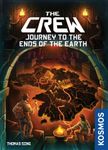
When I refer to “Crew-3” in the rest of this article, I’m always referring to the new Crew game, Journey to the Ends of the Earth. The term Crew-3 isn’t entirely accurate, since a third Crew game called Crew Family was released two years ago. However, that one was designed specifically for families. It does away with the trick-taking mechanics and was therefore significantly easier in terms of difficulty than the other Crew games.
I write down everything that comes to mind regarding gameplay, and as early as 2019–2020, I had already created lists with many completely new missions and numerous other innovative ideas for Crew. For every single small component of the game, I have a separate list of possible further developments or changes.
Many of those missions and ideas from back then can now be found in The Crew: Mission Deep Sea and also in the current The Crew: Journey to the Ends of the Earth. So the development of The Crew 3 had already begun unconsciously many years earlier—in some cases even before The Crew 1 was released. But the question that always comes to mind is: How do I bring these new ideas together?
The easiest thing, of course, would be to simply keep the gameplay from *The Crew* 1 and just tweak the story and the missions a bit. The gameplay of the *The Crew* concept, in a nutshell, is:
– Read the story text aloud
– Place mission cards in the center of the table
– Players select mission cards
– Complete the missions through a fully cooperative trick-taking game
– Once all missions are completed, move on to the next, slightly more difficult mission
– If a mission isn’t completed, repeat the mission.
When I spoke with Kilian Vosse, my editor at Kosmos, about a sequel to Crew-1, it was clear to both of us that any new game needs to strike a balance between continuity and innovation. In Crew-2, I developed entirely new missions and incorporated their difficulty levels into the gameplay. This allowed me to give the game tremendous replay value. But to make Crew-3 something entirely unique, it was obvious that I had to completely redesign the gameplay.
I decided that there should be only one mission left, which the entire crew would have to complete together. This further reinforces the cooperative element of the game. The game now includes more than 100 different missions with varying levels of difficulty. Before each game, you always have the choice between two missions. The game was designed to be a race between our crew and an opponent. The idea was that a difficult mission would move us further ahead in the race than an easy one. That’s why the difficulty level had to be indicated on the back of the mission card. Upon completing a mission, players should be allowed to move the mission’s difficulty level marker forward. The opponent, on the other hand, always moves forward at a steady, slow pace.
The game was structured in stages, and the goal was to reach the end of the stage before the opponent. Depending on its length, a stage consists of completing several tasks. The advantage of this is that you can certainly fail at one or two tasks, as long as you don’t arrive at the end of the stage after the opponent. This lightens the game up a bit and takes some of the pressure off the need to win at all costs.
Thematically, I initially set the game (back in 2021) as a journey through the Himalayas and later as an adaptation of the race to the South Pole between Amundsen and Scott. The Amundsen/Scott race would have been a wonderful thematic fit. However, in discussions with Kilian, we came to the conclusion that this event does contain tragic and horrific elements and could give the game a rather somber tone, which we didn’t want. We decided instead to go on a trip around the world and further develop that story.
Since every game I create is something of an autobiography, I simply started the trip around the world in Konstanz. That’s where I was born and where I live. Konstanz is right on the Swiss border, so we simply continued on into Switzerland, into the mountains, and in the blink of an eye we were already in Italy. I love Italy—and, admittedly, not just for its culture, but also for its food. Italian cuisine is simple and delicious, and that’s exactly how I want my games to be.
Not all travel is the same. Everyone knows that 10 km in the mountains is different from 10 km in the jungle or 10 km on the plains. Each type of movement should therefore come with its own rule that slightly varies the card game. Of course, I was able to fall back on my lists again. In total, the game features 16 different types of movement, and each movement comes with a small additional rule.
It was important to me that the journey follow real-world geographical conditions. So, in theory, you can trace the journey in an atlas and see what to expect geographically. The movement system in the game then takes these geographical conditions into account. For example, if you have to cross water, you’ll be in a boat or use a helicopter; in the mountains, you’ll have to hike or use skis. However, to keep things varied and maintain curiosity about new experiences, each mode of travel should appear in only a very small number of stages. After that, it should disappear, and new modes of travel should appear—always adapted to the geographical conditions. It was important to me that each stage has its own unique character and that it never feels like a repetition.
In addition to the many world-famous places we visit, there are also locations in this game that are likely unknown to many players. Everyone knows Rome, Rio de Janeiro, and Los Angeles, but who’s heard of Appenzell, Chandragiri, or Kulusuk? Yet exploring the unknown can be very appealing and inspire players to look things up. You never stop learning. Fiore GmbH then brought the game to life visually with the cover, cards, and logbook. It’s beautifully done and gives the game the perfect atmosphere. Many thanks to Fiore GmbH.
In Crew-1, specific cards had to be won by individual players in their tricks; in Crew-2, there were 96 completely different, innovative missions that differed greatly from those in Crew-1. There are now several games that draw on missions of this kind. It was therefore clear to me that I also had to develop entirely new mission cards with a new structure. I came up with the idea of creating missions that can be completed in every single trick of the game. At the end of the game, we then see how often we succeeded. These missions appear in the game as “special missions.” While with “standard missions” you know—based on the difficulty level—how many points or spaces the mission will earn you upon completion, this isn’t clear with special missions. It could be a few points or a lot, depending on how good you are.
To further explore the theme of travel, we’ve not only included stops along the way but also specific events and visits to world-famous sites. For example, we visit Pompeii, the city in Italy that was buried by Mount Vesuvius in 79 AD, where we admire the newly discovered mosaics. We take a scenic flight over Africa. We climb the world’s highest mountain, Mount Everest. In Macau, we play bingo. We visit Machu Picchu in Peru and battle caimans in the Amazon. We visit London’s biggest landmarks and end the game in the Catacombs of Paris.
In the game, we call these activities “Special Stages.” They feature a novel, sophisticated mission structure. It wasn’t until the Special Stages were created that I truly felt I had brought real innovation to the missions as well.
Innovation is always important to me. But I also know that innovation doesn’t automatically result in a good game. I would even go so far as to say that the challenge lies in creating a good game despite the innovation. It’s always much easier to fall back on tried-and-true structures than on new ones.
Innovation is like courage. Courage can turn into recklessness, just as innovation can lead to a bad game. Nevertheless, courage and innovation should always be valued. I really hope that the innovative game elements in Crew 3 will prove their worth.
Once I felt the game was basically finished, I sent it back to Kilian, who had since received active support from his colleague Elena Gross. As expected, the two of them sent back a whole range of suggestions on what we should reconsider in the game. I always look forward to this final phase of game development. So far, I’ve created all the Crew games together with Kilian. He’s a sharp thinker, and I’ve seen time and again on previous projects that he often views things from a completely different perspective, which gives the game a fresh momentum.
This time, I had two editors by my side, so there were quite a few changes. My heartfelt thanks go to Elena and Kilian for the inspiring collaboration. When I see the small Crew box at the end—measuring about 18x13x4 cm—I’m always overwhelmed by the massive machinery that’s now being set in motion for this game.
While in my version, for example, we had to repeat a stage if we hadn’t finished it before our opponent, Elena and Kilian wanted a completely different structure. There should be no failure in a stage. You simply keep playing until you’ve completed the stage. The faster you reach the finish, the better your score for that stage. That convinced me, because now there was a real reason for players to take on the more difficult tasks. We also turned the opponent into a time marker. Like a handicap in golf, the time marker indicates how many tasks it should normally take to complete the stage. If it takes longer, our score gets worse; if it takes less time, it gets better. If we take exactly as long as the time marker specifies for each stage, we’re in top form. If we’re just one space faster, we land right in the range that yields the best possible result at the end of the game.
Thematically, the two of them decided to go on a quest for Charlemagne’s treasure. However, we deliberately kept the story text in the background. There is a thematic introduction and a thematic conclusion, which varies depending on the final score. However, there isn’t a story text for every mission. Players who want to immerse themselves more in the theme are welcome to do so. Thanks to the game’s stage structure, gameplay mechanics, and the way it incorporates geographical elements, there are plenty of opportunities to do so during the game. First and foremost, though, the game is a trick-taking game with entirely new approaches.
For the two-player game, we’ve included a variant that presents some serious challenges. In a two-player game, each player can now decide whether to play the difficult variant or the familiar, simpler one.
Well, that’s it. Now it’s your turn. I hope you all have a lot of fun playing, and I’m really looking forward to your feedback.
Tom Sing
Tell us how can we improve this post?