
by Justin Bell
Over the years, I’ve had the pleasure of meeting team members at Panda Game Manufacturing, one of the most prominent partners of tabletop production in the industry. When I first joined BGG earlier this year, I connected with folks on the business side of Panda to explore writing occasional articles about the way board games are made, from the time a publisher connects with Panda to begin a new project to a game’s production cycle in China to the moment games arrive at ports around the world to begin their journey to the hands of individual players.
The “business of the business”, if you will, is pretty interesting to me. I’m a geek (just like you, if you are reading news on this platform!), and the way bits are made fascinates me. So, I am establishing a series to talk through the minutiae of various game elements, and the natural place I wanted to start came with player boards. I love player boards so much I make them a part of my annual Highs & Lows rankings over at Meeple Mountain, and when I learned about all the different player boards that Panda has produced over the last 10+ years, I wanted to dedicate an entire article to questions about the process.
This edition of the Panda series features Tyler Lipchen, Panda’s Director of Product Development. Tyler is based in the UK, but over a couple different conversations both online and in person during Gen Con and SPIEL Essen, Tyler and I discussed our passion for player boards. Below is our edited conversation. Enjoy!

Justin Bell (JB): Tyler, thanks for spending some time geeking out with me over player boards. First, let’s get a few things on the table. How did you link up with Panda, and what’s your journey been like at the company?
Tyler Lipchen (TL): I joined Panda in the spring of 2019 as a Prepress Specialist and Project Manager. I had learned about the company years earlier and interviewed for a position at a time in my life when I was transitioning out of the performing arts and looking for a major career move. Prior to the position opening, I had immersed myself in the board game hobby and tabletop game design community, so I was very familiar with Panda’s work. Spoiler Alert: I didn’t get the job on the first go… but after meeting with several Pandas throughout their very in-depth interview process, I decided that they were the company I wanted to work for and build a career with. So, I set off to gain experience and expertise in any and all fields that would better prepare me for the next time a position opened.
So, I started as a creative artworker, where I cut my teeth doing prepress and proofs for a card printing company here in the UK. When I had learned everything I could about the printing process and digital file setup, I moved to a more hands-on role for a factory specialising in high-end visual merchandising. I was running and maintaining the printers, laminating, mounting, trimming, and everything in between. I learned a lot about a wide range of machinery, materials and production processes during my time on the factory floor. Knowledge that, when combined with my love of tabletop games and game design, led me directly back to Panda.
My current role at Panda is all-encompassing, and my involvement with any given tabletop project begins with initial consultations with clients. During these conversations, we’ll discuss the game’s specifications and manufacturing requirements, materials, estimated project timelines, and even some higher-level topics like crowdfunding strategies and logistics. From there, I’ll issue initial quotations (including any stretch goals, upgrade options, or add-ons if it’s a crowdfunding project).
Once a client decides to work with Panda, I’ll be their main point of contact throughout the production process. I’ll be checking their digital print files and offering feedback, issuing digital proofs, arranging pre-production samples, and coordinating mass production with our factory in Shenzhen, China. When the project nears completion, I’ll work closely with our logistics team and the publisher’s shipping agents, warehouses and/or fulfilment partners to get the games off the factory floor and onwards towards their final destination: The gamers!
Recently I’ve taken on the role of Director of Product Development, which has given me more opportunities to work with new and existing Panda clients looking for fresh new components and production techniques to improve and expand their product lines.

JB: It seems like most “Pandas” work remote…which is a drag for one main reason: how do you link up with other Pandas to play games over the lunch break when everyone has their own home office and is in a different time zone? If I’m working for a game manufacturer, I would want to play games all the time!
TL: Panda has always been a remote company, even before the pandemic made it cool! We keep in touch on a daily, weekly, or monthly basis depending on each Panda’s role. I myself am involved in Project Management, Prepress, Marketing, Business Development, Convention Planning, and sometimes Training, so I connect with Pandas all over the world daily via video calls, email or Slack. During our downtime we’ll often get together remotely over Board Game Arena to play board games real-time or async. Someone from the team might also organise an online tournament now and then (usually Poker, Challengers, or Walkabout Mini Golf). And there are a plethora of other organised and casual activities always happening at the company, such as VR games, video games, book clubs, movie clubs… Even a Baking Club at one point! Even though we’re hundreds or even thousands of miles apart, I always feel connected with my team both personally and professionally.
JB: How about your gaming background? What kinds of games do you enjoy playing most, and what are your all-time favorite games? It must be easy to find a game group in your local market when you tell people what you do for a living!
TL: Right now I mostly play casual games with my wife and two young boys, or with family and friends who are non-gamers. My go-to games for these groups are Codenames, The Mind, SCOUT, and Flip 7. Whirly Derby was also my game of Essen last year, and that always goes down a treat! Personally, I love a good dungeon crawler or adventure game, especially if it involves dice or some sort of Deckbuilding mechanism. My eldest son just turned 8, and he and I are working our way through Mice and Mystics and Stuffed Fables, with some casual games of Star Realms, Super Auto Pets Card Battle, Deep Sea Adventure, and Fireball Island in between chapters.
JB: What’s your favorite player board? I went through the sample list of Panda’s previous work, and in many ways, it’s a “who’s who” of great production elements. Scythe’s player boards are still some of my all-time favorites, but Wasteland Express Delivery Service still stands out for me as a fun car-kit experience, with simple iconography that guided me both through a turn as well as showcasing the state of my vehicle at any given time.
TL: I think Eclipse: Second Dawn for the Galaxy is at the top of my list for UI/UX, especially the resource tracks that are integrated with the plastic trays. I also have to give a shoutout to Akrotiri (one of my top games I think every game designer should play). I haven’t played it in years, but the player board (that’s also the player aid) is so thoughtfully designed that I know I can pick it up and play it without touching the rulebook.
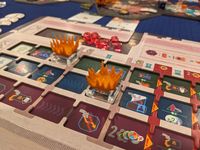
JB: Interesting. My pick is the player board set from Voidfall; I’ve dedicated entire articles to the feelings I get when I slip a faction mat into the triple-layer board, and sometimes that feeling is better than even playing the game. I have so many questions about the development of those player boards, but just take me back to when you first had the conversation with the Mindclash team about the goal of these boards and what they would mean to the player.
TL: Voidfall was an epic project! I ran the prepress for Mindclash at the time, and the files were mind-bending! One thing I always look for in any component is a smooth User Interface (I even did a one-hour talk at GDC about UX/UI in tabletop games in 2024). A good playerboard is more than just a place to store cubes… One of its core functions should be to reduce the player’s cognitive load. This can be done in several ways, but the most common are guiding players through the phases of a game, showing relationships between resources, or reminding them of important rules (especially if they’re unique to that player’s faction or character). The other focus (which goes for any tabletop game component) should be on creating a positive User Experience for the player, such as sliding those cards into the Voidfall boards, clearing a puzzle in Project L with that last, perfect tetrahedral piece, or unlocking that vital upgrade in Scythe that sets up your next turn for a final land grab. Tactility is one of the biggest advantages tabletop games have over video games, so using your components to their maximum potential (in terms of usability and enjoyment) should be paramount.
JB: It seems like some player boards are destined to be successful, because I’ve played so many games where the player boards go wrong. They don’t hold components as snug as one would hope, or the boards warp in a way that can ruin the experience for a player. Some player boards try to do too much, in terms of information overload or serving as a storage space for too many items. How do you manage some of this with publishers, who might be a bit too zealous for their—and our—own good?
TL: Our involvement in the design of a game’s playerboard depends on a few factors. For any publisher, we’ll always suggest the best materials and processes for the job at hand. Understanding the role of the boards in the context of the game is a huge help. If I can, I like to playtest the game with the publisher (either in person or online) to get a feel for the core game loop and how each of the game’s systems interact. Once I understand the function of the playerboard, I can start making suggestions and recommendations. How insistent I am about this depends on my relationship with the publisher, how far along in the development process the game is, and how much agency my contact has in regard to editorial decisions.
You mentioned a few instances where a playerboard has let you down. It’s unfortunate, but it can happen, particularly with new publishers who are working on their first project. Luckily, Panda has already rigorously tested our materials and processes, and we don’t offer paper stocks that are susceptible to warping or other Quality Control issues. Sometimes our level of quality can price us out of a project, but we’re very passionate about the hobby and the industry, and we view ourselves as partners with our clients, not vendors or suppliers. Their success is our success, and we value their end-product and their customers as much as they do. Our clients depend on us for our quality and expertise, and part of that relationship involves working together to find solutions to their production (and sometimes game design) problems. Our clients are on board (pun intended) with this approach and are open to our feedback and input, which is the part of my job I find most rewarding.
Part of that process (and another one of Panda’s core strengths) is the involvement of our Prepress team. During the Design Verification Process (when a publisher uploads their digital print files for prepress checks), a dedicated Panda Prepress Specialist will review the files thoroughly and flag any potential print or production issues. When it comes to any sort of die-cut player boards (like the dual-layered boards in Scythe), we’ll be checking which components are supposed to go into which slot on the board and measuring everything before we even start physical samples. They work closely with the Panda Project Manager and the Publisher, and are thoroughly briefed on the game’s specs and production requirements. They’ll often flag issues where the playerboard won’t work with the rest of the components, or if the design will cause any quality issues for mass production.
I’ll give you an example: Let’s imagine a dual-layer playerboard that has diecut slots to hold 8mm cubes. Those diecut slots can’t be exactly 8mm x 8mm, or else the fit of the cube will be too tight (especially if the greyboard used for the playerboard expands due to humidity). Therefore, we always have to allow some level of offset on the slots. Using plastic cubes requires a minimal amount of offset (an 8mm plastic cube may require an 8.5mm square hole on the board). Injection-moulded plastic components are very consistent in this regard, so you can bet each side of the cube is going to be exactly 8mm. But if those cubes are wood, there’s a higher chance of variance. The cutting process or type of wood can make some sides slightly more or less than 8mm². Plus, wood is a porous material that is susceptible to growing or shrinking due to ambient moisture levels. Even though Panda uses high quality wood materials, accurate cutting techniques, rigorous quality control measures, and even climatizes all game components prior to assembly, these are still very real physical limitations of mass production. Having a little more wiggle room in the diecut slot for wooden cubes compared to plastic can make all the difference in the final product. It might seem like a tedious thing to think about, but it’s what we do 😉
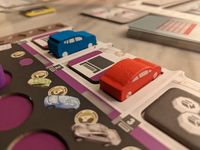
JB: Kanban EV is one of the best games in my collection; sometimes, I can’t tell if the game makes the player boards better or if the player boards elevate the play experience more. It’s a match made in player board heaven, though. The best thing about the Kanban EV boards is the way the boards provide easy-to-parse storage areas for everything that’s important for a player alongside helpful information, such as the value of the cars at the end of the game.
How do ideas like the player board for Kanban EV come to life? Do people like Vital Lacerda, Ian O’Toole, and the Eagle-Gryphon team collaborate with each other then feed ideas to your team? Or is that a process that develops with insight from team members on the Panda side?
TL: Kanban EV is another great example! Our level of involvement definitely depends on a few things (more on that later!). When working with industry veterans like Eagle-Gryphon, Ian, or Vital, they usually work out most of the kinks in advance. They would lean more on us to check their work and make sure their vision can be mass-produced as intended. This also shows the importance of industry experience and expertise. I’ve done prepress checks on a fair few titles from Ian and his print files are nearly perfect every time. He understands the medium and production limitations, but most importantly, how to squeeze the most out of every art asset (in terms of visual communication to assist gameplay, thematic immersion, and… I don’t know how else to put it… Art that is simply a pleasure to look at!). When it comes to hiring artists, graphic designers, 3D sculptors, Writers, Editors, or any other creative contractor, industry experience is invaluable! For any Creatives looking to gain more experience in the industry, I recommend approaching it like you would when studying any other art form: study the greats, think critically about what worked, what didn’t, and (this is the part that often gets overlooked…) learn everything you can about what goes into making the final product (including production processes, techniques, and materials, their limitations and restrictions, but also any opportunities to experiment!). Then, once you’ve done your research, let your creativity shine and forge your own path that sets you apart from the others.
JB: I’d love your opinion on the points in the process where player boards go wrong. Some boards warp almost as soon as I rip off a game’s shrink wrap. Some player boards were going for double-layer or triple-layer or quadruple-layer cardboard but never feel quite right. In some cases, the player board is massive when it could be two-thirds of the size.
I guess my question here is Panda as a consultative partner; when do you have to talk publishers off the ledge when it comes to their ambitions for a player board?
TL: This definitely depends on our relationship with the publisher and the current stage of development for the project. If we’re chatting very early on (before any art assets have been purchased, or before some gameplay elements are finalised) it can be easier to make suggestions that will make production smoother and the end product better. One of the more common instances of this that I experience is when a publisher is insistent on using dual-layer boards (especially as Stretch Goal for a crowdfunding campaign). I always question whether or not the extra layer serves a UI or gameplay purpose. If it’s just there to look fancy, it can significantly increase the per-unit cost of each game (extra materials and assembly for the playerboard itself, but also perhaps affecting the box depth, for example), which lowers the Publisher’s margins and could steer them into dire straits. In this example, I would make the following suggestions: If the extra layer exists only to hold components in place, then is it possible to keep the playerboard as a single-layer, but diecut slots for the components (Like Roll Player)? If it’s important to have information printed under the slots (like Scythe), then that’s a good reason to keep the dual-layers… but then I have to ask about the other components in the game… If we’re using wooden cubes (which are opaque) to track resources on a track printed on the bottom layer of the board, then we’re making a sub-optimal UI design choice. The wood cubes will cover information needed by the player. For example, if the wooden cube is on the “3” on a health tracker, then it’s actually covering up the number the player needs to read. They can see “2”, and “4”, and so they need to make a microcalculation in their mind to deduce that their current health value is “3”. This seems like a very small issue (and it is), but this minuscule amount of wasted brain energy can add up over a 3- or 4-hour game, causing mental fatigue. In this case, I would suggest a clear plastic cube that keeps the current health value visible (or better yet, change the shape and material to a glass semi-sphere, which has the added benefit of magnifying the printed value below it, like Viticulture). Or… better yet…. Remove the second layer of the playerboard, add the diecut slots, and print the numbers below the cube slots (not above, because the height of the cube could then also block the printed health value depending on the angle at which the player is sitting at the table).
These are the kinds of decisions I encourage when I’m talking about UX and UI for tabletop games. My motto is this: “UX and UI won’t make a bad game good, but it will make a good game great”. Your game components are an integral part of the User Experience, and they ARE the User Interface (video games use controllers; we use meeples and dice!). This is why I nerd out so hard over these production issues. When a tabletop game designer or publisher puts a concentrated effort into these decisions, the payoff is significant. Just look at Stonemaier, Mindclash, or Allplay for quintessential case studies!
JB: Are there player boards featured in games that you are working on that we, as players, should have on our radar? What are some of your upcoming faves?
TL: If you’re into Playerboards, Arctica from This Way! (launched on Gamefound a few weeks ago) is one to look out for! This Way! and I worked tirelessly on perfecting the spinning cog mechanisms and moulded trays, making sure each layer of the boards, the angles of the slides, the positioning of the dials, and the shape, size, and weight of the wood pieces work perfectly (all while being extremely conscious to minimise the environmental impact of the materials and processes we chose, especially given the theme of Arctica and This Way!’s and Panda’s stance on environmental responsibility). It’s a beautiful example of a fun, functional playerboard that complements the rest of the game’s systems and mechanisms. There are so many other clever and thoughtful design decisions throughout the rest of the game’s components that make it another great case study in UI and UX design for tabletop.
***
A big thanks to Tyler, and the team at Panda, for connecting with me on this interview. I’d love to hear your thoughts on this series idea, and stay on the lookout for more production chats like these in the months ahead!
Tell us how can we improve this post?