
by Guillem Coll
/pic9705462.jpg)
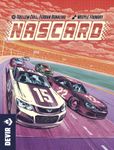
Nascard aims to capture the excitement and feel of big racing games, but condenses that experience into a deck of just 110 cards.
The challenge, however, was precisely that: how could we represent a race—complete with overtaking, risk, car management, tires, and fuel—without a board, without miniatures, and using only cards? And, above all, how could we ensure that this wasn’t just a simple abstraction, but truly conveyed the feeling of driving on the edge, deciding when to push and when to preserve the car?
The answer came from combining a trick-taking system with a car race. A combination that allowed us to concentrate the decisions of each round on how to drive, how much to risk, and which resources to sacrifice to try and gain positions.
However, reaching the current system required a lot of testing, changes, and ideas that would eventually disappear. This is the story of how we went from a trackless race with seven asymmetrical suits to the final version of Nascard.
STARTING POINT
At SPIEL Essen 2023, we (Ferran Renalias and Guillem Coll) were presenting our first joint game, Trekking, published by TCG Factory. That year, Ferran was in the spotlight, as his game Lacrimosa, published by Devir, was one of the sensations of the fair. Devir was also presenting their new ‘Pocket’ games, a line of small-box, economical games that particularly caught our attention.
I knew Ferran was passionate about Flamme Rouge—he always brings it to meetups along with all its expansions—and that year I was playing a lot of Heat. So I started mulling over an idea: could we bring the feelings we loved from those games into a Pocket box?
Once I had a first idea, I proposed it to Ferran, and we started working on it together.
FOUR PREMISES
Before starting to build prototypes, we defined four ideas that we wanted to serve as the foundation for Nascard. Each one addressed one of the challenges the project presented:
– How to represent a race without a board
– How to differentiate it mechanically
– How to convey the theme
– How to create interaction between the drivers
1. No Track → The Space Problem
In racing games, the main component is usually the track. Since we couldn’t fit a board inside the box, the first challenge was how to represent movement and the distance between cars without a physical track.
The initial idea was to dispense with it entirely and represent only the relative distance between the drivers. If a car had a better turn than the one behind it, it would place a space card between them; if it was better than the one ahead, it would remove one and, if there weren’t any left, it would overtake it.
With this minimalist system, we thought we could accurately represent the back-and-forth of a race. Later on, we would discover that it created more problems than it solved.
/pic9763338.png)
2. Trick-taking → The Main Mechanics Problem
The second challenge was finding a mechanic that would set Nascard apart from traditional racing games. Ferran proposed an initial premise: making the race work through a trick-taking system.
We didn’t know of any game that combined these two concepts, and it seemed like an interesting way to turn every round into a battle between the drivers. But we were clear about one thing: the trick-taking couldn’t be an abstract mechanic— it had to be the engine of the race.
3. Suit Abilities → The Thematization Problem
This brought us to the third challenge: how to prevent the trick-taking from being just an abstract card system with a racing theme slapped on top?
To achieve this, each suit needed to have an ability tied to car management: tires, fuel, overtaking, and so on. Suits wouldn’t just be a way to determine who wins each trick— playing a card would also mean deciding how to drive.
4. Turn Order → The Interaction Problem
Finally, we wanted the order of play to convey race feelings as well. Instead of a start player and clockwise order, turn order would be determined by the position of the cars: the driver in first place plays first, followed by second place, and so on. Beyond making thematic sense, this introduces a minor catch-up mechanism: cars behind can see what the ones ahead have done before making their decision. Just like in a real race, the lead car chooses its line first, and the others can react to it.
These four premises defined what we wanted to achieve. Now all that was left was to find a system that made it all work.
EVOLUTION OF THE TRICK-TAKING SYSTEM
The main challenge was creating a trick-taking system that was interesting enough on its own, yet at the same time fit the feelings of a race. We didn’t want to simply use tricks to determine who moved forward the most; we wanted every decision in the game to convey the feeling of deciding when to push and when to preserve the car.
The First Version
At the beginning, we proposed a system of seven suits with values from 1 to 9, featuring a specific ability per suit and a varying number of cards (from three to nine cards).
The card of the suit that set the round acted as trump and received a +3 to its value. Thus, a trump 5 became an 8 and could beat a 7 of another suit, while a trump 1 would still lose against a 7.
The idea had a lot of potential, but we quickly realized there were too many different abilities and that the system was hard to control and balance. We decided to simplify it and moved to five suits with 10 cards each.
The Stage System
At this point, we introduced a stage system to add more variety to the rounds. Each round, a stage card was revealed, determining rewards based on your final position in the trick: you would move forward more or fewer spaces and could recover or expend fuel on a track.
/pic9764637.jpg)
However, despite all these variants, we still hadn’t quite found the kind of decision we were looking for. We wanted players to ask themselves: ‘Do I go all out this round, or do I save the car and drive less aggressively?
/pic9764670.jpg)
Early stages of the trick-taking
The Key: Trump or Ability
And that question led us to what would become the key to the final system. If you play trump, you drive aggressively and move forward more; if you play another suit, you move forward less, but you can take advantage of its ability. From there, we also simplified the stage system. Each round, the winner of the trick moves forward 6 spaces, the second place moves 5, the third 4, and so on down to sixth place, who only moves 1.
This simplification made the decision much clearer: do you want to compete to win the trick and move forward more, or do you prefer playing another suit to take advantage of its ability? And above all, this decision was directly tied to how we wanted the driving to feel.
The Four Suits
With the system more defined, we had to balance the abilities of the four suits so that all of them were equally powerful, incorporating a thematic leitmotif into each one:
Yellow – Power: allows you to move extra spaces.
Orange – Fuel: allows you to draw cards from the deck.
Grey – Tires: allows you to recover worn-out cards in front of you.
Blue – Leadership: allows the card to always act as a trump.
/pic9764763.png)
Four ability variants – orange suit (prototype version)
And built upon this scheme, we also created four ability variants for each suit—preserving their character and core function, but varying their power and requirements from one game to the next.
That way, the trick-taking stopped being merely the system that determined who moved forward the most and became the engine behind driving decisions: pushing hard, saving resources, taking risks to win the trick, or letting it go to leverage an ability instead.
EVOLUTION OF CAR WEAR
We were clear that, to convey the feelings we were looking for, Nascard couldn’t just be a trick-taking game where whoever places best in the trick moves forward the most. We needed the car to experience some wear, and for driving decisions to have real consequences.
The first approach was a very simple fuel management system, with a small track that forced players to find a balance between spending and recovering fuel. But we quickly noticed a problem: it isn’t very thematic to recover fuel simply by driving. If we wanted to keep that system, we would need to introduce pit stops.
And that’s where an idea popped up that fascinated us: instead of managing fuel, we could manage car wear by introducing a tire card directly into our own hand.
The system was based on two very simple rules: you couldn’t change the order of the cards in your hand, and you could only play cards that were to the right of the tire card.
At the start of the game, the tire card was placed all the way to the left, so you had all cards available. When you played certain cards—especially when following trump and pushing the car to move forward more—you had to wear down your tires and slide the tire card to the right. Any cards left to its left were no longer available. The more you pushed the car, the fewer options you had left to keep driving. And when you needed to recover, you could make a pit stop: draw new cards and slide the tire card all the way back to the left.
/pic9764775.png)
We loved the idea because the wear wasn’t an abstract tracker: it was physically right there in your hand, directly affecting which cards you could play. However, during playtests we discovered it had a major flaw.
It restricted players’ options too much. They often ended up with very few available cards, which created a frustrating experience. On top of that, since you had to handle the cards to move the cars and manage other actions, maintaining their strict order without messing it up was an added headache.
That’s why we decided to simplify the system and remove the tire card. Now, all cards in your hand are always available, but when an action requires you to wear down your tires, you choose and place the affected cards in front of you. These cards remain temporarily out of play, and you can recover them when you make a pit stop or when you use a grey suit ability.
/pic9764777.png)
And we were still missing one element to represent: fuel. Instead of turning it into another track, we decided to allow certain actions to burn fuel by permanently discarding a card from your hand. That card can no longer be recovered for the rest of the race.
This way, we ended up with two distinct forms of wear: tires limit you temporarily, while fuel permanently reduces your options. And both are a direct consequence of the decisions you make during the race.
EVOLUTION OF THE TRACK
As mentioned earlier, our starting point was to create a racing game that relied on the relative position of the cars rather than moving them around a physical track board. In early versions, we used a system of adding or removing space cards between cars, but we quickly realized it created too many edge cases and exception rules. On top of that, constantly adding and removing cards felt clunky and tedious.
We then tested several alternatives. In one of them, the cars moved down a straight track with multiple lanes, using trick-taking cards to switch lanes and hunt for open spaces. It was more tangible, but at the end of each round we had to reposition the cars to maintain the gaps between them, making the system impractical.
/pic9764784.jpg)
In the end, we accepted that maybe we didn’t need to reinvent the track and decided to build it simply with cards. Each track card allows space for two cars—one in the inside lane and one in the outside lane. But what happens when a third car tries to occupy the exact same space? Well… NASCAR!
NASCAR racing has a key feature that fit our system perfectly: contact and bumps between cars. That’s how collisions were introduced, eventually becoming just another part of the race.
In the end, the simplest solution turned out to be the best one: a track built with cards that allowed us to represent the race in a tangible way, without sacrificing the pocket-sized spirit of the project.
/pic9764794.png)
SOLO PLAY AND LOW PLAYER COUNTS
From the start, we wanted Nascard to work well at different player counts, but there was an obvious issue: with only two or three cars on the track, part of the tension and interaction we were looking for got lost. The solution was to create an automa that could add extra cars to the race. This way, it not only allows for solo play, but you can also use it in two or three-player games to fill out the grid and make the race more competitive.
However, we wanted to avoid creating a complex automa that required a lot of its own rules. The automa needed to behave almost identical to any other car in the race, use the same system as the players, and most importantly, enrich the decisions you have to make while playing the game.
The solution (after numerous iterations) was as simple as placing a card in front of each automa at the start of every turn. By doing this, you can see the suit played on the card back, but not its value. Five seconds of maintenance, bringing extra tension to the game. A natural extension of the core racing system that also lets you adjust the intensity in lower player counts.
WORKING WITH DEVIR
A few months after that SPIEL Essen game fair, we pitched the game to Devir. Fortunately, the proposal fit their Pocket line and we began a new development phase—this time working alongside Diego San Martín.
Reaching this stage didn’t mean the game was finished, though. One of the most interesting parts of the process was seeing how the game continued to evolve with a fresh pair of eyes. We worked to polish the ability cards as well as the turn order, ensuring everything ran as cleanly as possible.
The illustration and graphic design were handled by Meeple Foundry, who, as with all their projects, did an incredible job, giving the game a spectacular look.
/pic9815112.png)
/pic9815111.png)
/pic9815113.jpg)
/pic9815114.jpg)
And that brings us to the end of the journey: from an initial idea of making a trackless race to a complete racing game packed into a 100-card deck.
This SPIEL, we’ll be presenting Nascard, and we hope to have achieved what we set out to do back in 2023: capture the thrill and feel of big racing games, all inside a… Pocket box.
We hope you enjoyed this designer diary, and above all, that those of you who try the game enjoy playing it as much as we enjoyed creating it.
Ferran i Guillem
Tell us how can we improve this post?