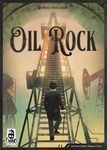

by BGG Cranio
/pic9581054.jpg)
Diary written by Marco Piola Caselli
If I had to describe in a few words the process that turned Oil Rock into the game it is today, I’d say it’s a story of oil, ambition, and collaboration. It’s the result of a long journey full of twists and turns;from the initial chaotic sketch through months of conceptual development to the awarding ceremony of the Premio Archimede ceremony and genuine teamwork with Studiogiochi, Simone Luciani of Cranio Creations, Andrea Chiarvesio, and their playtesting groups.
What follows is an honest account of that journey, detailing what I designed, how collaboration shaped it, and how every contribution improved the game. I am extremely proud of the result and grateful to everyone who worked with me to achieve it.
The Spark: Edwin Drake and the Black Gold Rush
Titusville, Pennsylvania, 1859. Edwin Drake, a railroad worker with no technical training, drills the first oil well in American history. This sets in motion a revolutionary transformation of the global economy.
I discovered his story while searching for an authentic and dramatically intense setting for a new game. Mid-19th-century Pennsylvania: a land of ambition, vision, and unbridled competition where market rules did not yet exist, seemed to me the ideal location for a true black gold, rush fueled by the risks and aspirations of entrepreneurs and pioneers alike.
This is where the idea for Oil Rock originated.
/pic9808576.jpg)
My Creative Process
As a designer, I take a “primarily mental” approach. Much of the design process takes place inside my head rather than on paper or a screen. This is precisely how Oil Rock came to be.
My process consists of three phases. First come notes as prompts (~20%), which are scattered and chaotic jottings that trigger my thoughts rather than documenting them. Next is pure mental development (~50%), the heart of the work, in which the game shapes up in my mind until it takes precise form, even before prototyping. Finally, there’s digital prototyping (~30%), which is more like transcription than exploration for me. That is how a game moves from my mind to the screen, where the final touches and corrections emerge.
Oil Rock fully reflects this process. From the initial idea to the first digital version, it took about three months: not because of haste, but because it is the result of a process that takes place quietly yet continuously, even before the first pixel appears on the screen.
/pic9808592.jpg)
Starting from Actions: Building the Game from the Ground Up
In thematic games, I believe the result should be a system in which every action is consistent with the theme and mechanically connected to one another. In Oil Rock, for example, there are no “neutral” actions; every choice ripples through the entire structure of the game. When designing Oil Rock, I therefore began by defining which actions made thematic sense and linking them organically to one another.
This led to actions such as drilling wells, extracting oil, building and upgrading refineries, moving across the territory via the railroad network, building offices, and exploiting patents.
/pic9808618.jpg)
/pic9808624.jpg)
The Heart of the Game: Reputation and Characters
The mechanic I’m most proud of ties the Reputation track to the Characters’ evolution. I believe it best captures the spirit of the era that the game aims to represent.
The Reputation track has seven colored sections. A player’s position on the track determines turn order (the player with the highest reputation plays last) enhances their Character (gradually strengthening its special ability), and contributes to earning Victory Points, with bonuses for reaching the most advanced spaces.
This threefold function creates constant tension, as every step forward is both an advantage and a risk. Similarly, during the 19th-century oil rush, a person’s reputation was as valuable as an oil well: being too visible could make you a target.
/pic9808634.jpg)
Characters amplify this dynamic. Each one provides a starting-round income and has a special ability that grows as the player advances along the Reputation track. This ability is limited at the start but becomes a formidable weapon in the final stages.
Once a character reaches the final section of the track, it stops providing income and instead offers a better conversion of remaining resources at the end of the game. This shifts the strategic focus in the closing stages.
/pic9808637.jpg)
Extra Focus: The Six Historical Characters
One of the greatest joys of designing Oil Rock was conducting historical research on its Characters. I sought out real-life figures who played a decisive role in the first oil rush, not just the most famous names, but also lesser-known figures whose stories struck a chord with me during my research.
I had two selection criteria: the characters’ stories had to be interesting and authentic, and their historical roles had to translate into game mechanics that were consistent with their real-life identities. I didn’t want decorative characters; I wanted each card to tell a true story through a genuine mechanic.
In addition, I conducted historical research to select each character. I also wanted to seek out lesser-known figures whose stories had resonated with me during my research. I didn’t want decorative characters; I wanted each card to tell a true story through authentic mechanics.
Characters playable in the game are:
Edwin Drake
“Colonel Drake” is the central figure in this story. On August 27, 1859, he successfully drilled an oil well for the first time in Titusville, Pennsylvania, using a technique inspired by water well drilling methods. Although he never patented his method and died in poverty, his innovation changed the course of global energy history. In the game, Drake is the drilling expert. His special ability allows him to purchase drills at lower prices, eventually earning him additional Victory Points without having to pay for equipment in the later stages.
George Bissell
Bissell, considered the father of the modern oil industry, was the first to realize that oil could be extracted from the ground and refined on a large scale to produce kerosene. He financed Drake’s drilling in Titusville in 1859. In the game, Bissell’s entrepreneurial vision translates into the ability to build offices in any city. These offices offer increasing discounts that, in later stages, make construction completely free and profitable.
Ignacy Łukasiewicz
Łukasiewicz is the most unusual character in the game, in my opinion, and one of the most fascinating. A Polish pharmacist and chemist, he invented the first modern kerosene lamp in 1853 and founded the world’s first oil mine in Bóbrka the following year. He introduced kerosene street lighting and built the first refinery in 1856. In the game, he is the only character with a unique mechanic: the Energy reminder. This allows him to convert oil into energy and upgrade refineries in a way that is unavailable to other players.
Cornelius Vanderbilt
The great transportation magnate first built his empire with steamboats, then with railroads. This made it possible to transport Pennsylvania oil on a large scale to major industrial centers. In the game, Vanderbilt is the locomotive master. His special ability allows him to make free “jumps” of any distance, earning increasing bonuses from the destination city. These bonuses range from reduced coal costs to additional Victory Points in the later stages.
John D. Rockfeller
The founder of the Standard Oil Company controlled up to 90% of oil refining and distribution in the United States. In the game, his power centers on refineries. Before the refining phase, he can purchase new refineries and receive an increasing quantity of additional barrels of oil in return: a significant advantage that grows even more substantial in the final stages.
Andrew Carnegie
Carnegie, a Scottish-born entrepreneur who became a naturalized American citizen, is known for founding the Carnegie Steel Company. His company revolutionized steel production, paving the way for the expansion of America’s railroad and oil infrastructure. He donated nearly 90% of his fortune to educational and cultural causes. In the game, his power is tied to turbines. After the extraction phase, he can purchase turbines in exchange for colored barrels of oil, a combination whose value increases as his reputation grows.
The Evolution of the Action Selection System
Of all the elements, the system for selecting and resolving actions has evolved the most during development. In the original version, the board was already diamond-shaped, but the system was different. Players pre-positioned their pieces in stacks within the four sections. Then, actions were resolved based on their reputation. This system was tactically interesting because everyone could see each other’s “bets”, but the order depended only on reputation, creating tension between positioning and execution.
/pic9808661.jpg)
When Studiogiochi analyzed the prototype, it became clear that the system was not compatible with the diamond-shaped board, resulting in excessive complexity. They therefore proposed a simpler circular wheel that would maintain rotation from one round to the next while making it easier to choose actions.
The Evolution of Wells, Refineries and Turbines
Thanks to the collaboration with Studiogiochi and Cranio Creations, other key elements underwent profound transformations during development.
– Oil wells: Originally, they were buildings that could be constructed progressively. Plus, the drills beneath them provided additional bonuses during extraction. This system was thematically faithful to historical reality but proved too complex without adding meaningful decisions. Thus, they became pre-printed zones, and the role of the drills was clarified: each active drill produces one barrel of the well’s color. This may seem like a loss, but it is actually a gain because every remaining decision carries more weight.
-Refineries: Originally, they were meant to be drawn from a shared board, a common display. However, this did not create meaningful interactions, only an extra step. Now, each player manages their own refineries, placing them in ascending order on a dedicated board. This made the game more compact and easier to follow.
-Turbines: They did not exist in the original version. Instead, there were warehouses with a different function. While working with Simone Luciani of Cranio Creations, these were reimagined as turbines: power-ups that amplify the bonuses of the neighboring refineries, adding an additional layer of strategy for players to consider.
/pic9808683.jpg)
The Map: From Fixed Roads to Hexagonal Tiles
The other significant evolution in the game’s structure concerns the map on which locomotives move, offices are built, and bonuses are earned. Originally, the territory was a pre-printed network with fixed connections between cities. This design was visually clear but lacked variety, as distances, routes, and costs remained identical in every game.
Thanks to Studiogiochi, however, the map has evolved into a system of twelve modular hexagonal tiles in three colors, each indicating a different level of cost and revenue. These tiles are arranged randomly in each game according to a pre-printed pattern, thus creating a different geography each time: movement strategies, office placement, and supply routes change accordingly from session to session.
To further refine the system, we have also introduced Railway Bonus Tokens, which provide permanent bonuses to players passing through each tile. These bonuses are always available and make every city significant. The territory is never neutral.
/pic9652482.jpg)
Premio Archimede and the Meeting with Simone Luciani
Oil Rock was presented at the Premio Archimede awarding ceremony, Italy’s most important competition for unpublished board games.
The event was attended by leading figures in the industry. The game remained on the podium throughout the finals, confirming the effectiveness of its design.
However, the award held much greater significance: among the judges was Simone Luciani, one of Italy’s most internationally acclaimed designers of board games, including Tzolk’in, Barrage, Grand Austria Hotel, and Lorenzo il Magnifico. Recognizing the game’s potential, he brought it to Cranio Creations for publication, and from there, my prototype began its journey toward an international release.
/pic9652479.jpg)
Teamwork: from development to publishing
Oil Rock, in its final form, is the result of genuine teamwork, with top-level professionals contributing to successive, complementary stages of the project.
– Studiogiochi: The first stage of development was carried out in collaboration with one of the most established game design studios in Italy. They resolved the issue of the diamond-shaped board by proposing a circular wheel, guided the simplification of the oil wells and transfer of the refineries to individual player boards, and refined the individual actions and bonuses together, giving each the right strategic weight.
– Simone Luciani & Cranio Creations: Luciani worked on several aspects simultaneously, including the actions on the wheel, the distribution of bonuses over time and the duration of the game, which was set at four rounds to ensure tension without slowing the pace. He also devised the turbines and Milestone tiles, variable round objectives that add variability and shared tension. They are simple in appearance, but require precise calibration.
Andrea Chiarvesio and the playtesters then took over. In the final phase, they systematically balanced the game by testing and measuring every path to victory (reputation, refineries, drills, consultants and territory) while relying on the mathematical balancing calculations that I had developed from the outset of the design process.
Oil Rock: The Game in its Final Form
As of now, Oil Rock 1864 is a board game for 2–4 players ages 14 and up. It takes 50–80 minutes to play. It is a heavy Euro game, featuring long-term management and planning, interconnected mechanics, and significant decisions every turn. Players assume the roles of ambitious pioneers during Pennsylvania’s first oil rush and lead one of six historical figures from that era. The goal is to build the most powerful oil empire by balancing extraction, refining, territorial expansion, and reputation management.
A game consists of four rounds, each of which is divided into nine sequential phases. These phases include spinning the action wheel, earning the Character income, extracting oil, refining, gaining Milestone bonuses, and determining the new turn order. Each round is a complete cycle of planning, execution, and consequences.
Oil Rock offers multiple paths to victory. Players can earn points from offices built in cities, the depth of active drills in each well, refineries on Side B with adjacent turbines, their final position on the Reputation track, and black Improvements if certain conditions are met. In the later stages, players can earn points from their Character. This variety ensures that every game can be won with different strategies and that no single tactic dominates.
Tell us how can we improve this post?