
/pic9464361.jpg)
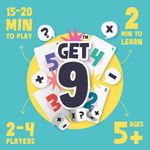
GET 9 is the first game I designed and published, and I am excited to share that story and provide a peek behind the scenes with you. Let’s start at the beginning.
[heading]Falling in Love with the Number 9[/heading]
I was introduced to a theory about the number nine—specifically that if you worked with numbers long enough, the result will either end in nine or add up to nine. The concept really intrigued me, and I started experimenting by playing with cards and dice to see if I could get to number nine based on that theory. Once I confirmed that I could do this consistently, I realized a fast, challenging numbers game could be fun to play and become a reality.
[heading]Simple Rules, Infinite Paths to Nine[/heading]
GET 9’s gameplay is a straightforward process of combining cards and dice to create calculations that end in nine, using the mathematical functions of addition, subtraction, multiplication, division, and even cross sums. The game ends when either one player no longer has cards, or the deck is empty. The player with the most cards in their calculation pile wins.
[heading]Prototype: Raw but Functional[/heading]
The first prototype components I developed to test the game mechanics were raw and unrefined. For the original concept test, I used Skip-Bo cards and a pair of dice from another game, adding stickers with plus, minus, multiplication, and division symbols. With these simple materials, I began experimenting and exploring whether GET 9 (I didn’t have a name yet) could work in play with others—not just me. Playing with others was basically going to tell all.
/pic9463957.jpg)
/pic9463919.jpg)
[heading]Early Voices that Shaped the Game[/heading]
During one of the first playtests with my sister Annette, she suggested that players place their cards face up rather than hold them in their hands. That single change transformed the game and the play experience– suddenly, everyone could see available options, stay engaged, and feel connected to the game at all times. From an educator standpoint, I love that!
/pic9463921.jpg)
Due to this one change, I added the opportunity to steal. If one player couldn’t produce a combination using their dice and cards and passed, and others saw a possibility, another player could steal by placing their hand over the dice. If correct, the stealer could use the other player’s dice and cards, to create combinations, and steal their cards.
Also, a subsequent test with her grandchildren, Loki and Thor resulted in Loki’s recommendation to add zeros. Out of the mouth of babes…of course we needed zeros!
/pic9463922.jpg)
My son Dylan arranged some playtests with his friends, Amy and Carly, teachers of 2nd, 3rd and 4th grade students who made many suggestions including that the card number options should be increased to thirteen to allow for more play calculations. However, instead of adding additional cards, my graphic design partner Murat, and I thought that allowing players to combine cards to create new numbers would be a workable solution instead of adding cards to the exiting deck. Again, I loved the kids and teachers’ suggestion, because joining cards to create new numbers really allows for infinite combinations to get to nine.
/pic9463923.jpg)
[heading]One Game: Many Learners [/heading]
Play testing with my son, Evan, we discussed that GET 9 could be beneficial for younger children like my granddaughter Alessa, but that multiplication and division functions are really too much for five-, six-and seven-year-olds. I wanted to develop a game version for younger players that could then transition them into GET 9. After several ideas, that really were no good at all, it turned out the simplest solution was just adding a set of dice for younger players. This is why GET 9 comes with four dice. Two dice for younger players focusing on plus and minus, and two dice using all four mathematical operations: plus, minus, multiplication, and division for everyone else.
Additionally, to add more of an element of chance and play, I added two options to all dice: a blank spot which means that that particular dice can’t be used to make a calculation during that turn, and a ? indicating a wild dice, allowing players to use any of the mathematical functions to create a calculation during that play.
/pic9463924.jpg)
[heading]Lessons Learned: Symbols Matter[/heading]
The one element that consistently confused players during playtesting was the symbol marking on the dice. I initially used an asterisk (*) to indicate multiplication—as used in Excel–instead of the traditional (x) symbol, hoping to avoid confusion with the plus symbol (+). Of course, the early symbols were hand-drawn and difficult to recognize after some playtesting wear and tear, so I replaced them with a printed version. Even then, the results remained the same and the confusion persisted. In the end, I switched to the standard multiplication symbol X. I was hoping that this change would reduce the confusion since, x on the dice is diagonal, and + is vertical. It did.
/pic9463925.jpg)
/pic9463926.jpg)
/pic9463927.jpg)
/pic9463928.png)
[heading]Collaboration: My Ace in the Hole[/heading]
I had a lot of fun coming up with the idea for the game and playing testing the GET 9 prototype with as many people as I could talk into it: young and old alike. But GET 9 would not have happened without my neighbor—now my good friend—Murat Kocyigit.Life has a funny way of placing exactly the right people in your path when you need them most. As I began tinkering with the idea of GET 9, a wonderful couple, Murat and Hande moved into our neighborhood, and we became friends almost immediately. Who would have guessed that just as I was developing a game idea, my new neighbors happened to be in the graphic design business Lapastudios.com? Their journey to becoming my neighbors—from Germany and Turkey, by way of Los Angeles, and ultimately settling in a house two doors down from where I lived was— Kismet!
Murat and I became an effective team. Together we came up with many ideas, and there were several card layout iterations. Everyone liked the visible numbers on the front of the cards, immediately; however, the back of the cards took a while. Every time we came up with a design, I would ask everyone—literally. I held a garage sale—I asked people to share their thoughts. I went to the grocery store and waited in the check-out line—I asked people. You get the drift.
/pic9463929.png)
/pic9463930.png)
/pic9463931.jpg)
/pic9463932.jpg)
Many of my family and friends received countless texts with possible images, options, and surveys asking which version they liked the most, and I couldn’t have done without all of their feedback and support. Incorporating their feedback, we played around with back of the card designs, dice images, and of course the overall box design. In the end, I hand drew an image, and Murat brought it to life.
/pic9463933.jpg)
/pic9463934.png)
/pic9463935.jpg)
[heading]From Wordy Rules to Visual Storytelling[/heading]
All of this creativity was fun! I think the biggest challenge I encountered was the rules. When I first began writing the rules, it felt so wordy, which it was. As an educator, I knew, too many words just get people to zone out. So, what started as a text heavy explanation to clearly communicate the gameplay and mechanics gradually evolved with a visual approach—first sprinkling in small graphic elements and eventually committing to transforming the instructions that relied on visuals to tell the story as well.
/pic9464002.png)
/pic9464004.png)
/pic9463938.png)
[heading] Goosebump Moments[/heading]
Apart from the fine-tuning suggestions, I noticed that the mechanics clicked immediately, and players of all ages got the game within minutes. What surprised me most was although this game is really designed to be competitive, when the game was played with children of different age groups, the older kids really encouraged and supported the younger ones (this was also true for adults). I got goosebumps when they cheered each other on. Again, as an educator, I love this!
/pic9463939.jpg)
/pic9463940.jpg)
[heading]Player Sweet Spots[/heading]
GET 9 is meant to be easy to access, and cross-generational as well as cross-cultural—open the box, deal the cards, select dice level options, and start playing right away at a variety of skill levels. When I began thinking about a specific target audience, I discovered that every playtesting group highlighted different benefits, depending on their age and experience.
The educators, teachers, and home-school parents I worked with quickly honed in on the game’s educational benefits: number sense, pattern recognition, mental math, confidence building, and social interaction. They really appreciated that GET 9 offers play and the kind of practice and that doesn’t feel like practicing–exactly what so many anxious learners need. Through this feedback, it became clear that there is a sweet spot for students in third and fourth grade. This finding was reinforced when GET 9 received the Parents’ Pick Award 2025 for alignment with math standards and educational value.
/pic9464187.png)
On the other hand, my more seasoned friends and play testers commented on the cognitive benefits of keeping their mind fresh and challenged. Additionally, they really liked the social component—connecting with others is fun, and now a research-supported way to nurturing longevity (Check out research on the Blue Zone). They also tended to take the game to its full potential based on their skill levels. Beneath the simplicity of GET 9’s game play is something powerful: the game will grow with you as your skill level develops. Check out some of their calculations that GET 9—in particular, when they zeroed in on the cross-sum option.
/pic9463941.jpg)
/pic9463942.jpg)
/pic9463943.jpg)
/pic9463944.jpg)
/pic9463945.jpg)
/pic9463946.jpg)
[heading]Bonus Applications[/heading]
As an educator, I also spent time teaching English, as well as English as a Second Language (ESL). Like I mentioned before, I used a lot of games in the learning process, and I know that games really work in supporting and building basic interpersonal language skills— in particular, the words and sentences we tend to use every day. That is what helps build fluency in a new language. Therefore, I am committed to translating GET 9 instructions into various languages, so they can be used for other language acquisition opportunities—be it in formal or informal settings. Since numbers are cross-cultural, it is just as easy to play GET 9 in German, or Spanish, or Vietnamese. My hope is that having language-specific instruction options available will support learning for both ESL students, as well as learners of a language other than English. I only have a few right now, but the goal is to grow this list. You can download these on www.gamekraft.us.
/pic9463947.png)
/pic9463948.png)
/pic9463949.png)
[heading]What’s Next[/heading]
My road to game designer really was an accident in what feels like the full circle of my life’s journey. As an educator, my passion has always been learning and teaching so that knowledge can make a difference in learners’ lives. As such, I have often used games in the learning process, because I intuitively knew that learning sticks, and is more enjoyable when it is fun and authentic—of course, now there is a lot of research supporting just that.
Although it was not my intent to create a math game, my time as an educator and personal finance coach made me realize that GET 9 could help reduce anxiety and build number sense by making math feel approachable, playful, and non-threatening early on. It is a game that builds confidence through repetition and success. My hope is that it will help individuals break through their mental blocks around numbers and math beginning at an early age, and that this confidence with numbers will continue to stick with them into adulthood, where numbers surround us daily. GET 9 is a way of making math, engaging, fun, and enjoyable for all ages.
I hope you enjoyed the behind the scenes in the making of GET 9, and if it sparked your curiosity, I Invite you to take the next step: play a few rounds, then post your comments in BGG, or connect with me at www.gamekraft.us for downloads/resources and email info@gamekraft.us to share feedback, questions, or your best “path to nine.”
GET 9 has only been around a very short time, and my goal now is to connect with as many interested players, retailers, and distributors as possible. Let’s Play!
Jacquie
Tell us how can we improve this post?