
by Walter Obert
/pic8732904.png)
A few years ago, the call for entries to the first FIW Award, the prize promoted by the Italian Wargame Federation for the best unpublished wargame, gave me the opportunity to bring together in a single project four, long-standing passions of mine:
– The first was the chance to rescue and reuse a double-sided counter mechanism that had been sitting unused for over 15 years.
– The second was the will to condense the extremely complex relationships between the Allied powers during the final phase of World War II into a system accessible to players.
– The third, the opportunity to explore the potential impact of the German secret weapons programs, suspended somewhere between historical reality and speculative imagination – halfway between “Raiders of the Lost Ark” and “Secret Weapons of the Luftwaffe”.
– And finally, I wanted to design a game with strong player interaction that would feel like a wargame, while still being approachable to all level players. At its core, WunderWaffen is built around these four clear design pillars, with a few more rules than I generally allow myself to use.
From the very beginning, I knew that the thematic heart of WunderWaffen would be the idea of “what if?” What if those experimental weapons had influenced the outcome of the war? This kind of counterfactual speculation is one of the core motivations that drives many wargamers, and I wanted to make it an explicit part of the experience.
Interestingly, the game’s core engine already existed. More than 15 years earlier, I had developed a cooperative design inspired by the movie Armageddon, based on double-sided counters showing a positive effect on one side and a negative effect on the other. Each turn, players had to resolve one positive and one negative effect. When I revisited that system, it immediately proved itself the perfect fit for a game centered on the race to Berlin, where players are forced to cooperate – but only up to a point – while simultaneously trying to slow down the German Research Track.
This became the foundation of WunderWaffen. Each player selects three counters from a pool of eighteen, which in the first part of the game are played over six rounds. On the reverse side of every counter there is an action that benefits one of the other players. Each turn, a player must resolve two counters for themselves and must give one counter, flipped, to another player. This single rule generates a surprising amount of strategic depth.
First, it eliminates self-sufficiency. No player can plan in isolation, because every turn includes a deliberate act of interference. Second, it forces players to evaluate not only what action to take, but who should be forced to deal with its consequences. The system immediately becomes political; the players start to negotiate.
The game is played with four Factions: United States, United Kingdom, Soviet Union, and Germany. Although the Allied players compete against one another for Victory Points, they are still collectively opposed to the German player. At the same time, even the German counters include reverse-side actions that benefit the Allies.
The result is an asymmetric, team-based, semi-cooperative system, something I had rarely seen on the market at the time. What makes it particularly interesting is that every player is forced, every turn, to grant an action to someone else, and in the case of the Allies that action may even go to Germany.
/pic9392349.jpg)
One side of the game counters
In practice, each turn offers three possible counter configurations, depending on which counter is flipped to its reverse side. This simple structure generates surprisingly rich dynamics involving planning, negotiation, and the evaluation of side effects.
/pic9392350.jpg)
Opposite side of the game counters
At the end of a turn, players refill their personal supply, keeping their available counters visible to everyone. This transparency allows opponents to anticipate what others can or cannot do, encouraging long-term planning and table awareness: elements that players tend to appreciate more with repeated plays.
The obligation to give actions to other players also introduces a layer of diplomacy and bargaining. Phrases like “I’ll give you this Counter, but don’t use it against me,” or “Advance on the Event Track, but choose this option, or I’ll hand the Counter to someone else” emerge naturally at the table. One of the most common pitfalls of semi-cooperative games is that cooperation often becomes superficial or purely opportunistic. In WunderWaffen, cooperation is structurally enforced, but never comfortable.
This system mirrors historical tensions quite effectively. If the Soviet player advances too quickly toward Berlin, the other Allies may stop supporting them, or even begin handing actions to the German player, coordinating their use in advance. Over time, the weakest Allied player tends to receive the most help, and the system self-balances organically.
/pic9392353.jpg)
The game board depicts Central Europe, divided into Territories corresponding to the Allied starting areas: the Soviet Union in the east, the United States in the south, and the United Kingdom in the west, with Berlin at the center.
Allied players must advance by conquering Territories, meeting each Territory’s requirements by placing specific troops. Each Territory provides tiles with Victory Points and bonuses, all visible from the start of the game. The German player can also occupy Territories by building Fortresses (Festungen in German), but their primary focus is advancing along the Research Track, unlocking WunderWaffen Cards. These cards allow Germany to bend the rules, gain additional Victory Points, and restrict the Allies’ actions.
/pic9392355.jpg)
Additional tracks – such as Morale, Politics, Events, and the Conference Area – represent broader strategic pressures. The Event Track, in particular, reflects real historical events specific to each Allied Faction, granting increasingly powerful effects as players progress and often involving others in their resolution.
One of my goals was to offer a holistic view of the final year of the war, using a streamlined system that keeps all players engaged, even when it is not their turn. Early playtests were promising, but two issues remained: regulating the Allies’ advance toward Berlin and creating a satisfying sense of localized conflict. The solution was to divide each Territory into three spaces, which must be fully occupied to determine control.
Counters have increasing strength values: Infantry, Armor, Aviation, Artillery, and Faction Flags, the latter acting as powerful wildcards. Stronger counters can defeat weaker ones, creating the feel of a contained micro-battle. After resolution, all counters are discarded except one belonging to the controlling player, which stays to mark control with a wooden cube on it. After six rounds, all players will have used their 18 counters, triggering the first Scoring Phase. Players then select 12 of their discarded counters to play the final four rounds.
Early in development, players preferred to graze the rich plains of Germany, collecting bonuses from the Territories. So, I increased the Victory Points in Berlin, encouraging the Allies to push toward the city, but now the game was too fast, ending too quickly! It was indispensable to regulate this situation. The final solution was to require control of at least four of the six Territories surrounding Berlin before the city could be conquered. This change not only solved the issue but added a new layer of tension and coordination, as no one wants to be the player who opens the gates of Berlin for someone else. Bingo!
Designing the WunderWaffen cards was one of the most exciting parts of the process. If a game is called “WunderWaffen”, those weapons must feel truly dangerous, forcing the Allies into close cooperation. The base game includes 24 Research cards, divided into three levels, each offering immediate effects, combos, twisted rules or end-game scoring conditions. I deliberately chose to include only weapons that were historically built or at least concrete projects, leaving more speculative ideas for a potential future expansion with a retro, science-fiction flavor.
/pic9392351.jpg)
/pic9392352.jpg)
WunderWaffen was born as an exercise in synthesis: historical theme, speculation, strong interaction, and accessibility. I wanted a game where difficult decisions did not stem from complex rules, but from unavoidable choices. A game in which every turn leaves someone dissatisfied but always involved. And I think I achieved it.
From the very beginning, the Italian publisher Oliphante, led by Gianfranco Fioretta, has been an enthusiastic supporter of the project, while Ares Games was overseeing the development and international distribution.
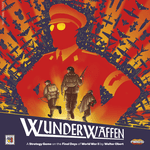
After extensive refinement and playtesting, the project was completed and ultimately won the first FIW Award, selected among 19 prototypes submitted. Following an initial folio publication in the Para Bellum magazine in 2023, WunderWaffen underwent a long development phase with Riccardo Vadalà, Roberto Di Meglio, and the Ares Games development team. To top it all off, Alan D’Amico designed the striking cover art.
Tell us how can we improve this post?