
You can’t just tell AI to ‘do SEO’ on your website and expect to rank at the top of Google. But the right tools can cut hours of repetitive work from your schedule.
Many people think AI is just for writing blog posts, but the real time-saving advantage comes from automating technical tasks like internal linking and content optimization.
At WPBeginner, we use All in One SEO every day. Its AI-powered features help us optimize content directly inside the WordPress editor. At the same time, we know that every website has different goals and needs.
So for this roundup, I tested 10+ popular AI SEO tools for WordPress to see which ones are truly worth using. In this guide, you’ll learn what each tool does best so you can choose the right one for your website. 🧰
Quick Overview: 10 Best AI SEO Tools for WordPress
To make things a little easier, I’ve put together a quick overview of the best AI SEO tools for WordPress so you can compare them:
| Product | Best For | Free Plan? | Starting Price |
| All in One SEO | All-in-one SEO inside WordPress – no extra tools needed | ✅ | $49.50/yr |
| Semrush One | Deep keyword research, backlinks, and AI visibility tracking | 🟡 (Limited free account + trial) |
$165.17/mo |
| SEOBoost | AI-powered content optimization, briefs, and SEO scoring across the full content lifecycle | 🟡 (Free trial) |
$22.50/mo |
| LowFruits | Finding low-competition keywords | 🟡 (Free trial) |
$20.75/mo |
| Link Whisper | Internal link building | ✅ | $97/yr |
| Surfer SEO | On-page optimization using live SERP data | ✅ | $99/mo |
| Frase.io | Competitor research and content briefs before you write | ❌ | $39/mo |
| Jasper AI | Scaling marketing content across formats with a consistent brand voice | ❌ | $59/mo |
| Outranking.io | AI drafts you can actually fact-check | ❌ | $19/mo |
| Rank Math | Real-time SEO scoring and keyword suggestions inside WordPress | ✅ | $7.99/mo |
Why Use AI-Powered SEO Tools?
SEO is one of the biggest factors in whether your WordPress site gets found online. But doing it manually takes time you probably don’t have.
AI SEO tools help you work smarter by automating the most time-consuming parts of the process. They can spot keyword gaps, suggest internal links, analyze competitors, and help you write better content faster.
Here’s why more WordPress users are turning to AI for SEO:
- ⏱️ Save hours on keyword research: Instead of spending your afternoon digging through search data, AI tools can suggest the best keywords for your topic in seconds. That means less time researching and more time writing.
- 📈 Target topics that are actually worth your time: AI analyzes search results and competitor pages to show you what people are looking for and where you have a real chance to rank. No more guessing which topics to write about.
- ✍️ Know exactly how to improve each post before you hit publish: AI writing tools score your content in real time and tell you what to add, cut, or change. You get clear suggestions instead of wondering why your post isn’t ranking.
- 🏗️ Automatically connect your related posts: AI-powered internal linking plugins find related content on your site and link them together for you. No more manually hunting down posts to connect.
- 🔍 Find out which old posts need a refresh: AI can scan your existing content and flag which pages are underperforming. That way you know exactly where to focus your energy instead of starting from scratch every time.
- 🤖 Generate meta titles and descriptions in seconds: Writing SEO-friendly meta tags for every post is tedious. AI can draft them for you and you just tweak as needed.
- 🗓️ Do it all inside WordPress: Most AI SEO tools plug directly into your WordPress dashboard. No need to juggle multiple tabs or learn a separate platform.
Ultimately, these tools make it incredibly easy to improve your rankings and grow your search traffic without spending hours on manual optimization.
How I Evaluated the Best AI SEO Tools for WordPress
Testing AI SEO tools isn’t just about clicking around a dashboard. I wanted to see which ones actually help you rank better, actually save you time, and provide a positive return on investment (meaning the time saved and traffic gained outweighs the tool’s cost).
I tested each tool on a working WordPress site to see how well it handled everyday SEO tasks. My goal was to find out which ones are genuinely useful and which ones just add noise.
Here’s what I focused on during testing:
- Setup and onboarding: I installed or connected each SEO tool from scratch to see how long it took to get started and whether setup required technical knowledge.
- WordPress integration: I checked whether each tool worked inside the WordPress editor or required switching to a separate tab or app.
- Keyword research and suggestions: I ran keyword searches and checked whether the tool’s suggestions were relevant, specific, and based on real search data.
- Content optimization feedback: I used each tool to analyze existing content and tracked how useful the recommendations were in practice.
- Internal linking: For tools that offered linking features, I tested how accurately they suggested relevant posts and how quickly I could apply those links.
- AI content generation: Where available, I tested the AI writing features to see how accurate, readable, and useful the output was without heavy editing.
- Pricing and value: I compared what each plan includes against its cost to see whether it makes sense for small business owners, growing blogs, or larger teams.
This process gave me a clear picture of which tools are worth using and which ones you can skip.
Why Trust My Recommendations
At WPBeginner, we have over 17 years of hands-on experience with WordPress SEO at every level – from optimizing content with SEO plugins to running in-depth audits and scaling content strategies.
Every tool in this list was tested on real WordPress sites. We don’t rely on feature pages or vendor claims. We install, use, and compare tools based on how they perform in actual content workflows that serve millions of readers.
For AI SEO tools, we looked at how they handle keyword research, content optimization for AI Overviews, competitor analysis, and more. We also made sure they’re easy to use, even if you’re new to SEO.
You can read more about our process in our editorial guidelines.
1. AIOSEO – Best for Doing SEO Without Leaving WordPress
| AIOSEO Pros | ✅ Works directly inside WordPress ✅ Provides detailed optimization reports and competitor insights ✅ Automates internal linking and content repurposing ✅ AI Writing Assistant for optimizing content ✅ AI-powered headline and meta description generation ✅ AI crawler access with robots.txt and llms.txt support✅ Optimization Wizard includes LSI keywords, synonyms, and real-world usage examples ✅ AI Content tool generates FAQs, key points, social media posts, and email copy |
| AIOSEO Cons | ❌ AI Writing Assistant requires a separate SEOBoost license |
| Pricing | Starts at $49.50/year (Free plan available) |
| Best For | WordPress users who want AI-powered SEO tools without leaving their dashboard |
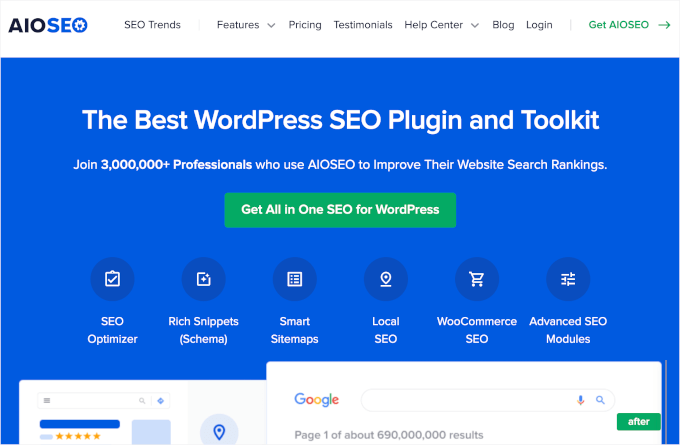
All in One SEO (AIOSEO) is a complete SEO toolkit that lets you optimize your entire site using AI without ever leaving the WordPress dashboard. It is a great fit for bloggers and business owners who want to automate their SEO without juggling multiple platforms.
At WPBeginner, we use All in One SEO every day. See our detailed AIOSEO review for more insights into this plugin.
My Experience
The AI Writing Assistant was one of the first features I tried. It suggests keywords and gives optimization tips based on what’s already ranking, so I wasn’t just guessing what to write about.

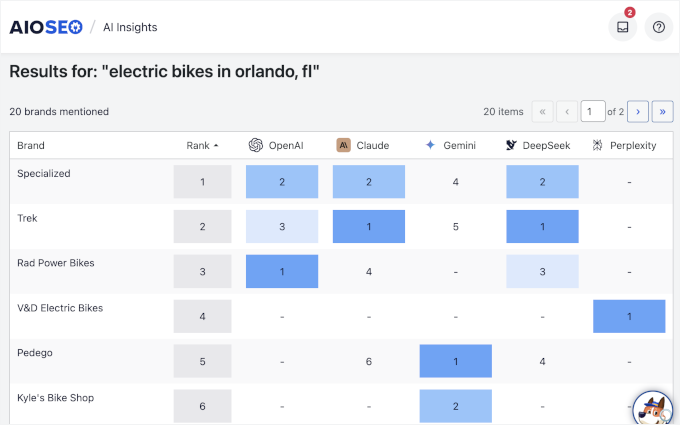
When I explored the AI Insights feature, I focused on the brand comparison table. During testing, it showed how my different brands are mentioned across AI platforms like ChatGPT, Gemini, and Perplexity, all in one place.
The color-coded layout made it easy to scan the rankings and see exactly where a brand stands. In my experience, this made it a useful starting point for understanding AI visibility.
I also tested the AI-powered headline generator, which is built right into the AIOSEO settings in the WordPress editor.
I clicked the robot icon next to the post title field and instantly got several SEO-friendly headline suggestions based on my content.
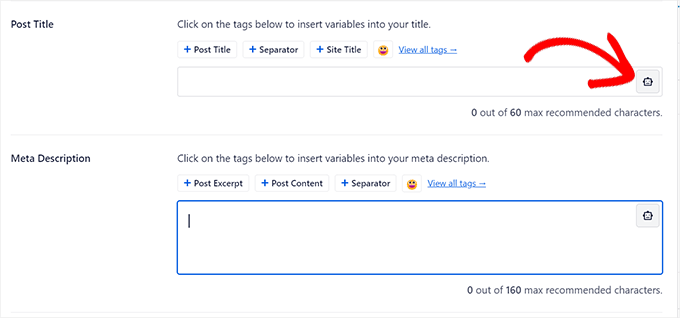
You can also use the same feature to generate meta descriptions, which helps keep everything consistent without needing a separate tool.
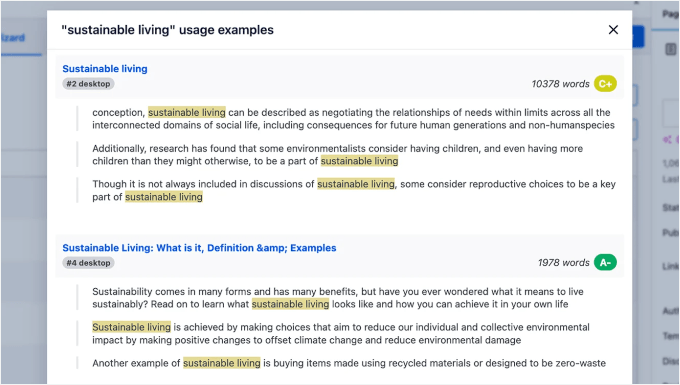
Alongside that, I spent some time using the Optimization Wizard. It shows a list of related keywords pulled from top-ranking content, along with data on how often they’re used and how important they are.
What I found especially helpful is the “See Examples” feature. It let me view real examples from top-ranking articles and see exactly how those keywords are used in context. To me, this made it much easier to write content that feels complete without forcing keywords in.
From there, I tested the AI Content tool. It can turn your blog posts into FAQs, key takeaways, social media posts, and even email copy. In my experience, this saved a lot of time on content repurposing that I’d normally do manually.
Plus, you can use AIOSEO to generate entire articles inside the content editor. For details, see our guide to the best AI blog post generators.
I also looked at the AI crawler settings, which are especially important if your goal is to get your content cited in AI-generated answers.
During testing, I checked how AIOSEO handles files like robots.txt and the newer llms.txt, which act like rulebooks for search engines and AI crawlers.
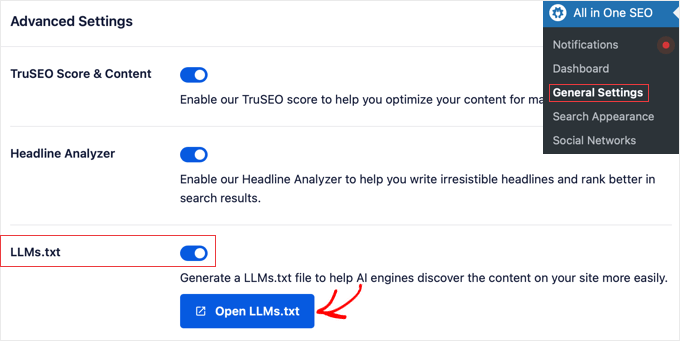
What I liked is that you can easily control access for bots like Google-Extended and GPTBot. This is a useful check because certain settings or plugins can accidentally block these crawlers.
I also used the Link Assistant during testing, which suggested relevant internal links across my posts and pages. Adding them only took a few clicks, which saved me from digging through older content.
There’s also an AI image generator included. To me, it’s a nice extra for creating simple visuals without leaving WordPress, though it’s not meant to replace a full design tool.

One limitation is that the AI Writing Assistant requires a separate SEOBoost account.
While you can connect it to AIOSEO in just a few clicks, it’s still an additional tool with its own pricing. This is something to keep in mind when comparing plans, especially if you’re looking for an all-in-one solution without extra costs.
🧑💻 Why I Recommend All in One SEO: I recommend AIOSEO because it combines core SEO tools with practical AI features like content suggestions, headline generation, and AI crawler control. This way, you can optimize everything from your WordPress dashboard
2. Semrush One – Best AI SEO Tool for Keyword Research, Backlinks, and AI Visibility Tracking

| Semrush One Pros | ✅ Powerful keyword research and backlink analysis ✅ Helps you plan SEO and content strategies using real search data ✅ Includes AI writing and content optimization tools ✅ Tracks AI visibility and brand mentions across platforms like ChatGPT, Gemini, and Perplexity ✅ Provides competitor analysis for both search rankings and AI citations ✅ ContentShake AI combines writing, keyword data, and competitor insights in one place ✅ Content quality and readability scoring for quick content evaluation ✅ Position tracking, site audits, and overall SEO performance tools |
| Semrush One Cons | ❌ Large number of features can feel overwhelming for beginners ❌ Premium pricing may be expensive for smaller websites |
| Pricing | Starts at $119.95/month |
| Best For | Content creators and SEO professionals who need deep keyword research, backlinks, and AI visibility tracking |
Semrush One brings together AI-powered writing assistance with some of the most detailed keyword and backlink data available. It’s well suited for site owners and content teams who want to build SEO strategies based on real search insights rather than guesswork.
I came into this test already familiar with Semrush as a keyword research tool. What I wanted to find out was how well its AI features held up alongside that existing data.
For details, see our complete Semrush One review.
My Experience
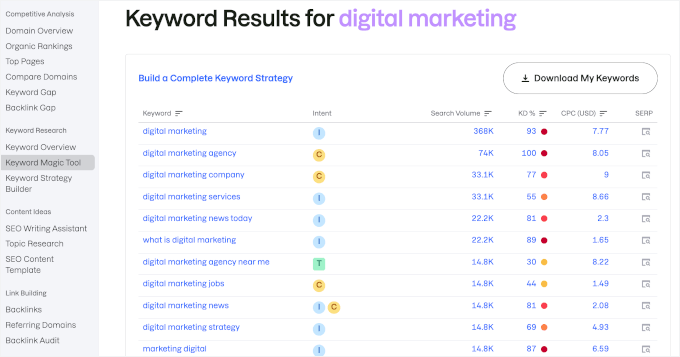
In my testing, I started with the keyword research tools. What stood out is how they pair keyword ideas with search intent. This makes it easier to focus on topics that match what people are searching for.
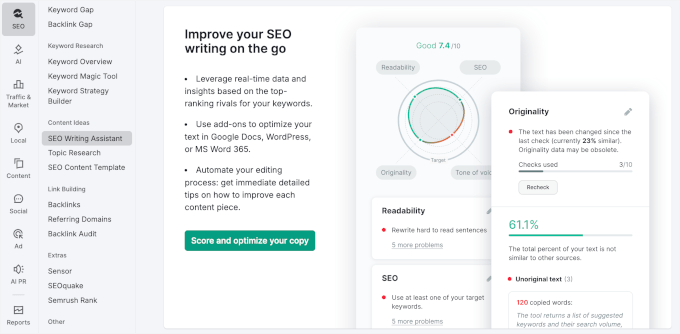
Moving on to writing, I used the SEO Writing Assistant. It suggests related terms based on your target keywords and competitor content, so the recommendations felt grounded in real search data rather than generic ideas.
The content scoring feature was also useful. Each draft gets a score out of 10 based on factors like SEO, readability, and tone, which gives me a quick way to judge whether a piece is solid or still needs improvement.
I also tried ContentShake AI, which combines keyword data and competitor insights in a single editor. This made it easier to move from planning straight into drafting without switching tools.
For brainstorming, the built-in AI features were helpful for expanding ideas quickly, especially in early drafts. That said, I still see them as a starting point rather than a replacement for manual writing.
From there, I explored the newer AI-focused tools.
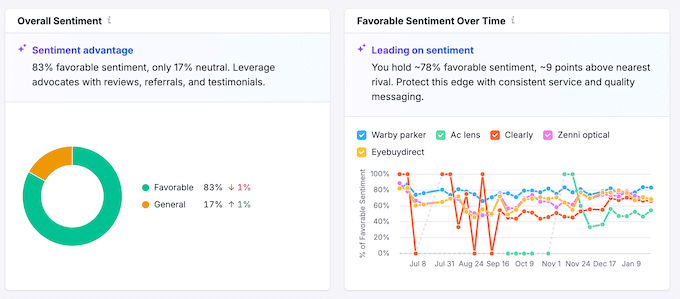
The AI brand performance and Brand Mentions features show how often your business appears across platforms like ChatGPT, Gemini, and Perplexity, along with sentiment.
The Prompt Research tool adds another layer by showing the actual questions people ask AI tools. For me, this helped shift my thinking beyond traditional keyword research.
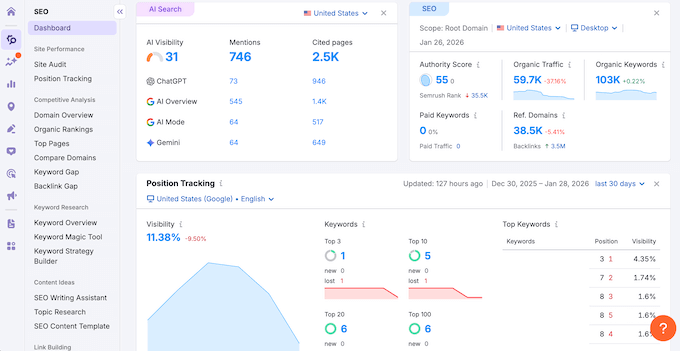
To round things out, I explored the position tracking and site audit tools. These tools gave me a clearer picture of overall performance – from rankings to technical issues.
One thing I noticed is that many improvements for AI visibility also support traditional SEO. The tool highlights gaps early, so you can fix them before they impact rankings or traffic.
The main downside is the number of features. If you’re new to SEO tools, it can take some time to get comfortable with the interface. Plus, this is one of the more expensive AI SEO tools on the market.
🧑💻 Why I Recommend Semrush One: Semrush One brings keyword research, backlink analysis, and AI visibility tracking tools together in one platform. It’s a strong choice for planning, creating, and optimizing content based on real search data while keeping up with how AI is reshaping SEO.
3. SEOBoost – Best for Content Optimization and Content Briefs
| SEOBoost Pros | ✅ Real-time AI content scoring as you write ✅ AI-powered content briefs built from top 30 SERP results ✅ Topic Reports analyze competitors and find keyword gaps ✅ Content Audit feature finds posts that are losing traffic over time ✅ Central Content Management dashboard keeps your whole workflow in one place ✅ AI-generated FAQs, key points, and structured outlines ✅ Connects directly with AIOSEO as its built-in AI Writing Assistant |
| SEOBoost Cons | ❌ Requires a separate subscription when used alongside AIOSEO ❌ No backlink analysis or technical SEO audit tools |
| Pricing | Starts at $22.50/month |
| Best For | Content teams and bloggers who want AI-driven optimization and brief creation, from research all the way to publishing |
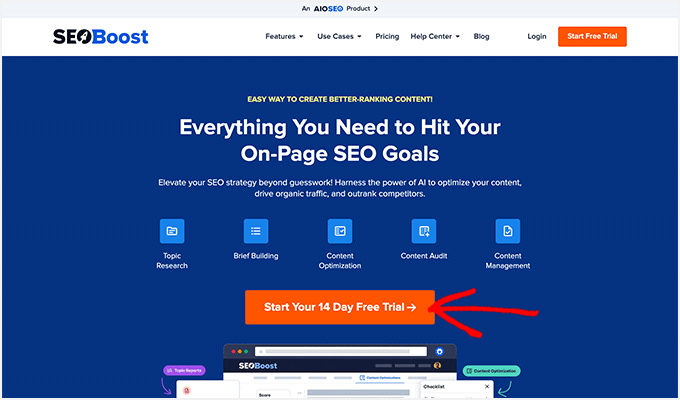
SEOBoost is an AI-powered content optimization platform with one clear goal: helping you create content that ranks. It covers the full content process, from keyword research and brief creation to real-time optimization and content auditing.
Everything is powered by AI and live SERP data. It is also the tool behind AIOSEO’s AI Writing Assistant, so WordPress users who already use AIOSEO can connect it in just a few clicks.
I use SEOBoost every time I want to optimize an article for publishing on the WPBeginner blog.
My Experience
I started by testing the Topic Reports feature. You enter a target keyword, and SEOBoost pulls data from the top 30 ranking pages.
It shows you competing content angles, how often keywords appear, average word counts, and readability scores.
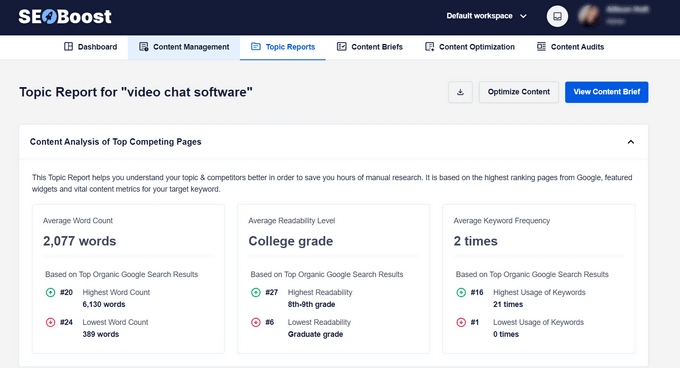
What I found most useful is that it does not just give you a list of keywords. It also tells you whether the top results are guides, listicles, or product pages. That detail alone changes how you plan your content.
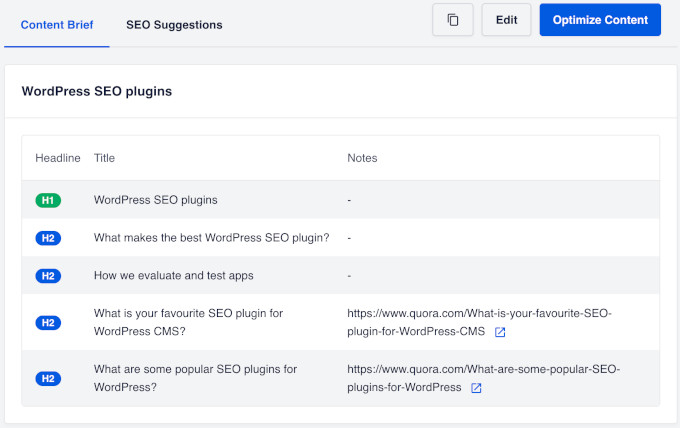
Next, I tried the Content Briefs tool. SEOBoost takes the Topic Report data and turns it into a ready-to-use brief.
You get suggested headings, subheadings, People Also Ask questions, and SEO checkpoints like target keyword density and linking tips. If you work with freelance writers or a content team, this feature saves a lot of time because you can share the entire brief with them.
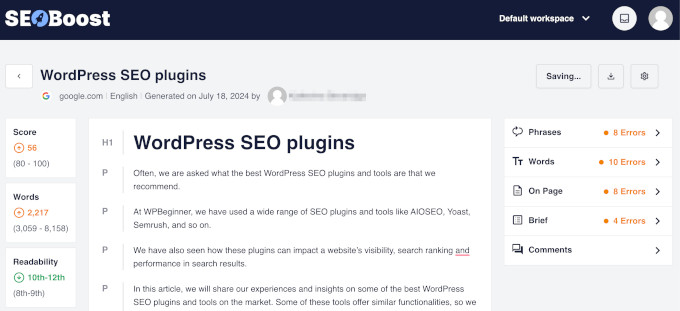
In my opinion, the Content Optimization tool is where the AI helps most in day-to-day work. You can write directly in SEOBoost’s editor, or paste in a draft you already have.
The tool scores your content in real time as you write. It flags issues with keyword placement, readability, internal links, and metadata. It works like a live SEO checklist, not a one-time audit.
I also tested the Content Audit feature. It scans your existing posts and flags ones that are losing search visibility over time.
Once you find a weak post, you can run it through the optimizer and refresh it using updated keywords from a new Topic Report. This is very useful for sites with large content libraries.
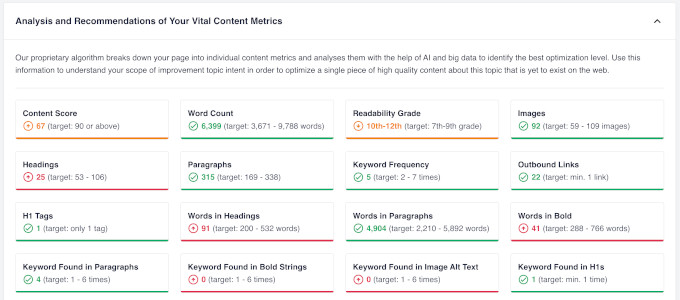
Finally, the Content Management dashboard brings everything together. Each article has its own project space where you can attach briefs, track scores, assign writers, and monitor SEO performance. For many content teams, it can replace the mix of spreadsheets and separate project tools they were using before.
One thing to keep in mind: if you want to use SEOBoost as the AI Writing Assistant inside AIOSEO, you need a paid SEOBoost subscription on top of your AIOSEO plan. That is an extra cost, but the two tools are designed to work together.
🧑💻 Why I Recommend SEOBoost: SEOBoost is the strongest content optimization tool on this list for teams that need to go from research to published post without losing momentum. The AI does not just suggest keywords. It also shows you the competitive landscape, helps you structure your content, and keeps scoring it until it is ready to rank.
4. LowFruits – Best AI SEO Tool for Finding Low-Competition Keywords
| LowFruits Pros | ✅ Finds SERP weak spots where low-authority sites already rank ✅ Bulk SERP analysis saves hours of manual keyword checking ✅ AI-powered keyword clustering groups terms by search intent ✅ Long-tail keyword discovery using Google Autosuggest data ✅ Domain Explorer with a database of 150,000+ weak competitor sites ✅ Competitor keyword and sitemap extraction tools |
| LowFruits Cons | ❌ No built-in content optimization or writing tools ❌ Credit-based pricing can get expensive for very large keyword lists |
| Pricing | From $20.75/mo + pay-as-you-go pricing for extra credits |
| Best For | Bloggers, niche site owners, and WordPress publishers who want to find keywords they can realistically rank for |
LowFruits works differently from most keyword tools. Instead of filtering by a difficulty score, it uses AI to analyze the actual search results for each keyword and finds weak spots that you can actually rank for with your content. These are pages from low-authority forums, user-generated content sites, and domains that do not have many backlinks.
Overall, it can save you from wasting hours on impossible keywords and shows you exactly which topics your site has a real chance to win.
My Experience
I started with the Keyword Finder. You enter a seed keyword, and LowFruits generates a list of long-tail variations using Google Autosuggest data.
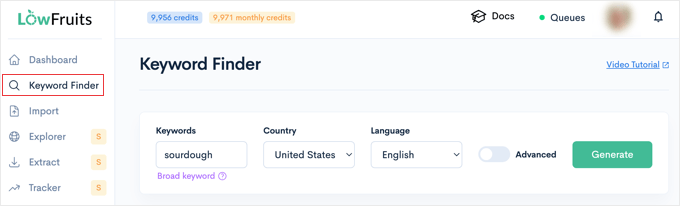
The list of keyword ideas was solid, but the real value comes when you move to analysis.
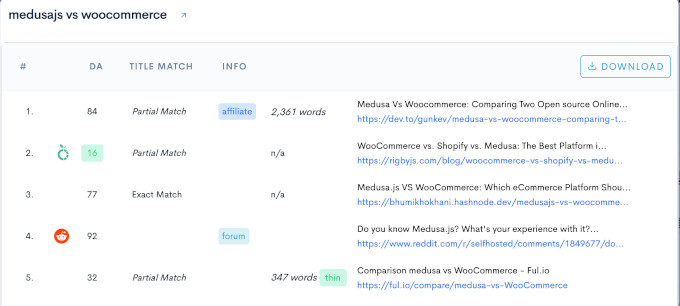
Once you submit a keyword list, the tool checks the live search results for each term.
It shows you the domain authority of the ranking pages, whether any results come from forums or user-generated content like Reddit or Quora, and their word count.
Each of these signals points to a keyword you can potentially outrank with a well-written, focused post.
The keyword clustering feature is also very useful for content planning.
LowFruits automatically groups related keywords by search intent. This makes it easy to plan a group of posts around one topic, instead of targeting individual keywords one by one.
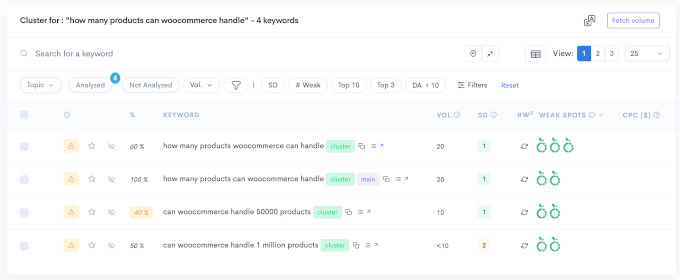
A good workflow I found is to use LowFruits to find these keyword clusters first, then bring them into SEOBoost or AIOSEO to build content briefs around the best opportunities.
I also tested the Domain Explorer. It gives you access to a database of over 150,000 low-authority websites across different niches.
You can find competitors in your space, see which keywords they rank for, and download their sitemaps to understand what topics they are covering. This makes finding content gaps much faster than doing it by hand.
The main limitation is that LowFruits is a keyword research tool only. There is no content editor, no optimization scoring, and no writing assistant built in. You will need to pair it with a tool like SEOBoost or AIOSEO to turn the keyword opportunities into actual content.
🧑💻 Why I Recommend LowFruits: LowFruits solves a real problem that most keyword tools ignore. A low difficulty score does not tell you whether you can actually beat the pages that are ranking right now. LowFruits does. For WordPress site owners who want to find content gaps where they can realistically compete, it is the most focused keyword research tool on this list.
5. Link Whisper – Best AI SEO Tool for Internal Linking
| Link Whisper Pros | ✅ Saves time on manual internal link building ✅ Helps improve your site’s internal linking structure ✅ Allows you to add links directly from the suggestion list ✅ AI-powered suggestions for relevant internal links ✅ Automatically finds related posts and pages to link to |
| Link Whisper Cons | ❌ Focuses mainly on internal linking rather than full SEO optimization ❌ Works only with WordPress sites |
| Pricing | Starts at $77/single-site license |
| Best For | WordPress site owners who want to build a stronger internal linking structure without doing it manually |
Link Whisper does one thing and does it well. It automatically scans your content and suggests relevant internal links. This makes it much faster to build a strong internal link structure across your site.
I tested it on a site with a large back catalog of blog posts, which is exactly the kind of situation where internal linking becomes a real chore. The difference was noticeable from the first session.
My Experience
After installing Link Whisper, I noticed it started working right away. During testing, it scanned my posts and pages automatically and began suggesting internal links without me needing to set anything up.
What I liked most was how relevant the suggestions felt. The tool uses AI to recommend links that actually fit the context, so I didn’t have to reject a lot of them, as I’ve experienced with other tools.
Each suggestion also comes with editable anchor text. I found this really helpful because I could quickly adjust how the link appears without opening the post in a separate editor.
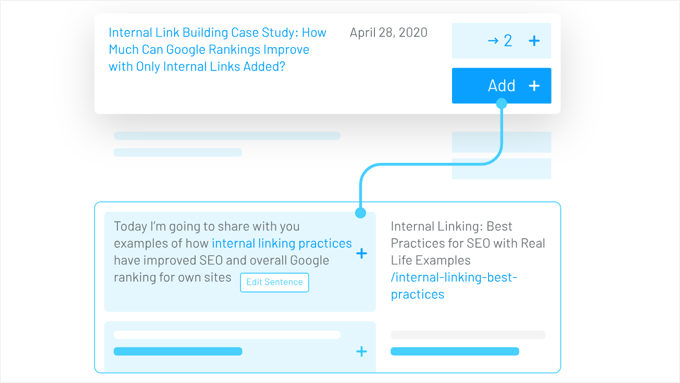
Then, I could review and insert links directly from the suggestion list, instead of opening each post, finding the right spot, and adding them manually. This was one of the biggest time-savers for me.
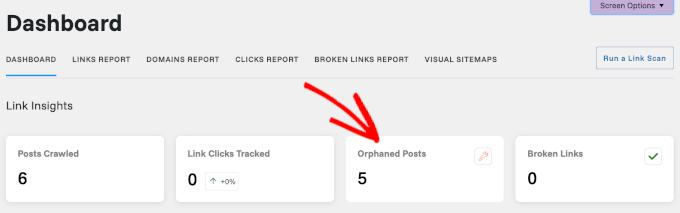
While testing, I also used it to find posts that had very few or no internal links pointing to them. This is the kind of issue that’s easy to miss on larger sites, and fixing it can help search engines better understand and crawl your content.
Expert Tip: I’ve found that Link Whisper is most effective once a site has at least 10-20 posts, as the AI needs a baseline of existing content to generate meaningful internal link suggestions.
If you are starting a brand-new blog with zero articles, you will want to wait until you have a small content library before using this tool. Additionally, if you’re looking for features like keyword research or content optimization, you’ll need to use it alongside another SEO tool.
🧑💻 Why I Recommend Link Whisper: I like Link Whisper for taking the manual work out of internal linking and helping find gaps across my site. It’s a practical time-saver for any WordPress site with a growing content library.
6. Surfer SEO – Best for On-Page Optimization Using Live SERP Data
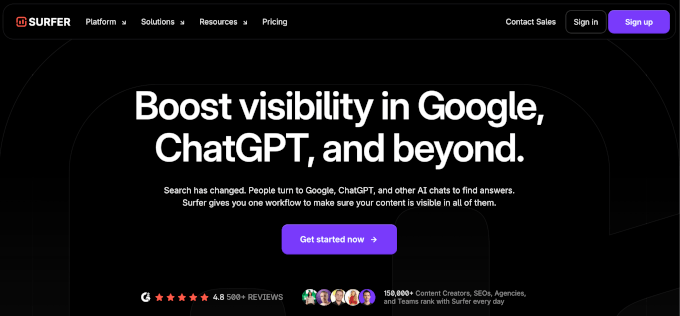
| Surfer SEO Pros | ✅ Helps optimize content based on real SERP data ✅ Generates outlines and content briefs quickly ✅ AI-powered on-page optimization based on top-ranking content ✅ Detailed reports comparing your content with top-ranking pages |
| Surfer SEO Cons | ❌ Focuses mainly on content optimization rather than full SEO management ❌ May require additional tools for broader SEO tasks |
| Pricing | Paid plans start at $49/month (Free plan available) |
| Best For | Writers and content teams who want to optimize articles using live SERP data |
Surfer SEO analyzes top-ranking pages and turns that data into keyword recommendations and content briefs that you can act on right away. It’s a practical choice for anyone who wants to improve on-page SEO without spending hours on manual SERP research.
I went into testing with a specific goal: find out which keywords I was missing and how my content stacked up against pages already ranking in the top positions.
My Experience
When testing Surfer SEO, I noticed that its on-page optimization is driven by real search results. It looks at top-ranking pages and shows what your content needs to compete.
The keyword suggestions are pulled from that same data. Instead of generic ideas, I got terms that high-ranking pages are already using, which made them easier to apply in a meaningful way.
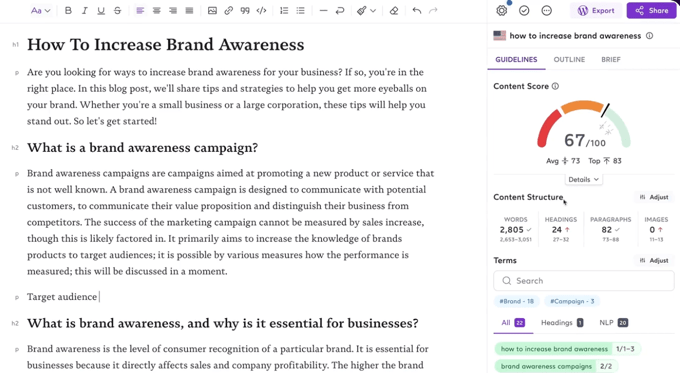
One feature I kept coming back to was the content briefs. Surfer builds structured outlines based on competing articles, which gave me a clear starting point and made writing feel less overwhelming.
When updating existing posts, I relied on the comparison reports. I liked how they break everything down into simple factors like word count, headings, and keyword usage. They made it much easier to spot gaps and prioritize improvements
The main limitation I noticed is that Surfer SEO focuses mainly on on-page optimization. It doesn’t include features like backlink analysis, technical SEO, or full site audits, so you’ll likely need another tool to cover those areas.
🧑💻 Why I Recommend Surfer SEO: I like that SurferSEO gives you clear, data-backed guidance for improving content using live SERP data from top-ranking pages. It’s one of the most focused on-page optimization tools I tested.
7. Frase.io – Best for Researching Competitors Before You Write
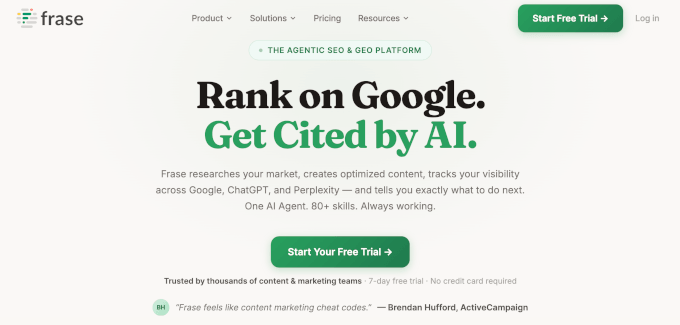
| Frase.io Pros | ✅ Makes competitor research faster and more convenient ✅ Lets you review and analyze top-ranking content without leaving the platform ✅ AI drafting tools help speed up content creation ✅ SERP research panel shows outlines from top-ranking articles ✅ Expandable headings let you view competitor content directly inside the tool |
| Frase.io Cons | ❌ AI-generated drafts may still require heavy editing ❌ Primarily focused on content research rather than full SEO management |
| Pricing | Starts at $14.99/month |
| Best For | Content writers looking to research competitors and plan content before writing |
Frase.io simplifies competitor research by letting you explore outlines and content from top-ranking pages directly within its research panel. It’s a good fit for writers who spend a lot of time studying what’s already ranking before they start writing.
I tested it during the research phase of a new article, and it changed how quickly I could get from a blank page to a working outline.
My Experience
In my testing, I started with the SERP research panel. After entering a topic, Frase pulled in outlines from top-ranking articles, so I didn’t have to open multiple tabs to see what competitors were doing.
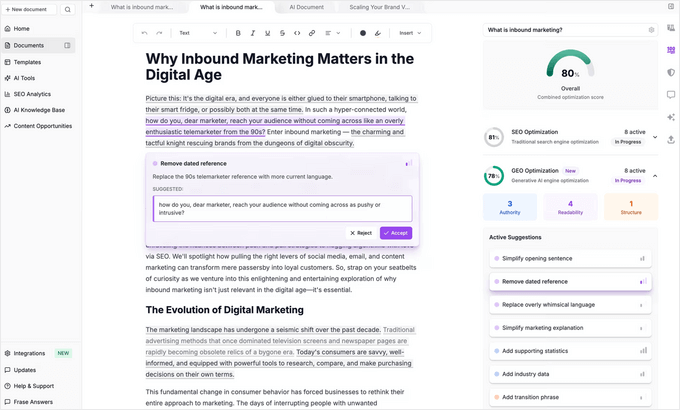
The collapsible headings made it easy to scan each article’s structure and quickly understand which topics were being covered. I could also copy content snippets directly into the editor, which helped me reference ideas without breaking my workflow.
Once I had a clear direction, I generated a draft based on my own instructions. In my experience, it worked best as a starting point – it followed a solid blog post structure, but I still needed to refine the tone and add more depth.
The main drawback I noticed is that Frase focuses mostly on content research and writing. It doesn’t include features like keyword tracking, backlink analysis, or technical SEO, so you’ll likely need other tools to cover those areas.
🧑💻 Why I Recommend Frase.io: Frase.io pulls competitor research and AI drafting into one place, making it a real time-saver for planning and outlining before you write.
8. Jasper AI – Best AI SEO Tool for Scaling Marketing Content Across Different Formats

| Jasper Pros | ✅ Generates many types of marketing content quickly ✅ Helps maintain a consistent brand voice ✅ Useful for a wide range of content marketing tasks ✅ Dedicated tools for writing blog introductions and conclusions ✅ AI image generation for blogs, newsletters, and social campaigns |
| Jasper Cons | ❌ AI-generated content may still require editing ❌ Primarily focused on content generation rather than technical SEO |
| Pricing | Starts at $39/month |
| Best For | Marketers and content teams looking to develop AI drafts they can actually fact-check |
Jasper AI stands out with its wide range of AI templates that help marketers quickly generate blog content, ads, product descriptions, and other marketing copy. It’s a strong fit for teams that produce a high volume of content across multiple channels and need to keep the tone consistent throughout.
I used it to generate content across a few different formats. What I wanted to find out was whether the output felt consistent and usable without too much reworking.
My Experience
As I was testing Jasper, the wide range of AI templates was one of the first things I noticed. Whether I needed a blog post, a Google Ad, or a product description, there was already a starting point, so I didn’t have to begin from scratch.
I also tried templates for blog introductions and conclusions, which I usually find the hardest to write quickly. In my experience, Jasper generated options that felt natural and gave me a solid starting direction.
For marketing tasks, switching between content types was simple. I could move from blog writing to social media captions or product descriptions without leaving the tool.
The brand voice feature was another highlight. After training it on a specific tone, Jasper did a good job keeping the output consistent across different types of content.
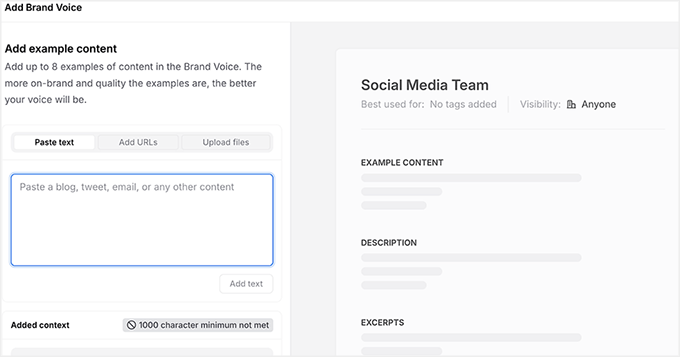
I also tested the AI image generator. It’s a helpful add-on for creating simple visuals for blog posts or social media. It won’t replace a full design tool, but it’s convenient when you need something quick.
The main limitation I noticed is that Jasper doesn’t include features like keyword tracking, content scoring, or backlink analysis. So you’ll need to pair it with a dedicated SEO tool.
🧑💻 Why I Recommend Jasper AI: From testing, Jasper AI covers a wide range of content formats and keeps your brand voice consistent. It’s a strong choice for teams producing marketing content at scale who want solid first drafts they can review and fact-check before publishing.
9. Outranking.io – Best for AI Drafts You Can Actually Fact-Check
| Outranking Pros | ✅ Focuses heavily on factual accuracy in AI-generated content ✅ Provides source links so users can verify information easily ✅ Includes helpful tools like auto-linking and plagiarism checking ✅ Processes over 50 sources to produce more accurate drafts ✅ Ability to learn and maintain your brand voice |
| Outranking Cons | ❌ AI-generated content can still contain errors and needs review ❌ Some editing may be required to refine the generated text |
| Pricing | Starts at $79/month |
| Best For | Writers and content teams who need AI-generated drafts they can actually verify and trust |
Outranking stands out by prioritizing factual accuracy in AI-generated content and providing source links so that users can verify information easily. It’s a good fit for writers who want the speed of AI drafting without sacrificing the ability to fact-check what gets published.
I tested it specifically to see how it handled sourcing. For content that needs to be accurate and credible, knowing where the information comes from matters a lot.
My Experience
In my testing, Outranking.io’s AI content generation tool (powered by GPT-4) gave me a strong starting point. The drafts read naturally and needed less cleanup than I expected.
What stood out most is how it handles research. It pulls from 50+ sources when generating content, and the source links are shown alongside the draft. This made it much easier to verify information without jumping between tabs.
I also tested features like automatic link insertion, which adds relevant links directly into the content. The brand voice setting worked as expected, helping keep the tone consistent while still producing content that felt well-supported.
The built-in plagiarism checker was another helpful addition. It flagged sections that needed attention and made it easy to fix issues without leaving the editor.
That said, I still found that AI-generated content needs careful review. Even with strong research behind it, some details weren’t fully accurate, so I had to edit before publishing.
🧑💻 Why I Recommend Outranking.io: After extensive testing, I found that Outranking.io shows you where the information in your draft comes from, which makes fact-checking faster and gives you more confidence before publishing
10. Rank Math – Best for Real-Time SEO Scoring as You Write
| Rank Math Pros | ✅ Provides keyword suggestions while writing content ✅ Real-time content scoring helps improve SEO quality ✅ Works directly inside the WordPress editor for a smooth workflow ✅ AI-powered Content AI analyzes competitors to suggest relevant keywords ✅ Keyword suggestions tailored to headings, titles, and meta descriptions |
| Rank Math Cons | ❌ AI suggestions may require manual review and adjustments ❌ Some advanced features may require a paid plan |
| Pricing | Starts at $59/year (Free plan available) |
| Best For | WordPress users or content creators who want real-time keyword suggestions and SEO scoring as they write |
🧑💻 Expert Tip: Do not install Rank Math alongside AIOSEO or Yoast. Running two SEO plugins at once can cause technical conflicts and hurt your rankings.
Rank Math‘s Content AI delivers keyword suggestions and SEO scoring directly in the WordPress editor. This lets you optimize your content as you write it.
It’s a natural fit for bloggers and content creators who want actionable SEO feedback without switching between tools.
My Experience
During testing, I used the Content AI feature directly inside the WordPress editor sidebar. Since the feedback appears as you write, I didn’t have to switch screens, which made the whole process feel much easier.
As I worked on content, it analyzed competitor pages and suggested relevant keywords for my SEO topic. These recommendations felt specific and were clearly organized by where to use them, like headings, titles, and meta descriptions.
I also kept an eye on the real-time content score, which updates based on factors like word count, headings, and media files. This made it easier to spot gaps before finishing a draft.
Plus, because everything runs inside the WordPress editor, I didn’t need to copy and paste content into another tool, which kept the workflow simple from start to finish.
One limitation I noticed is that some AI suggestions still need a quick review. A few didn’t fully match the context, so I had to tweak them to keep the content sounding natural.
🛑 Important: Rank Math’s ‘Content AI’ uses a credit-based system, which differs from AIOSEO’s ‘Writing Assistant’ that is tied to your SEOBoost subscription. I recommend checking the credit limits for your plan to avoid unexpected costs during high-volume content updates.
🧑💻 Why I Recommend Rank Math: It brings real-time keyword suggestions and SEO scoring into the WordPress editor as you write, helping bloggers and content creators optimize without interrupting their workflow.
Honorable Mentions: Other AI SEO Tools I Tested
While the tools above are my top recommendations, there are a few other AI SEO plugins and platforms I tested that still deserve a quick mention:
 |
🟢 Pros: WordLift uses AI and structured data to help search engines understand your content more effectively. 🔴 Cons: Focuses heavily on semantic SEO, which may feel complex for beginners. 🧑💻 Best for: Websites that want to improve structured data and semantic SEO. |
 |
🟢 Pros: SEOPress provides a complete set of SEO tools through a clean, ad-free interface. 🔴 Cons: Its AI features are limited compared to dedicated AI SEO tools. 🧑💻 Best for: Users who want a lightweight alternative to larger SEO plugins. |
 |
🟢 Pros: Provides detailed keyword and content recommendations to improve rankings. 🔴 Cons: Pricing is higher than many other SEO optimization tools (it also feels similar to Semrush One). 🧑💻 Best for: Content teams focused on high-quality SEO writing. |
 |
🟢 Pros: Yoast SEO provides on-page SEO analysis and readability checks directly inside the WordPress editor. 🔴 Cons: Some advanced features and integrations require the premium version. 🧑💻 Best for: Beginners who want guided SEO recommendations while writing. |
 |
🟢 Pros: Slim SEO automatically handles your technical SEO settings without requiring any complex setup. 🔴 Cons: It offers fewer customization options than larger SEO plugins. 🧑💻 Best for: Users who want a simple, no-configuration SEO solution. |
What Is the Best AI SEO Tool for WordPress?
After testing the tools in this roundup, All in One SEO (AIOSEO) is the best choice for most WordPress users because it delivers practical AI features directly inside WordPress.
It helps with the core SEO tasks site owners do most often – content optimization, keyword and related-term suggestions, internal linking, and content repurposing, like generating FAQs and key takeaways.
You can also create AI-assisted headlines and meta descriptions without leaving the editor, which makes it a strong all-in-one option for bloggers and small business sites.
If you need deeper keyword research, backlink analysis, competitor data, and broader tracking/audits, then Semrush One is worth considering. It’s better suited for content teams and SEO professionals who want a full research platform.
🌟 Where to start: Try AIOSEO first if you want the fastest, most-beginner friendly “inside WordPress” workflow.
FAQs About AI SEO Tools for WordPress
If you’re exploring AI SEO tools, you might still have a few questions about how they work and whether they’re worth using.
Here are some quick answers to common questions from WordPress users.
What are some good AI writing tools for SEO?
Some of the best options include AIOSEO for AI optimization inside WordPress and Semrush One for SEO-driven writing and keyword data.
Other helpful tools include Frase for fast competitor research and drafting, Jasper for scaling marketing content with a consistent voice, and Outranking for creating drafts with source links for easier fact-checking.
What are the best SEO tools for a beginner?
All in One SEO (AIOSEO) is a great choice for beginners because it works right inside WordPress. This means you can optimize your content as you write without needing to switch between different tools.
Can AI tools replace traditional SEO tools?
Not completely. Some advanced SEO research still benefits from dedicated SEO platforms. Many AI SEO tools focus mainly on content rather than full audits, backlink analysis, or broader SEO management.
Can AI SEO tools help improve rankings?
Yes. They can improve the work that influences rankings by suggesting keywords based on what’s already ranking, helping optimize on-page content, and speeding up internal linking. These help search engines crawl and understand your WordPress site.
Are AI SEO tools worth it for small websites?
Often, yes. They can save a lot of time on repetitive SEO tasks.
Affordable, WordPress AI SEO tools like AIOSEO (starting at $49.50/year) are a great fit for most users. Whereas more advanced platforms like Semrush One make sense if you need deeper data, research, and tracking.
Do AI SEO tools have hidden costs?
Yes, many AI features require extra credits or a separate subscription. For example, AIOSEO’s Writing Assistant requires an SEOBoost license, and Rank Math uses a credit system. I recommend checking the pricing page for each tool to see what is included in your plan before you buy.
More Guides for Using AI in WordPress
If you found this guide helpful, here are a few more WPBeginner resources to use AI in WordPress:
- How to Make Money in WordPress Using AI
- How to Use AI to Translate Your Website
- Best AI Automation Tools for WordPress
- Best AI Prompts for Bloggers, Marketers, and Social Media
- Tips for Using AI to Skyrocket Your Lead Generation Campaign
If you liked this article, then please subscribe to our YouTube Channel for WordPress video tutorials. You can also find us on Twitter and Facebook.
The post I Tested 10+ Best AI SEO Tools for WordPress to See Which Are Worth It first appeared on WPBeginner.
Tell us how can we improve this post?