
by Tom Lehmann
/pic8942612.jpg)
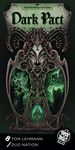
Dark Pact is a deck-building game for 1-4 occult researchers seeking to make pacts with otherworldly forces. The game includes thirteen dark pacts, and the first player to obtain and satisfy a dark pact’s condition wins.
/pic9256116.jpg)
An Occultist’s Tools
In my games, I want players to be able to act immediately, so each player’s initial deck includes a Laboratory to gain actions, a Library for draws, Self-Sacrifice to thin their deck, and Investigate to alter what’s on offer, as well as some money.
/pic9256117.jpg)
/pic9256118.jpg)
/pic9256119.jpg)
Cards are bought from a central display of ten cards that are drawn from a single deck.
/pic9256120.jpg)
This style of card appearance, familiar from games such as Ascension, tends to be fairly tactical. Investigation sends cards from this supply to the Exile, allowing players to filter cards in the center, both to obtain desired cards and deny their rivals needed cards.
/pic9256121.png)
In addition, each player begins with three reserved cards in their grimoire, a tile that holds up to three cards that only its owner can purchase, including Inscription.
/pic9256122.jpg)
If added to a player’s deck, this card enables them to reserve an expensive card from the center, either for their own later use or for denial, adding a strategic element.
This emphasis on immediate player action is further emphasized by allowing unplayed cards to optionally be saved — not discarded — from one turn to the next and having purchased cards go to your hand, not your discard pile. Buying a card has both strategic value — improving your deck — and a potential immediate tactical use, in combination with your saved cards for next turn.
/pic9256123.png)
Since purchased cards go to your hand, triggering an early reshuffle isn’t a big effect. This allows a set-up change from most deck-building games, with players (in order) selecting their initial five-card hand from five, six, seven, or eight cards of their ten-card start deck, respectively.
Later players get better first turns on average, typically generating an extra coin or two. This compensates for always being later in turn order in a first-to-win game. Test statistics on player position vs. win %s confirmed this.
Insight and Curses
Thematically, occultists are seeking to obtain knowledge from beyond, represented by insight.
/pic9256124.jpg)
But, of course, there are temptations and dangers lurking in the nether realms.
/pic9256125.jpg)
Insight and curse points mostly have no direct effect — though you cannot buy Insight cards if you have any cursed treasures in play — but various dark pacts refer to them:
/pic9256126.jpg)
In addition, if the deck runs out before any player satisfies a dark pact, the game ends, each player totals their deck’s insight and negative curse points, and the player with the highest net value wins. This alternative end condition happens rarely, unless one or more players buys Banishing Spirit and aggressively pushes the game along by repeatedly sweeping most supply cards into Exile.
/pic9256127.jpg)
Cards sent to Exile can sometimes be recovered or exchanged.
/pic9256128.jpg)
/pic9256129.jpg)
Further, the Exile is the realm of spirits and exiling cards makes the Spirit Lord — who can only be destroyed, not exiled — more powerful.
/pic9256130.jpg)
Destroyed (not exiled) cards go to the Graveyard and are generally harder, but not impossible, to recover (though Fool’s Gold tends to recover only the treasures destroyed for being too weak).
Multiplying Effects
Some of the costs and requirements on the cards above may seem high, but players also start with one 2x multiplier card (and are guaranteed access to second 2x multiplier which begins play in their grimories).
/pic9256131.jpg)
Multiplier cards are played with another card (an action or a treasure) and multiply every numeral (not “choose one” or “a”) on a card, so a 2x Guiding Spirit provides +2 actions, 4 draws, and requires 2 discards, while its clean-up effect is done only a single time.
/pic9256132.jpg)
Multiplying only numerals, as opposed to playing a card multiple times, greatly simplifies the rules and can lead to some surprising effects. Multiplier cards are either 2x or 3x, and several of them can be played to affect a single card.
/pic9256133.jpg)
For example, Visions played by itself draws 2 cards and shifts 3 cards to the start of next turn (after you replenish your hand to five cards at the end of this turn) — a nice, but not game changing, effect.
/pic9256134.jpg)
Visions played with both a 2x and a 3x draws 12 cards and shifts 18 cards (likely, most of your deck and your remaining hand) to next turn. You’ll begin next turn with 23 cards (five from replenishing your hand) and will be quite likely to win…if you have a dark pact and have set up your deck for it.
Multipliers make achieving some dark pact requirements much easier. For example:
/pic9256135.jpg)
45 insight to satisfy Hallow the Ground becomes possible with 2x, 2x Enlightment for 40 insight plus, say, using Enlightenment to play Attunement directly from the supply for 5 more insight.
/pic9256136.jpg)
25 Curse points to satisfy Curse the Land becomes 2x, 2x, 2x Cursed Gold (-3 Curses) for 24 Curse points plus, say, 1 Curse point from playing A Little Learning earlier that turn.
In my games, I try to include things for all three player personas that Mark Rosewater described in his seminal Magic: The Gathering article. I surround a core of efficiency (Spike) with large, fun effects (Timmy) and opportunities for creative play (Johnny). Deck-building games — by their nature — involve efficiency considerations. Multipliers add both large effects and ways to creatively play cards.
Designing Dark Pacts
The thirteen unique dark pacts divide into two broad groups: Keepers (shown above), with large requirements that involve playing several multipliers and one or two key cards to win, and Instants, mostly based on revealing cards in your hand.
/pic9256137.jpg)
Instant pacts have much lower requirements since multipliers affect cards as they are played, never those in your hand. These pacts are all about timing your card draws and arranging your hand to get both the Pact and its needed cards together.
/pic9256138.jpg)
Other dark pacts count things besides insight and curses, such as coins or cards in play.
/pic9256139.png)
As new players are often unsure as to which direction they should adjust their decks, for your first game each player begins with one of four straight-forward Keeper dark pacts to provide them a focus. (They can also win with any other dark pact that they acquire during play.)
Experienced players don’t get a starting dark pact and are faced with the dual challenge of how to focus their deck and which dark pact to acquire.
A common denial tactic by players who already took a dark pact is to exile other dark pacts from the supply. As it is hard to win without a dark pact, Investigation exiles either 1 dark pact or 2 other cards to discourage — but not eliminate — this tactic.
/pic9256140.jpg)
Renegotiation lets a player shift pacts to match different strategies, while Temptation is added in four-player games to help ensure that all players get at least one Dark Pact.
While a random dark pact could be dealt to each experienced player, this has two issues: First, it conflicts thematically with the idea that players are occult researchers exploring the unknown. Second, and more important, while the dark pacts are balanced, some groups may feel that a given dark pact is stronger than the other ones — for their group’s play style — and that a player randomly dealt that pact has too strong an advantage due to luck during set-up.
Testing, Testing
I had been thinking about deck-building games when Trick or Treat Studios reached out to me. I wanted to design one with varied “play shapes”, not just: buy cards to make your deck efficient via thinning or draws, possibly slow your rivals via attacks, acquire a payload, then purchase victory points.
Instead, I wanted alternate payloads (based on different card types or sets of cards) and multiple deck archetypes (efficient decks, big decks, draw everything decks, multiplier combos, sweep the supply for deck-end wins, etc.) so that play would vary more, using unique victory conditions to drive this.
Since Trick or Treat Studios is a publisher specializing in occult horror, this led me to a Faustian setting and a game title: Dark Pact. From these ideas, I put together a prototype.
The first big hurdle was controlling card flow and proportions. I had lots of card ideas and the central supply (which initially scaled in size from 6-10 cards with 2-4 players) got too easily clogged with cards that were too situational, early game cards showing up too late, late game cards showing up too early, etc.
/pic9256141.jpg)
I changed the supply to always have ten cards, eliminated some cards, improved Banishing Spirit to help with clogging, and figured out which fifteen supply cards were central to game play and needed to scale at one per player. Another sixteen cards needed to scale at one per pair of players and I split the second of each of these across the three- and four-player cards. That left seventeen unique specialized cards, which got split up by game function.
The two-player supply deck is 57 cards, plus all thirteen dark pacts, with 26 more cards for each additional player. Adding needed duplicates and fewer cards per player for three- and four-player games keeps card dilution in check.
With card flow working, I then examined balance issues. Initially, all dark pacts cost the same amount (5 coins), but I knew this would change during development. Being able to vary both pact requirements and cost gave me two tuning knobs.
/pic9256142.jpg)
Two pacts were particularly hard to balance as they line up with efficient play. If you build a deck by thinning and buying that works off a single treasure and has lots of draw power with cards that chain together in an efficient action economy, then this deck will tend to play all of its cards every turn, satisfying Great Work. If it can do this without playing any duplicates — which greatly limits your use of multipliers — then Diverse Learning also becomes trivial once your deck has fifteen unique useful cards.
By tripling Great Work’s cost, it is hard to buy with a single treasure, even with multipliers. Having multiple treasures makes it harder for a deck to also have the draws and action economy to play itself in a single turn since the treasures tend to clog up your hand. Needing duplicate multipliers, in turn, slowed down Diverse Learning.
/pic9256143.jpg)
Like many Instant pacts, Great Potential is conceptually simple: play x2, x2, x2 Visions to draw and set aside most of your deck. Next turn, add those cards to your hand, play Great Potential, and win.
However, not only do you need card filtering and retrieval powers to get this combo together, you must also have at least nineteen cards in your deck, which takes time to buy, during which the pacts for efficient decks might win first. For both this pact and Occult Mastery (play 22 cards), tuning consisted of first taming the “efficient deck” dark pacts, then setting the required card thresholds for these cards to match the desired speed.
/pic9256144.jpg)
In addition to basic treasures — copper, silver, gold — Dark Pact also has various special treasures. A pact needing some number of different treasures in play seemed obvious, but it was surprisingly hard to balance.
/pic9256145.jpg)
My first attempt (called “Pieces of 8”) required eight different treasures. Players begin with three treasures — copper, cursed copper, and silver — but this is misleading as thinning your deck by replacing its copper is a frequent early move and being encouraged to keep them while hunting for five more treasures is a bit of a trap.
I reduced the pact’s requirement to six different treasures. To counter it being too easy if you get it before thinning your initial copper, I increased its cost. Now, buying it is hard to do with just your start cards, and it competes with buying either gold or 2x multipliers (which both cost 6).
We tried using it as a start pact for new players, but the other players then denied them treasures by either buying or exiling them, which was frustrating. Seeing this, we swapped Occult Mastery for it as our fourth starting pact.
/pic9256146.jpg)
Players who don’t aim for an Insight pact tend to exile the Insight cards, which can be frustrating for a player aiming for Hallow the Ground, Sun Aspect, or the Four-Fold Path. This behavior, however, was expected, and the game has various ways to get Insight cards out of exile, including Inheritance.
As I dislike player frustration, my initial design had a reserve to hold some useful cards so a player couldn’t get stuck. While wrestling with card flow, the tactical nature of the supply, and higher cost cards, the need to reserve cards for the future during play became clear. My original reserve became the current grimoire, which begins with an extra silver and a second 2x multiplier, plus Inscription.
The Demon in the Corner
With an occult theme revolving around pacts with otherworldly beings, many cards could suggest things lurking in the background, but I knew we would need some demon cards and, thematically, they would need attack powers. What attacks were needed? How would they work?
I considered and rejected Dominion-style curse cards for Dark Pact. First, I didn’t want attacks to help players going for dark pacts involving curses. Second, I think cards that throw “dirt” into the gears of a deck-building game work best if they are not present in every playing, which didn’t match this game’s Ascension-style card appearance from a single deck.
While deck-building games tend to be multi-player solitaire, one advantage of the common supply and exile mechanism is that they provide player interaction. (A Spike player who immediately thins their initial Investigation card for deck efficiency often rues their lack of control over what’s in the supply.) Destructive effects weren’t needed for player interaction; instead I wanted effects that mostly slowed rivals, given players are racing to complete pacts.
/pic9256147.jpg)
Oppression puts cards back on your rivals’ decks, forcing one of their next two turns to be a bit worse. Maxwell’s Demon is a fairly mild discarding attack that, due to the card selection it provides, can sometimes actually help your rivals.
/pic9256148.jpg)
In addition to supplying defense cards, I discovered an interesting property of how multipliers interact with attack cards that also provide a benefit. If you apply a multiplier to obtain a bigger benefit, then the attack part ceases to matter (as most rivals, in the case of the attacks shown above with a 2x multiplier applied to them, won’t have ten cards in hand to be affected by them).
In games with attack cards, once you obtain them, you almost always play them. You’ve paid their cost, why not? Here, there’s a trade-off. Depending on the situation, you can either play them to slow your rivals down or multiply them to speed up your own progress. It’s often an interesting choice.
/pic9256149.jpg)
The strongest attacks — if not multiplied — can slow players substantially, especially when combined with another attack on the same turn. Experienced players know how to use retrieve powers and defense cards to deal with this, but newer players can find them frustrating.
These attacks — just 2-4 cards, depending on the number of players — have a * in their upper right corners. We recommend that players don’t use them in their first game. Players who prefer fewer, milder attacks can remove them as a variant.
Solo Considerations
The oldest way to play a game solo, familiar to most wargamers, is to switch positions and play both sides. Many players don’t find this satisfying as they want to play their position against decent opposition, so one solution is to provide a “Bot” player to play against them.
In my solo designs, I usually avoid Bot opponents for two reasons. First, it is hard to design paper Bots that play well; that’s something neural net AIs in apps do far better. Second, the amount of effort to run a Bot is often substantial, interfering with the player’s enjoyment.
My preferred approach is to abstract play as much as possible to provide some opposition (plus a timer) against which a player can try their best.
/pic9256150.jpg)
However, with Dark Pact, I saw an opportunity. What if I seeded a Bot with a particular dark pact, the Four-Fold Path, plus Banishing Spirit, and had it try to end the game on Insight, either by playing that pact first or by rushing the game and trying to win via a deck end insight victory?
These are both narrow and strong strategies and not too hard to simulate, which would provide a solo player with strong opposition.
/pic9256151.jpg)
I could also have the Bot seek to claim Hallow the Ground and try to win by playing it with 45 Insight points. This means the Bot would also try to obtain multiplier cards, so the solo player couldn’t just scoop them up or ignore this pact when it arrived in the supply.
I then wrote out the simplified Bot rules in a “checklist” fashion and developed and tested it.
It works pretty well. The first few Bot turns go slowly, but as you get used to the checklist and how it loops, you get a feel for what you need to check carefully and what you can skip over because the Bot doesn’t have the relevant cards, and everything speeds up.
The biggest hurdle was presentation. Despite a detailed explanation and sample turns, the checklist is pretty intimidating, especially for solo players who have not played the multi-player game.
Andy Van Zandt of Trick or Treat Studios wrote a Bot behavior summary, along with a flowchart, to complement the checklist and help a solo player to better visualize what’s going on.
/pic9256152.jpg)
Andy also challenged me to come up with simple ways to adjust the Bot’s difficulty, both to make it easier and, once the solo player is experienced, more challenging. Thanks, Andy!
Artistic Considerations
After Trick or Treat Studios accepted Dark Pact, we discussed theme and presentation. Trick or Treat Studios has, due to its other business lines, relationships with many talented artists.
My vision for the art was to suggest a late Victorian spiritualism and occult vibe, with the demons having a very different appearance. They suggested Dug Nation as an artist who could do this, showed me pieces he had previously done for them, and then discussed the project with him.
Dug was enthusiastic and developed three different styles for the card illustrations.
/pic9256153.jpg)
For pieces involving the occultists or their interactions with the spirit world, he used an etched style suggesting late Victorian newspaper illustrations.
/pic9256154.jpg)
For the mystical insight effects, Dug evoked a bit of the black and white line art style of the Victorian artist Aubrey Beardsley, along with pyramids, eyes, and other staples of Victorian spiritualism.
/pic9256155.jpg)
For the circles and magical treasures, he did somewhat more naturalistic pieces in this style.
/pic9256156.jpg)
For the demons and cursed activities, Dug did painted pieces. Tonally, I didn’t want blood and gore and had named most of the demon and cursed actions either for negative emotions (envy, jealousy, oppression, torment, etc.) or to suggest bargaining and deals gone wrong (temptation, debt, renegotiation, thief, fool’s gold, etc.). Dug liked these themes and emphasized these things in his paintings.
/pic9256157.jpg)
When I reviewed Dug’s first painted pieces, I noticed his overall red/orange color palette and suggested using splashes of color in the later pieces to visually vary things.
We wanted the player start decks to include at least one card in each art style, so Dug also created a painted piece for A Little Learning.
/pic9256158.jpg)
This is one of my favorite pieces. I love the almost completed circle and how the occultist’s upturned head and the looming shadow suggest the danger involved in contacting forces beyond our ken.
Jody Henning designed the graphic frames for the action cards to suggest Victorian detailing.
/pic9256159.jpg)
As many later deck-building games don’t use a Dominion-style action economy, we designed the action cards so their tops overlap to make it easy for new players to track actions and coins generated during the action step. (Experienced players who are used to tracking actions can ignore this and play their cards in other arrangements.)
/pic9256160.jpg)
For the basic treasure cards, Jody and Dug created sculptural-like art suggesting elaborate stone carvings and, for the cursed treasures, grotesque metal work.
I was still testing and fine-tuning cards, so as Dug and Jody completed pieces, I would print them out and swap them into my test kit. This allowed me to gather usability comments, and we made various adjustments such as increasing the size of the numbers on coins, lightening the background colors behind text boxes, etc. to improve the graphics for playability.
Andy, Jody, and I then worked together on the rules, figuring out how to best present the game. I’d like to thank Dug, Jody, and Andy for all their hard work on this project.
Publishing games is now quite challenging in a constantly changing business environment. I’m grateful for Chris Zephro and Trick or Treat Studios producing the game in these trying times.
To sum up, Dark Pact is a deck-building game for 1-4 occult researchers with thirteen unique victory conditions that combines the tactics of a changing supply with an action economy and different ways to specialize your decks. Enjoy!
Tell us how can we improve this post?