
/pic8805300.png)
Alien Origins
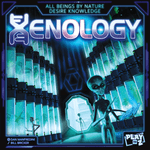
Some of my designs begin with a single starting point. Xenology, which Play to Z released in December 2025, began with several.
Every once in a while, I sift through my old design notes and sketches. Revisiting them often sparks new ideas as I try to decipher discarded concepts and half-finished drawings. During one of these sessions, I came across a concept for an alien-themed board game. Not everything was fleshed out, but the core was there: Exploring a planet as an alien species and cataloging everything you could learn from it.
I’ve always been captivated by aliens, especially their mysterious motivations. From The X-Files and E.T. to stories of late-night encounters, I’ve often wondered what things would look like from their perspective. If their goal is to gather knowledge, what exactly are they studying? How do they choose where to land? How do they organize what they find? Those questions were exactly the kind I wanted to explore in a game.
So I dug into what could be salvaged from the old concept. The idea of visiting a planet from your mothership was definitely going to be carried forward. You could explore several tracks related to various forms of knowledge, like biology and geology. That seemed promising and helped show the breadth and enormity of the aliens’ task. Reducing your risk of exposure and waking new aliens from cryogenic sleep were also fun ideas that I wanted to keep in the new design. With those pieces in hand, I began building Xenology as a full board game.
Research Cards
While I had the concept of aliens gathering information on broad categories like the “biology” of the planet, I felt that was too general. I needed something more specific and interesting, so I came up with research cards. These would represent sub-topics within the broader categories, like “reptiles” or “fungus”, and give players more variety in what they are looking for.
/pic9257856.jpg)
A sketch of the first research card
The early versions of these cards used various symbols to show how you could complete the research. Some symbols involved the planet, while others involved further study and experimentation back on the mothership.
Eventually, the cards were simplified to focus solely on planetary symbols. Each symbol represents something on the planet the aliens can study, with requirements tied to features such as biomes (forests or mountains), continents (tropical or polar), or population sizes.
/pic9279393.jpg)
Examples of final research cards
The Elder Council
The Elders, that is, the ancient aliens guiding the mission, began as two separate systems. In early versions, the mothership had many more rooms with various actions. One of those rooms contained several spaces with seated Elders, each with their own ability. They provided resources you could use on your missions and allowed you to propose research by playing cards from your hand onto your player board.
/pic9257855.jpg)
Early elder council chambers
The knowledge tracks I mentioned earlier were another system in the game, but they were not as integrated as I wanted. I realized that I could combine the two, with each Elder becoming a specialist in a knowledge type, and with their bonuses moving on spaces along the corresponding track.
/pic9257849.jpg)
Final Elder council chambers
The Mothership and the Core Loop
The heart of Xenology is a simple loop:
propose research → travel to the planet → complete research → upload data → repeat
At first, it may seem that you can just follow this pattern and everything will run smoothly. However, you quickly realize that your alien meeples are often working on different steps of this loop simultaneously. One may already be down on the planet without objectives, while others are still figuring out how to upload completed mission data into the database.
/pic9257835.jpg)
Final mothership action spaces
Earlier versions of the game experimented with more rooms on the mothership, some with one-way doorways to enforce this loop. Over time, the mothership became more flexible, with the “one-way doors” simplified into the single-directional paths of entering a landing craft and returning from a mission on the planet.
/pic9257836.jpg)
Alien on a landing craft
Sneaking around the Planet
The planet is made of hex tiles, mostly face down to conceal their details. However, the backs of the tiles show population levels. I envisioned that an arriving alien ship would instantly detect population centers by the lights of their cities at night, while finer details would require closer investigation.
/pic9257837.jpg)
The planet with a few visitors
Aliens that make it down to the planet still need instructions. To complete their research, an alien on the mothership must take the “Mission Control” action. This allows each of those aliens on the planet to either explore a tile (that is, flip it over) or extract information to complete the research and return to the ship.
Extracting information requires leaving behind “evidence” cubes equal to the tile’s population. After all, a mission in New York City is harder to keep discrete than one in a remote field. When the alien returns to the ship, you check for matching symbols on the planet tile and your research cards or specimen containers. Matches allow you to complete research or collect specimens.
From the earliest concept, I knew I wanted the evidence left behind to be a liability that players needed to manage. Cleaning up evidence is effectively the stereotypical “alien cover-up”. In the final version, cleaning up returns all cubes on a chosen continent to their owners. This may mean helping other players with their mess, so I added an incentive: By cleaning up, you impress the Elders, which allows you to advance on any of their tracks.
The Galactic Database
The final destination for all of the research is the galactic database. When you have completed a research card (by filling it with cubes), you can visit the database to upload that data (cubes) into gaps in the database. The research card is then added to your score pile, which determines the value of your specimens at game’s end. This took on many iterations, but it always included the placement of cubes onto a network of icons related to your research.
For my first iteration, I knew I needed something basic to test the rest of the game. I wanted something that looked like a web of connections, something a detective might put together with their collected clues, so to start I drew several cards with boxes, icons, and connections via lines. I didn’t know how many spaces I needed, so I made several that connected to each other in a chain…
/pic9257853.jpg)
Early database prototype
This version helped me start playtesting the core of the game, but I knew it was a placeholder with some obvious problems. For example, there was a fixed set of places to put your cubes. If you had completed biology research but no place was available for those cubes, then you couldn’t add your info to the database. This led to the next version: the tiles.
/pic9257854.jpg)
Database tiles prototype
This version had empty white spaces between the symbols. These spaces are where you could place your cubes as long as an adjacent symbol matched your research. This meant that one space could potentially store different types of research cubes.
Additionally, I switched to tiles to add another gameplay element; you could now build the database as you played. You could spend research cards from your hand to draw database tiles and play them (in addition to adding cubes). This allowed the database to grow and accommodate the types of spaces you needed.
These tiles improved the database but still had a few issues. For example, when they were rotated, their lines didn’t always match the other tiles. Another issue was that each tile had only two spaces for cubes – and the game still felt too tight in this regard. I wanted more options. These issues brought me to the final version of the database tiles…
/pic9257834.jpg)
Final database tiles
This version had more spaces per tile (3 or 4), so you had many more options from which to choose. Additionally, each tile could be placed next to another tile with the right rotation. Overall, this system gave the feeling I was wanting for the player.
A Menagerie of Specimens
Specimens were added later in development but quickly became a major pillar of the game. Collecting specimens works similarly to research: you find a matching symbol on a planet tile. Instead of placing a cube, though, you flip your specimen container to its filled side. Delivering it back to your storage locker grants a bonus — perhaps a special device, a research skill, or even the ability to wake another crewmate from deep sleep.
Ultimately, specimens contribute significantly to your score, with their value determined by the scoring icons on the research cards you have completed throughout the game.
/pic9257851.jpg)
Storage section with specimen containers
Space Can Be a Lonely Place
During development, I used makeshift solo rules, but I knew I needed to develop something more substantial.
Rather than competing against a virtual opponent, solo Xenology became a race against time, with the planet on the brink of cosmic destruction. Your mission is to catalog as much as possible before it’s gone forever.
The main challenge was creating the right amount of tension. Without other players competing for resources, the only possible curveballs were random card draws and face-down planet tiles. To fix this, I created a small deck of event cards that gradually interfere with your mission: blocking planet spaces, landing craft, and database openings, as well as restricting card draws.
/pic9279392.jpg)
Solo disaster cards
This worked, but I wanted to turn up the pressure. I added versions of events that “escalate” if you ignored them for too long. For example, the card “Planetary Impact” adds disaster cubes to a forest tile, but if all such tiles are already full, it instead destroys all face-down tiles adjacent to forests. This forces interesting decisions about risk management and timing, making the solo mode both tense and unique.
Close Encounter
I am very pleased with the final result of Xenology, especially seeing it come to life with the otherworldly visuals from artist Bill Bricker. While many other mechanisms came and went along the way, it was a rewarding journey watching all of these systems evolve and ultimately lock together. I hope you get a chance to try it out for yourselves!
Thanks for reading!
Tell us how can we improve this post?