
by Igor Zuber
/pic8905819.png)
1. The Origin
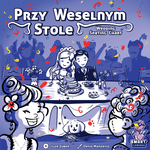
Wedding Seating Chart all started with my own wedding, a relatively small one for Polish standards as we invited around 50 people in total.
There is a tradition of giving a small gift to all the guests at the end of the event. It’s usually a small pack of wedding cake or a mini bottle of alcohol with a self-made wedding label…but since my life revolves around board games, I thought that designing a small game instead would be a cool idea. The biggest issue was that I had around six months to do so, which felt quite challenging.
The theme for the game came right away. A game designed for a wedding should be about the wedding! Together with my wife, we had already spent some time planning the wedding seating chart, and it proved to be a tough task: “Those two don’t like each other. Your cousin shouldn’t sit alone with the children, she’s already too old. Grandmas like to talk a lot, they should sit next to each other, right? There are nine non-family friends, and the tables have eight seats each; how do we do this?”
This felt like the perfect experience to simulate in the game.
Most of the guests were couples, so a two-player game was an obvious choice here. I wanted to make the game as easy as possible. Our family and friends were mostly non-gamers, so I wanted it to be short and simple. Also, the components had to be easy to produce at home, so most likely cards only.
The idea of cards having two different colors on different sides came at the same time. The game was already a two-player design, and by doing this there was no additional need to mark cards as yours with another component.
I came up with eighteen guest cards and a simple game board, then we started testing.
2. The Development
The game worked in my head, so I knew it would be at least playable on the table, and I was right. My wife didn’t get half of the words I manually wrote on the cards, but I had fun with the first playtest, which was a good indicator that this could be something nice.
I started thinking about the icons and how to make the cards at least somewhat balanced in a short time. Fortunately I’m a programmer, so I implemented the game and made the algorithm play against itself with a naive brute-force implementation of “locally best move” approach. The game was simple enough and the game space narrow enough that I could run a million games in less than a minute. The statistics helped me detect which cards were more or less powerful and adjust them a little. The data was slightly incorrect as the algorithm couldn’t plan for the future turns, but the tool was helpful enough anyways.
At the same time I contacted my friend Denis Mandrysz, a graphic designer, to help me out with the project. He was one of the invited guests and happy to help. I decided that since the game is aimed at non-gamers, the scoring rules should be explained on the cards themselves. This approach had drawbacks since we had non-Polish guests and would need to prepare two language versions, but I believe doing so would increase the chance of the game being played after the wedding, as little as that might be.
The art direction requirements were “Make it adorable and clear”. I also sent an example minimalistic image of grandma — “You know, something like this will do” — and I pasted a random grandma image found somewhere:
/pic9215068.jpg)
It took only a moment before Denis was already done with the bride and initial icons:
/pic8148968.jpg)
I showed it to my wife and she loved it: “It’s me!”
We had the cards, we had the images/icons, the game was working, and it felt balanced enough. It was time to produce it.
3. The Production
I think we were already down to two months. The game was pretty much ready, so now we had to make it real. I looked up printing companies recommended in Polish game designing groups and asked one for pricing. Four components total were necessary:
• The guest cards
• The rulebook
• The box
• The “board”
The cards were the easy part, I wanted standard CCG format so there was nothing to reinvent here, and the price of producing fifty copies of the game was acceptable.
The rulebook and the board seemed to be easy as well. I wanted them to be a single pamphlet that would be rulebook on one side and the game board on the other. This would be a non-standard format, and the price was surprisingly high, which was already on the verge of being acceptable.
For the box I found a nice guide on BGG for how to make a non-cut, non-glue, foldable, paper-only two-piece game box. Denis prepared nice files for the printing company, but the pricing for these was crazy.
With all the money that already went into the wedding, I couldn’t justify spending more than €1,000 for fifty copies of an eighteen-card game. I was quite demotivated, but there was still time, so I started looking into alternatives.
For the box, we could use something already available on the market. I started browsing online and most standard CCG deckboxes like the ones from Ultra PRO were already cheaper than printing mine, but they were non-transparent with the branding on them, which wouldn’t work.
I put in more effort and found a solution! One company offered transparent, small deck boxes for a price below €1 a piece! I ordered two samples in different sizes, and they were perfect, with the only downside being that the closing mechanism was fiddly, so we had to add a rubber band to prevent an accidental opening. That was acceptable, though, given the alternatives.
/pic8149009.jpg)
The issue that came with this new box, though: How do we make a cover for the game?
The answer turned out to be simple. We added an additional cover card that would be put first in the box, which worked perfectly. One issue had been solved.
/pic8149010.jpg)
The rulebook was another challenge. We decided to go for a single sheet of paper at a size of four times a CCG card so that after folding it twice, it would fit inside the box. This worked, but printing it professionally would be pricey.
I had recently bought a nice printer, and the quality of the print was good, but there was another big issue: the black ink was not durable, spreading upon touch.
Again, I spent time online and learned that in photography, the artists use transparent lacquer to secure their prints. The professional products were again crazy expensive, but I tried a multi-purpose cheap one and it did wonders. Two short sprays, and the ink was secured. It took time to print the rules, cut them, and secure them, but it was a big win.
/pic8149011.jpg)
/pic8149019.jpg)
/pic8149012.jpg)
The last issue was the board. At the time we didn’t think of adding four additional table cards, which should have been the obvious choice.
Instead what came to my mind was a thread with knots that would simulate the game space. This would have the advantage of fitting inside the box. I found thread at my place and tried this, but it didn’t work. The knots were too small, even if I made them triple-sized and were not easily visible.
Then I started thinking about beads that could be thread onto the string. I ordered a few hundred at different sizes and colors from allegro (which is like Polish eBay) and started production.
It was a painful and time-consuming process, but two seasons of some TV series later, we managed to produce fifty game boards that looked amazing and gave the game a nice handmade feel!
/pic8149013.jpg)
I started completing the games, and the end result felt perfect.
/pic8149017.jpg)
/pic8149018.jpg)
4. The Wedding
The wedding and the reception were great as we had a perfect time, and the game was the icing on the cake, at least for me. I even had a chance to play it during the event, which was really fun.
/pic8149003.jpg)
I know that most of the guests probably didn’t care and have never played it to date, but also I got feedback from the guests who did play it and enjoyed it, which felt satisfying.
One piece of feedback coming from my wife’s grandma was that the game is too hard and she couldn’t go through the rulebook.
5. The Contest
Since then, I’ve showed the game here and there and got overwhelmingly positive feedback, which ensured me that the game has potential. I know it had rough corners since the development was rushed, so I decided to revisit the design in a community of more experienced players, focusing mostly on streamlining the experience, making the game language-independent, and improving the UI.
In the meantime, I gave away a few copies of the game to Polish publishers at Planszówki w Spodku 2023, but while two publishers were initially interested, after a few months I had no concrete decisions from them.
/pic8149005.jpg)
In 2024, I entered the game in a two-player print-and-play game design contest, and amazing people helped me by detecting potential issues with the game.
One aspect worth mentioning here were stereotypes that were meant to give the game a wedding feeling, but were received by some testers as problematic or offensive. I had to swap a few characters with their scoring to mitigate this issue. For example, initially the uncle wanted to sit around women, but I moved that scoring to the bridesmaid. Similarly, I experimented with the priest character, but got a sarcastic comment: “Why doesn’t the priest want to sit around children in this game?” This was a surprisingly valuable comment as I wouldn’t have thought of that connotation myself and decided to get rid of it.
In the end, the game did great, winning the main category and placing high in others.
/pic9148901.jpg)
6. The Release
A month after the contest ended, I signed the game with Polish publisher Smart Flamingo. They decided to keep the original art style and include Denis as the illustrator and graphic designer for the project.
The development process was quite fast as the game stayed almost the same, with relatively minor updates, including:
• Adding two more cards
• Updating the scorings
• Removing the scoring text, and using only symbols
• Using nice table boards instead of string with beads
• Placing a scoring track on the board so that players don’t have to use pen and paper
• Adding two lovely meeples used for scoring and improving the presentation of the game
• Including a bilingual rulebook
/pic9023388.jpg)
/pic9148937.jpg)
I suggested to Łukasz from Smart Flamingo that we could do some kind of a photoshoot of the game with my wife and myself dressed as for the wedding. The idea was met with great enthusiasm as it turned out that Kacper, their marketing specialist, lives in my region. We met at Pszczyna Castle and spend a few hours creating content. My wife was happy that her wedding dress wasn’t a one-time thing after all…
/pic9148936.jpg)
The release of the game took place at Pyrkon in June 2025. It was a great feeling to showcase the game, sign copies, and see people enjoying the gameplay.
We met again in September 2025 at Planszówki w Spodku, the biggest boardgaming event in Poland, where Denis and I helped with the organization of the event.
/pic9148942.jpg)
From left: Igor and Denis
7. SPIEL Essen 25
Finally came time for the international release. The fact that Wedding Seating Chart wasn’t the hottest game on Eric’s SPIEL Essen 25 Preview didn’t make the show any less exciting for me. I came to Essen working for a different publisher, but I still had time to jump booths and showcase my creation. The reception of the game was great. It was amazing to see people having fun playing it, buying copies, and asking for signatures even after I gave them a solid beating. (Well, at least some of the time.) Some loved the gameplay and wanted a copy for themselves; some found it to be a perfect gift for the upcoming wedding they were invited to and just bought a copy blindly.
Ultimately, the game wasn’t that far away from selling out and was one of the publisher’s top-sellers. A few notable characters dropped by as well.
/pic9238537.jpg)
/pic9238551.jpg)
But SPIEL wasn’t the end of positive surprises. Despite the lack of blown-up marketing campaigns, the game is starting to reach its audience. It proved to be not only a good game, but also a great product. People buy it as a gift for the newlyweds or the newlyweds buy it as a gift for their guests, exactly the same as I did.
/pic9239718.jpg)
Elwira, who had her wedding recently, shared a great story in a Polish boardgaming group on Facebook about using Wedding Seating Chart as prizes in the games she organized at her wedding. The post got very popular and became an organic advertisement. Every now and then, I see similar pictures of the game being used at wedding receptions, which gives me great satisfaction.
I believe that a designer’s job is to bring smiles to people’s faces. Thanks to all these stories I’ve read, I feel like I’ve lived up to the challenge.
/pic9238634.jpg)
Thank you for reading the story behind Wedding Seating Chart, and I’ll see you at the table!
Tell us how can we improve this post?