
by Flo de Haan
/pic6220022.png)
Editor’s note: With apologies to the designers, I’m publishing the diary they submitted in 2021 and that I have somehow overlooked until now. —WEM
The Start of Civilization
At the beginning of the century, the moment when this project sparked, communication was mostly done by landline telephone, e-mail, and the shipping of paperwork. John Rodriguez, living in Texas, and me, Flo de Haan, living in The Netherlands, at the other end of the Atlantic ocean eventually met through Civproject, an online community for civilization games. We were both lovers of Francis Tresham‘s Civilization, and John and I had spent several years on various ideas independently, but were on the same track — bigger, better, more.
We had picked up the idea to work together on the professional development of this unique game, this game that had not been defined yet, but would be BIG — bigger than any other game. Starting from scratch, it would be a tribute to Civilization, making a 2.0 version, or even a 3.0 version, as Mega Empires is today.
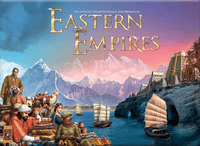
The development of Eastern Empires didn’t start after the release of Western Empires in 2019, but was part of a long term plan that formed sometime in 2008.
/pic6419528.jpg)
Testing, with the map board fitting in a living room
The Objective
Over the years of development, my cousin Gerart de Haan joined the team. The objective was to create the biggest game that could fit within a single living room, within a single day, so that instantly defined the size of the board, the player count, and the playing time. As opposed to what people might expect, right from the start, the game was developed as two equal, yet asymmetrical counterparts: The East and The West. This can be seen as a metaphor for either end of the Atlantic Ocean.
John and his team were testing on their side of the ocean, while Gerart and I took our part in the Netherlands. We would send emails, ship physical test examples, and make telephone calls every now and then. In the beginning, there weren’t enough people available that would give up their spare days for testing, but after a few years, that was not a problem any longer as conventions and many weekends were filled with dozens and dozens of game sessions. The map board was deformed many times, trying to fit in the right balance of landmass for each civilization.
/pic6419532.jpg)
Map deformation
/pic6419533.jpg)
Drawings by Flo
The First Publication
I was working on all of the prototype artwork, drawing monochrome images by hand for each token and advance. This became the final briefing for the desired illustrator: Franz Vohwinkel.
While talking to Michael Bruinsma, CEO of Dutch publisher 999 Games, he suggested combining both games into a limited edition collectors item: Mega Civilization. Finally, no sooner than 2015, the game was published: a heavy wooden box of 11 kg (25 lbs), a game that supports 5-18 players and takes thirteen hours to play. It sold out in a few months.
But it did not stop there…
/pic6419535.jpg)
Flo de Haan and John Rodriguez at BGG.CON 2016
/pic6419536.jpg)
Michael Bruinsma and Gerart de Haan
While working on a second edition, discussion arose with the licensor for the brand “Civilization” that had acquired it from Francis Tresham years ago, and who would receive royalties for the publication. The game proved too different to be called “Civilization”, which might interfere with their plans for reprinting Francis Tresham’s original. Also, there was much confusion about the computer game series, which has nothing to do with Mega Civilization.
We had no other option than to change the name. The old game was officially discontinued and a new modular approach stepped in: Mega Empires.
Mega Empires
The new brands Western Empires and Eastern Empires implied some changes. The two standalone games should be next level.
At conventions and through the internet, we had gathered a lot of answers to clarifications to the rules. We did minor adjustments on the cards, the map board, and some rules. We have fixed errors and developed new artwork for the cover, and some components. Splitting the game again implied a different card division as well. A community questionnaire made clear what the fans would like to see in a new edition: customized player mats, expansions, miniatures… In this period the Special Buildings Expansion was developed for both games.
The most often heard request: People want to play this game with fewer players than the determined minimum of 5. Reducing it to a three-player game? Well, that wasn’t easy. Yes, you could simply put “for 3 players” on the game box, but the game would be broken and no fun to play. A lot of issues would occur if you would simply remove players from a five-player set-up. This had already been well tested and had proven impossible years ago.
But impossibilities can be reconsidered. The game was developed through the massive interaction between players while trading, along with the inability to keep track of cards and the game’s 46 commodities. The calamities are well balanced for primary and secondary victims among a large number of players. The “Civilization Advances” are balanced for the current system of calamities.
Most importantly, the trade system requires sufficient cards in rotation each round, so that enough wealth is inserted into the player’s hand in order to be able to acquire the advances they need to keep the game going.
/pic6419538.jpg)
Testing Eastern Empires
Creating a 3-4 player Scenario
While testing games on the map board, it became clear soon that an equal balance of neighbors is very much required to provide both interaction and counteraction from players, so for fewer players, all of this had to be fixed.
John and his team had done a great job in the historical research for the area names, although after talking to historians and with more years of experience, slight adjustments have been made compared to the first release. This is all fixed in Eastern Empires. This is also true for additional historical backgrounds on the back sides of all nine player mats.
/pic6419539.jpg)
Historical research for Eastern Empires
Early in the process, we decided that a game for two players is utterly impossible, even with the infamous imperial-variant (with twice as many tokens per player), so a set-up for three and four players would be it. In any case, this set-up contains so many adjustments to the base game that it would mean “additional scenarios” for three and four players — for both games, that is.
/pic6419540.jpg)
The first version of the market board
The need for additional trade partners was eventually solved using a market board. This board not only acts as an additional trading player, but adds a whole new trading experience. Players now trade in a turn order, which adds to the seated experience of smaller games, as opposed to the trading system of 5-18 players in which all players would get up from their chairs all the time. This would make no sense with 3-4 players.
This system was first developed with pen, paper, and tape, and has changed a lot during the development phase. From this market board, calamities could resolve without a primary victim. Unlimited trade turns would mean way too much wealth compared to a regular game, so a limit of trading turns was added. During testing, players sometimes liked the system so much that they would play it as a game by itself. Eventually, this new trading system has proven to become the key difference to a regular game.
/pic6419541.jpg)
Testing new set-ups for Western Empires
Map Board Set-ups
Finding balanced map board set-ups was a real challenge. For Eastern Empires, this meant the current region-division could never make an equally balanced set-up. One civilization would always be more powerful due to the lack of neighbors. Also, the total size of the laid-out board would have to be as small as possible due to lack of space on smaller tables. Therefore, a new region division had to be introduced to the 3-4 player scenarios. This even meant moving some starting locations. Many options were tried using movement simulation.
Calamities had to change as well. Not only did the impact have to be reduced, but also the number of secondary victims should sometimes differ. Since calamities now sometimes resolve from the market board instead of from player’s hands, a new role was introduced: the deputy. This player acts as the controller of a calamity when the primary victim is a non-playing victim.
In addition, some calamities had to change thematically. Where Eastern Empires has its focus around the Himalayas for a large part, with almost no large water parts, these mountain areas now serve as the source for blizzards, avalanches, and raiders from the North. The Kushans, in three- and four-player set-ups, are no longer invulnerable to Cyclone, Flood, and Piracy as the chance they get hit by those calamity cards increases a lot compared to a nine-player game. Instead, they will now meet their snowy counterparts.
Testing
Speaking of calamities, the COVID-19 pandemic made some things harder, though it also created opportunities. A lot of people were at home alone with just their families, or one or two friends could come over — perfect for playing a “smaller” game. We decided to take this to our benefit and have people test the developments at home. The internet had quite developed since the start of the millennium when shipping of paperwork was the main thing.
This new way of testing turned out to be a major hit. In a short period of time, a lot of test results and proofreading helped develop the 3-4 player scenarios. We are happy with such a widespread fanbase that aids the gaming experience of Mega Empires.
/pic6419545.jpg)
More testing…
/pic6529816.jpg)
Flo holding the Eastern Empires prototype
Tell us how can we improve this post?