
/pic7585104.jpg)
In December 2017 I was asking myself a couple of times a day whether Newton was ready, and I could not come up with a convincing answer; but since no game is ever truly ready, the very fact that I kept asking the question meant it was ready enough. I had worked on it so much, and with such stubbornness, that I was genuinely tired of board games, of players, and of myself. I therefore decided to take a few months off and focus on my main job, which in the meantime was falling apart.
Then in January 2018, Newton did what it was not supposed to do. Barely three weeks after my noble resolution, a leisure visit to one of the many castles built by Frederick II in southern Italy sparked a renewed curiosity about this figure I had already heard so much about. I read a few things from my father’s library and understood that I could not avoid starting to design a new game about the most astonishing character of that period.
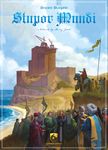
So, on a feverish night, while snowflakes were falling on the heights of the Sila, I locked myself in my studio-laboratory and created the first version of a game that would stay with me for a long time: Stupor Mundi, which at the time was more simply called Frederick II.
The first version of the game was completely different from the current one; in the next image you can see the very first iteration, printed and tested.
/pic9369042.jpg)
At the beginning there was no central board, only a display to draft various types of cards and a personal board to activate them. The interesting part was that each player owned two castles, one on the left and one on the right, and allies determined how to score points in that specific castle against the castle of the adjacent player on the same side.
The idea was genuinely good, but several problems emerged. Deciding the seating order in a four-player game was the least of them. The real issue was tracking power relationships dynamically and giving players the ability to react, turn after turn, to limit losses, mitigating the despair of those who saw points being torn away relentlessly, sinking into the feeling of playing a wargame disguised as a euro.
The game was interesting, but it was not what I wanted to achieve. I had a specific type of player in mind, and that direction did not work.
Some elements, however, were already clearly defined and I would never change them; they were the pillars of the game.
1. The card system – Face down or face up? Pure emotion, hard choices, the feeling of being clever because you give something up for something bigger; pain and pleasure. This is how euros are made. Nothing is given away; every time you lose something to gain something else, perhaps better.
2. The concept of allies – Those little rascals were mini-games on a single tile, worlds within the world. If the game was a large and complex stellar system, those entities were planets, each with its own scoring cycles to be fitted into the larger design.
I kept working, with difficulty. I was short on testers and at the time I lived in Calabria. Finding suitable people for a game like this required hours of travel, which I could only afford every two or three months. In any case, I was determined to finish the job. I made many sacrifices, and by Essen SPIEL 2018 I had a new version to show to a few publishers.
/pic9369072.jpg)
The new version introduced the central castle. If I could not have players confront each other directly, I could do it indirectly. Thus the castle of Frederick II was born, the shadow fief that ties together the plots of every other fief. The castle, in truth, is not a castle. If you think it represents a pile of stone, wood, and lime, you lack imagination, and that is a problem if this is your main hobby. In the Middle Ages, castles were useful defensive structures, but they were also symbols; the symbolic value of the castle points to the concept of dominion over land. Building and dismantling the castle of Frederick II means acting within a network of pacts and agreements, those made with the little rascals: the allies.
In this version the castle had eight sides; it was all about dense construction. More than half of the actions were directed toward building, but the numbers never worked out, the game went on forever, and something was missing. Something I had already wanted to include in Newton but had failed to achieve: passive powers.
If construction dominated everything, there was no room for anything else that was complex and cerebral. For years I had wanted to design a game in which passive powers were central; yes, exactly those powers that we players forget to use, only to complain later and accuse the designer of our own negligence.
I therefore decided to change the numbers. After returning from Essen SPIEL, carrying with me a certain excitement sparked by the interesting comments of various publishers, I got back to work. I was truly enthusiastic and produced two more iterations in quick succession, but something still did not add up. Where could I place passive powers and give them a different meaning? I did not want to give up; I wanted to bring that aspect to light.
At the beginning of 2019 however, a novelty arrived swiftly, like a brigantine pushed by the most favorable winds. I had spoken with Simone Luciani; we were both satisfied with Newton and decided to start working on a new game with a scientific theme. After several conversations it became clear that Darwin would be the next project, and that I would handle the first phase of development. I therefore had to set Frederick II aside.
In September 2019, I returned to work on Frederick II. Some time had passed and I needed a strategy to restart. Destroying everything seemed the most intelligent thing to do. I deliberately deleted all files, spreadsheets, and destroyed the prototypes by burning them in the fireplace while cooking lentils in a clay pot. I bought a bottle of Irish whiskey, got drunk alone, slept for two days, and then started working on the game again.
The next image shows the step taken in January 2020. What was new? The mini-tracks with passive powers. What was different compared to all the other games with this element that I had played? Timing. The passive power was not something you kept for the entire game; it was a temporal opportunity. You had it for a limited time. Which time? You decided. You were the one saying, “This part of my life went this way. I change everything. I put myself back into play. I take a step forward.” And once again that real, authentic concept returned: in life you win and you lose. Sometimes you have to let go (at the end, you lose everything and die).
/pic9369096.jpg)
Right around that time I decided to leave my main job and devote myself entirely to game design. Just like the workers in my game, who leave a space, lose a power, but immediately gain a new one – another “skill”, as English speakers would say. This gave a new meaning to my existence. I lost something; I gained something else. It was not necessarily an absolute improvement; it was a step to be taken with the right timing. It was only a potential improvement, perhaps even a short-term worsening, but a move toward a major improvement in the near future – a tango danced with time and power relations. The greatest satisfaction comes when something you create speaks not only about the game, but about your life.
Does the game seem devoid of theme to you? Do you not feel the theme? I can assure you that, for me, this is not the case. I am sorry when this happens and I fully understand when players feel lost because they do not grasp the connections between things. I always try to create points of contact between reality and the game, but 1) it is not always easy, and 2) it is not my priority. A creative does not necessarily have to be a servant to other people’s needs for existential representation. In general, being someone’s servant because they have money to give you is not the most edifying goal a creative should aspire to.
At that point the game was very close to what you see today; the final step was creating a system to manage the displays with all the various elements: cards, the goods market, and the allies market. I therefore designed the board with five zones and the movement mechanism. It felt like a natural solution, something that emerged on its own.
By then the game was mature, and I found a publisher, Quined Games, who helped me greatly with their comments and experience.
The game then went through further slowdowns due to a series of problems: COVID and other personal matters. Then one day I was put in contact with the person who would become the illustrator of the game, Maciej Janik, a phenomenal artist. We talked about atmosphere, imagery, castles, and about what interested me from my point of view regarding allies – about a universalistic game in which allies spoke about a very important aspect of political life and of that historical period. The absurdity of the Crusades and the way Frederick II had addressed the problem. If on one side the game spoke about power relations and the ability to face sacrifices in order to obtain greater things, on the other it spoke about concord. A game about the Middle Ages without bloodshed, without hatred between religions or races, but only intrigues, machinations, and growth within the framework of diplomacy.
Some people believe that one medieval king is the same as another, that an emperor is nothing more than a meme, a warrior with a crown who fights like a ninja, killing armored opponents with sword blows. If you strike someone in armor with a sword you will not stop them, even if you are the protagonist of a movie, but Hollywood directors do not seem to know this. Frederick II was not just any character; he is not a boring generic icon printed on the sign of a medieval pub. Frederick II was one of the most fascinating figures in European history, but a game is not required to explain this to you.
In any case, one day this arrived at my home: the first advanced prototype of the game. I almost cried with emotion.
/pic9369097.jpg)
The rest concerns the work of bringing the game to BGA, the balancing process, the sleepless nights, creative insecurity, and the Gamefound campaign… but that is another story.
Tell us how can we improve this post?