
by Fat Francis
/pic8966878.jpg)
AUTHORS AND DESIGNERS:
Michael Rieneck
Franz Vohwinkel
Franz:
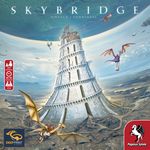
“Three Illustrations with fantasy motifs for a new series of 1000-piece jigsaw puzzles.” That was the assignment that led to the creation of the Skybridge in autumn 2010.
Beyond this, there were no instructions from the publisher, so I had to come up with something. Dragons! Fantasy – there must be dragons. But what else? I wanted it to be something else than the usual fantasy cliché with sword-swinging heroes and princesses to be saved in front of a Neuschwanstein-castle backdrop. Also, instead of developing three unrelated motifs, I wanted to come up with a small, short story to connect the three puzzles.
So, what’s cool? A hollow world. Ever since Journey to the Center of the Earth, I always found hollow worlds fascinating. What else? A huge tower, like the tower of Babel. Together with dragons, this could be exciting. Why is the tower being built? Well, as always with large monumental buildings, it is built to get closer to God.
Somehow this doesn’t really work for a hollow world, because there’s just the other side of the world to be seen in the sky. The sky over Thraen is finite, not infinite like ours. There was something missing to make it worthwhile for such a tower to be built.
Then I had an idea: In the middle of the hollow world floats a small planet, a moon! And what if the roles were reversed? If not the moon was an unlivable, dry world but the hollow world that surrounds it?
People must constantly fight for their survival on the outside, while they have to watch a lush, green and fertile world above their heads? A visible, real paradise, right in front of the eyes of all humanity? Wouldn’t that be enough motivation to build a huge tower into the sky that forms a bridge between the worlds? A world-bridge? A Skybridge?
Suddenly I had found my little story for the puzzles:
Part 1 – The construction of the bridge begins;
Part 2 – The bridge is half built, gravity flips to the other side;
Part 3 – The bridge is finished, people of both worlds meet.
/pic9362433.jpg)
The completed illustrations for the three jigsaw puzzles
The puzzles were produced and published, but were, as far as I know, not a great success: The puzzle series was not continued anyway. Normally, this would have been the end of the Skybridge and its worlds – if it hadn’t been for those prints.
The publisher gave me prints of the puzzles from the manufacturer. Full-sized, stable prints on really thick cardboard, not yet cut into individual puzzle pieces. I displayed and sold them in the following time at conventions, tournaments and game events. My little story about the Skybridge made visitors curious.
“Where can I read something about it?” was a question I was often asked. I always answered with “Sorry, I’m an artist, man. I can’t write.”
/pic9362434.jpg)
LEFT: Prints for sale at Emerald City Comic Con, Seattle, 2014 / RIGHT: Gen Con, Indianapolis, 2015
But over time, it started to bother me. Was it true that I couldn’t write? After all, I hadn’t tried it since my school days. So at some point, I decided to give it a shot sometime in 2011. I couldn’t say afterwards whether the result was good or bad, but one thing became clear to me: I really enjoy writing.
In the following years, the history and worlds of Skybridge grew dramatically. It became obvious that a short story wouldn’t do the emerging, complex relationships justice. The more I explored Thraen, Beeledhans Eye and the Skybridge, the more questions had to be answered. A three-part structure again offered itself.
Part I: How did the bridge come to be built after no one had dared to do it for thousands and thousands of days?
Part II: What happens when such a bridge is built under conditions of constantly decreasing gravity that finally flips to the other side?
And, last but not least,
Part III: What happens when the Skybridge is completed and paradise suddenly becomes accessible to all of humanity?
I would be a strange game illustrator if I hadn’t asked myself whether there isn’t a game somewhere in this story. Unfortunately, there is a good reason why I became an illustrator: math and I have always been at war with each other. But game design needs mathematics for their mechanics like players need the rules to play a game. It was clear to me that I was completely unsuited to developing a game on my own.
Then at a party during SPIEL in Essen – it must have been 2013 – I met someone who knows how to make games based on given stories: Michael Rieneck. I had already illustrated games he designed, but didn’t know him well. When we started talking, I gathered all my courage and finally told him about the Skybridge. Then I asked him if he could imagine designing a game for an unreleased book…
Michael:
… These are days still remembered many years later. And by that I don’t mean anything specific, like the weather or the corresponding date. I mean the feeling that this day triggered in you. Some kind of feeling that this day would change something. And that those experiences will have an effect for a long time. How long, I couldn’t guess, then back in the fall of 2013 …
Franz Vohwinkel just asked me if I could imagine developing a game based on a story that has been on his mind for a long time and that he intends to write a book about it. I had to sort that out for a moment and let it sink in. I have worked with book templates before and appreciate doing it very much. On one hand, books usually provide great stories and ensure that you don’t have to look for a – usually superimposed – theme for the game anymore. In addition, books offer a common thread for the development of a game right from the start.
But a book that doesn’t even exist yet? That seemed quite bizarre. But there were no doubts. When an experienced game illustrator like Franz Vohwinkel comes up with a story, then it must be something very imaginative that should give enough starting points for a game idea. I didn’t know what the book is about, but I already knew my answer: “Sure, I can imagine that.”
And so begins a long journey into a strange and epic world that has been taking an increasingly concrete form in my mind’s eye ever since that day, drawing me further and further into its spell.
I can’t remember exactly when over the years Franz told me various details of the story. But because I couldn’t read anything about it, I asked him countless questions about it while we were working together, and he patiently gave me just as many answers – a process that continues to this day. In fact, there is still a lot for me to discover in Thraen. In the beginning, it was the big topics that we discussed and that were supposed to play a role in the game. The hollow world of Thraen, Beeledhans Eye, the peoples of Thraen, the cruel queen, the Drakhes and all the Gods. And most importantly, the desire to build a Skybridge. “Great,” I thought, I had already found the game goal. I immediately felt reminded of the building of the cathedral in The Pillars of the Earth. With this, the thematic framework established quite quickly. Another one thing was clear to me from the beginning. Franz certainly would want to illustrate his story with opulent pictures. Hence, large playing cards are undoubtedly the best medium to let off steam artistically. Also, we’d need a big game board, of course.
When you accept such a big assignment, you quickly want certainty. Can I even come up with something suitable? Am I really capable of developing a good game for Skybridge that can convince the players and especially Franz? The project has taken over my mind and it keeps occupying it until I have success or I failed. After our first conversation that night, I got to work very soon and created a card-based board game in which the Skybridge is built. At that time, I knew only a few main characters from the story. Franz had already told me about some of the cities and landscapes of Thraen. I still remember vividly how strange many names seemed to me back then. Today they are familiar and it feels like I have known them forever. But I wanted to ignore all this at first and develop a good game mechanic that fits the topic and can be filled with life later. The first prototype was actually ready before Christmas. It crashed with a loud bang, not just for my test players but also for myself. The decisions were bland and the atmosphere of an epic story did not even begin to come up at the game table. Franz didn’t see this prototype or the second one, which also was a disaster.
So the start was already an utter failure. In addition, I had gained a realization during those first two attempts that initially frustrated me, but turned out to be a stroke of luck later on. Initially the players were supposed to form their own extensive card displays, which they laid out successively on each side of the game board. The space required for this reached far beyond the normal dimensions of a conventional play table. It quickly became obvious: A maximum of one row of cards could be placed on each side of the game board, nothing more, unless we use very small cards.
/pic9362435.jpg)
Example of cards displays on all sides of the game board
This didn’t seem to be a real option for this project, which was supposed to come to life through its impressive illustrations. Then I got the idea to limit the card display to a row of six cards, to make them fit comfortably to the side of a large game board. Whoever wants to play a seventh card needs to cover up one that’s already lying out. The covered card would then no longer be usable for the player. For the available space, this worked wonderfully. From this moment on, each player had six card slots available on his side, which had to be tactically used in a smart way. We already assigned a color to the cards of each ethnic group. Each group consisted of eighteen cards, which were available in separate piles on the game board. At the beginning of a turn, one player could draw an open card from one of the piles and receive a bonus from the respective people. This mechanism hasn’t changed to this day. Even back then, the top cards of the piles were only refreshed at the beginning of the new round. So the starting player always had the largest selection of cards to draw from in the current round.
With the help of the cards, the actions required for the game were controlled: procurement of technical knowledge and raw materials for the construction of the Skybridge, supply of food for the population, the expansion of military power, intrigues, oracles, praying for favors from gods, usage of Drakhes and more. There were quite a few different actions on the cards. Many were tried, many more were changed or abandoned.
The space problem was solved, but the game still didn’t work. The decisions were still trivial unfortunately. It was far too easy to construct a well-functioning display. So I wanted to limit the freedom of the construction of the card display. This was when the runes were born. With their help I wanted to tie the individual cards to certain card slots. If a player wanted to play a certain card, it had to be placed on a specific card slot and cover the card that might already be there. This quickly turned out to be a step in the right direction and I asked Franz to design six runes for me that could be depicted on the cards and slots. At first there was a total of six runes, but as it turned out, the freedoms were still too great.
/pic9362436.jpg)
The original six runes
Only after we limited the slots to five – and thus also the runes – was the slot management (as I called it) challenging enough as an essential game mechanic. (By the way, the sixth rune from that time still exists – you can see it on a belt of the rebel leader Raphis and as a tattoo on the neck of Hamises).
Franz:
In the meantime, Michael and I had started working on a serious prototype for the game. The first elements we needed were, of course, icons for the actions, layouts for the playing cards, and the game board.
/pic9362437.jpg)
Michael needed more and more background information about Thraen for his work on the game. My focus during this time was therefore mainly world building. Although much of it already existed in writing, the geography of Thraen needed to be visualized. I had to create maps to fully understand the connections between the regions and their peoples.
From these maps, prototype graphics of the game board and the playing cards were then developed.
/pic9362438.jpg)
Maps of Thraen
/pic9362439.jpg)
The first playable board
/pic9362440.jpg)
Prototypes for SPIEL in 2018[
Michael:
In the meantime, I was sure I had found the core mechanism of the game. Now I got down to work on the distribution of the cards and their functions over the five runes. For this I was in a lively back and forth with Franz about what could be included in each stack of faction cards. “Metal and Drakhes are only available for the Utreng, salt comes only from the cities of Shenna” is an example of the kind of information that I received from him. One can easily imagine that thematic correctness and game developing necessity did not always go hand in hand. We had to make compromises, but by that time I had long fallen to my own “Skybridge fever” and I no longer wanted things in the game to be completely different from the written story. It was a challenging puzzle that we had to solve together, but we managed to distribute the actions coherently and meaningfully among the now 100+ cards.
Meanwhile, Franz had made a breathtaking three-dimensional skybridge that was enthroned in the center of our game board. It looked absolutely gorgeous and I still have the picture of it close to my heart.
/pic9362441.jpg)
Cardboard prototype version of a 3D Skybridge
By that time, I had no more doubts that we’d find a publisher for Skybridge. What a painful misconception! Many days, weeks, months and even years of work were already spent on the project. Not only in terms of the development of the game design itself, but also in terms of the design of the prototypes, which, thanks to Franz, presented themselves differently than those I usually create. Should all of it have been in vain? For a brief period of time, we even played around with the idea of running a Kickstarter campaign. But in the end, the project seemed too big for us—we had no experience in this area. As difficult as this was for us, we had to admit that we would probably not be able to capture the history of the Skybridge in a board game and convince other decision-makers. At this point, the chapter “Skybridge board game” looked like it had finally reached its end.
Then the Vohwinkels decided to move from Seattle to Eckernförde at the beginning of 2020 – which happens to be about a 15 minute car drive from my home.
Franz:
After presenting the first prototypes to various publishers, it became clear to us that we still had a long way to go with the second prototype: Most important steps were moving the card slots from the game board to individual player boards and to disconnect the skybridge and the group of central draw piles into two separate game boards. With this new flexible version, Skybridge was now adaptable to a wider range of table sizes.
We also streamlined the gameplay and its essential mechanisms to make Skybridge less complex and more accessible.
/pic9362442.jpg)
Streamlined prototype versions of the game board, player board, and Skybridge
Michael:
Instead of communicating across the Atlantic, we were suddenly able to work collaboratively at the same table and try out new ideas together in smaller steps.
But what was left of our game, after all? Our “old” Skybridge was too bulky and overloaded, too confusing and long-winded for most publishers. There was so much criticism, I hardly remember it all. Still, we wanted to use the luxury of simply being able to meet every week in person to make one last attempt. For a start, we subjected our prototypes to a radical cure. Game board reimagined, event cards forgone, 3D bridge removed, development tracks eliminated. All that and much more. We streamlined the game significantly. As it turned out, we were really lucky. Maybe it was the luck of the skilled, but still, I consider us lucky: The new, stripped down game still worked. In fact, we instantly liked the new version much better than the previous version. It is actually rather rare that such drastic changes immediately work well.
/pic9362443.jpg)
But, surprisingly, so it happened. The flow of the game was better, the playing time was significantly reduced, somehow everything seemed to be more precise, more to the point. Suddenly we were hopeful again and we got to work – now in Eckernförde – with renewed verve. We had the new player boards and smaller, more functional game boards. This made the handling of the components much more pleasant and feel less rigid. We played countless times to further balance the game and test the new individual abilities for the players. Expanding these asymmetric player skills was an important step for us, to give the game the greatest possible variance.
Franz:
The large card size had been planned from the beginning, but until this point we used the regular trading card size, because it was more convenient for the creation of the prototypes. Now the time had come to convert all the cards to the large format. At the same time, the old placeholder-graphics on the cards – which showed just early sketches for the maps of Thraen – were abandoned in favor of mock-up sketches that showed people, landscapes and cities.
/pic9362444.jpg)
Example of original prototype cards next to expanded illustrations
Michael:
When we presented the new version, it seemed like we were actually on the right track. But despite intensive work on the game, this version also turned out to be a fallacy in the end. And so, at the end of 2022, we again reached the point to put Skybridge with a heavy heart into the drawer of failed projects. By now, we were mentally too deeply involved in our game for another complete restart – we were still convinced that our game was the best it could ever be.
Franz:
The second version of Skybridge also did not find approval from the editors. Our Skybridge board game project was thus over for the time being. Looking back, I can’t say whether I felt more disappointment about our failure or relief that the ordeal was finally over.
In my free time, I concentrated all my energy on the novel, which had grown to a considerable size in the meantime.
Michael:
And then luck struck again. This time it did not come from ourselves, but it came to us from the outside. I can’t remember the context and on which occasion it happened, but Peter Eggert asked me about our game -it was the beginning of 2023. He wanted to know what actually became of the game I and Franz had been working on.
I always had the different versions with me for testing at a game event of Inka and Markus Brand in Lieberhausen. That’s where Peter had seen the various prototypes in the years before.
“Unfortunately nothing,” I had to tell him. “Then bring it to Lieberhausen again,” he suggested. I brought it along in consultation with Franz and I played the game several times with Peter and his team. It actually went well. Or, as Peter usually phrases it: “That’s pretty good, but it can be even better.” He could actually imagine publishing the game after editorial processing at Deep Print Games. And just like that, hope and enthusiasm for the project were back again and we got to work with Deep Prints editor Moritz Bornkast. One thing was particularly important to Peter: He thought the game needed a little more complexity. He envisioned a third strategic level in addition to building the bridge and worship the gods. The resistance against the rebels and the simultaneous expansion of one’s own military power should become significantly more important to achieve this. The implementation of this third branch of strategy was once again a lengthy process. Not least because it made profound changes in the cards necessary. The new rebel game plan was created, which led to new garrisons and a new function on the cards. Other elements had to give way. Once again, thematic and mechanical adjustments to the many cards were necessary. In the end, it was worth it.
/pic9362445.jpg)
/pic9362446.jpg)
Franz:
When Peter Eggert from Deep Print Games appeared out of nowhere and expressed interest in Skybridge to Michael, I was extremely skeptical at first. I just couldn’t imagine that a solution could be coming to us and our game so easily and unexpected.
At the moment of signing the contract, the hobby of “Skybridge” instantly became a huge pile of work. It had suddenly become clear to me, that my imagined worlds would indeed be published after such a long time. I immediately started to feverishly turn the images in my head into pictures for the game.
In order to be able to really dive deep into the project, I stopped accepting any commissioned work since then and I solely focused on Skybridge.
Michael:
While Franz devoted himself to his artistic work around the clock, for me the most wonderful time began. I worked with Moritz fine-tuning the content for the last time. A few details here and there – there wasn’t much more to do for me. I don’t know how other authors feel, but for me, these are the best moments in a project. The moments when you see your game idea take shape with your own eyes for the first time and its full creative power unfold. I got to see new images from Franz every week, one more beautiful than the other. Places and people, all of which had existed only in my imagination, suddenly became visible, as if a thick veil of fog had been lifted step by step. It felt a bit like I was meeting old friends again after a long time and I was traveling to forgotten places of longing with them …
Whatever happens, however the game continues its journey, it has a special place in my heart and I’m utterly happy and grateful that I don’t have to get it out of my drawer when I want to play it.
Tell us how can we improve this post?