
by Vics78
/pic8978383.jpg)
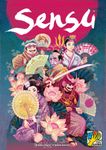
What immediately stands out in Sensu is the beauty of the fans and how they are constructed simply by placing the cards next to one another — long, oversized cards enhanced with a golden effect that highlights their elegance.
But as I’ll describe in this diary, Sensu is a game born primarily from its number-based mechanisms and card combinations.
The Gioco Inedito Competition
In the autumn of 2022, the new theme for the Gioco Inedito contest was announced. This is an international competition associated with DV Games and Lucca Comics & Games, the biggest Italian geek-related convention. The winner is announced in March of the following year, then the winning game is produced and presented at the Lucca fair in late October of the same year.
The theme that year was “Venti”, a wonderful theme for a game designer, a single Italian word with two meanings: “winds” or “twenty”. The choice wasn’t random as it was the twentieth edition of the contest.
The competition includes constraints: either a pure card game (of up to 110 cards), or a game with 55 cards plus one die and up to five pawns. Interestingly, this second option — which could allow for more variety — had rarely been used among past winners. Even I, in the three years I had participated, had never chosen that route.
The Core Mechanism
I began designing a card game inspired by the contest theme, but treating the two meanings (“winds” and “20”) separately. Curiously, the “winds” idea didn’t lead anywhere — perhaps because I tend to start from mechanisms, and I do have a mathematical background. I briefly considered a game in which wind drafts had to be blocked on a map built from cards, but abandoned that quickly.
The number “20”, however, immediately suggested something:
• Numbered cards
• Create card combinations that add up to 20
• Score more or fewer points depending on which cards were used
My key observation: If cards are numbered 1 to 9, using a 1 makes the combination more difficult than using a 9. For example, if your combination includes a 1, you need at least three more cards to reach 20.
As a result, I decided that the points earned from a combination would be based on the lowest card used in that combination. After playing the combination, the player would claim that lowest-numbered card to keep as a scoring marker: 4 points for a card with value 1, 3 points for cards with values 2 and 3, and decreasing from there.
But I didn’t want the scoring to be only about sum-to-20 combinations. I wanted players to be rewarded for pairs, triples, and quadruples, as well as for matching colors, so that players had tactical choices when building combinations. The card design would show these combinations.
The challenge was how to assign these additional points and record them. One thing was certain: The first player to reach 20 points would win!
At first, I used dedicated point cards that could be stacked and oriented to represent 1-4 points each. Not elegant — and driven by the contest’s “cards only” restriction — but it worked for early testing.
/pic9287262.jpg)
The first prototype of Sensu‘s ancestor: Do20!
With the core mechanism ready, I needed a card-drawing system. For the initial playtests, I used a simple draw-or-discard structure, like Rummy. However, one feature that stayed from the start was that on your turn, you either draw or play a combination. This choice made the game flow more cleanly.
Japanese Fans: The Sensu
The game worked and produced interesting decisions — but was it original enough?
A few weeks before the contest deadline, I had the key inspiration: What if the scoring cards formed a fan? This instantly reinforced both aesthetics and theme.
The three colors of cards became three types of fans. The goal became completing two 10-stick fans…which was still 20 points in total to win! This also allowed an “exact closure” mechanism such that if you exceed 10 sticks in a fan, you must discard the excess. That added a meaningful strategic constraint.
At the same time, I simplified the bonus scoring by allowing bonus cards to be claimed directly when forming certain combinations (such as pairs or color triples), eliminating the need for separate point cards.
In other words, the theme didn’t just make the game more beautiful; it improved the mechanisms of play.
Tweaking the Fans
I researched Japanese folding fans, the “Sensu”, and focused on three traditional types (without worrying too much about historical periods):
• Hi-ōgi – ancient wooden court fan
• Mai-ōgi – used in dance and theater
• Gun-sen – metal war fan used by samurai
I even added kanji, taking the risk of inaccuracies, but atmosphere mattered. I checked whether anyone had ever made a game in which players physically build fans out of cards. To my surprise, I found nothing. A simple idea still unused!
At this point, I felt I had something strong, both mechanically and thematically. The game was ready to submit, under its new name: Sensu.
/pic9287264.jpg)
The Sensu prototype I sent to the competition
There were sixty entries that year, so competition was fierce. In March 2023, the finalists were announced, and soon after I learned that Sensu had won first place!
I immediately began the development phase with DV Games, working with their developer and renowned author Domenico di Giorgio. The contest version already worked smoothly, so few mechanical changes were needed. Even the title — usually reconsidered at publication — remained Sensu, which was short and distinctive.
I spent the following months designing a solo mode.
The illustrator, Andrea Guerrieri, began working on the artwork right away. One important ergonomic change was avoiding upside-down fan drawings on the cards. This made handling the cards easier and ensured numbers were visible for left-handed players, too.
I suggested adding fan-closure cards featuring characters that embodied each fan type. These would be useful for gameplay clarity, but they also added a strong thematic presence. When I saw the final illustrations, I was amazed. Professionally drawn fans gave the game a soul. (My prototype fans now looked very ugly!)
Lucca Comics & Games Presentation
The game premiered at Lucca Comics & Games in November 2023, with three play tables and a team of demonstrators.
/pic9287265.jpg)
First edition of the game at Lucca Comics & Games 2023
I spent many hours teaching Sensu, signed lots of boxes, and gathered excellent feedback. Two recurring problems emerged:
• Flow and scoring mechanisms: about 10% of players needed a couple of practice rounds.
• Mental arithmetic: casual players sometimes found sum-to-20 combinations non-intuitive.
A New Development Phase
DV Games was interested in a wider edition, so I explored versions in which the target sum was not 20. I developed and tested two versions: “Sensu-12” and “Sensu-15”. The goal was to reduce arithmetic strain and shift decisions toward combination quality rather than calculation.
I also expanded the fans from three types to five, which allowed richer aesthetics and introduced two new wonderful characters: the cook and the priestess.
The 12-sum version felt too simplified, while 15 struck the right balance. From there, I carefully re-balanced the combinations and playtested thoroughly. In the new edition:
• The basic mode still focuses on closing fans, but now players must complete three fans, each with seven sticks.
• The advanced mode introduces alternative victory paths, such as collecting power symbols or opening all five fans early.
At SPIEL Essen 25, the new edition of Sensu was officially presented. Never would I have imagined such a beautifully refined edition of my game!
/pic9288477.jpg)
Tell us how can we improve this post?