
by AC Atienza
/pic8531044.png)
Part 1: How Hard Can It Be to Design 1-HP Heroes?
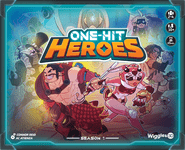
One-Hit Heroes ended up with an ambitious design vision, but it didn’t start that way. My coworker Connor Reid just thought the name “One-Hit Heroes” sounded cool and liked the idea of boss battles that started at the “good part” when you’re one hit away from losing.
But a cool title alone would not have been enough reason to muddle through the trials that we did. Ultimately, we did it because the more we learned why other games don’t give players just one health, the more we became determined to make it work anyway.
Early designs of this game were rough. Unsurprisingly, making all your characters have 1 HP leads to lots of balance issues. Tweak one number, and a previously dull boss would become insurmountably difficult. Make the heroes a little stronger, and suddenly the fight’s trivial again.
This was our first design lesson: Health pools don’t exist just for the sake of tradition. They give you granular amounts of feedback on your performance. Not only does that health pool let players make mistakes without being forced out of the game, but it also lets the game have variability without suddenly making them lose out of nowhere.
We had plenty of design time to experiment, so we did. It quickly became clear that the concept of “Aggro” (the mechanism where attacking enemies makes them more likely to hit you) would be instrumental in making this game work. We followed the fun, not knowing at the time that it would become a core gameplay mechanism.
Another thing that became clear was that fights were far too swingy with just one health. A bad dice roll, a bad decision, or a tough boss could make you lose before your first turn, so we re-framed the phrase “One-Hit Heroes”: What if heroes started with 1 HP, but could heal or play armor cards for more health? We’d get the benefits of health pools and keep the title at the same time.
Designing armor (and extra health) made the game seem fine enough to play, well enough to maybe ship, so we built the heroes, got art, finished Episodes 1 and 2, and began working on new content. Everything looked great! In particular, we were proud of the Aggro system, which gave us design freedom for bosses to threaten damage without directly dealing hits. Somewhere in this mechanism, we knew we were really onto something. It was just a matter of smoothing out some of the squishier heroes, and we’d be right on track to launch our game soon.
/pic9214932.png)
Part 2: Letting Players Play
The next challenge came up in four-player games. Players who went last in turn order were far more likely to die than players who started sooner. Along the same lines, player elimination was a thing, so heroes could spend 90% of a fight twiddling their thumbs while everyone else played.
Tested: What if heroes started fights with armor in play?
Rejected: Starting with what was essentially extra hearts went against the “One-Hit Heroes” concept, and it made the game just a little too complex to learn armor cards on turn 1.
Tested: What if we changed how turn orders or boss attacks worked?
Rejected: We tried many ideas. They either made balancing even worse, or made the game too boring. Having the boss threaten attacks against all heroes semi-frequently was a feature that kept the game feeling tense even when it wasn’t your turn.
Tested: A “recovery” card given to all heroes that allows you to play it on your turn to give any hero 1 health (even KO’d ones).
Accepted: It worked!
Each option we rejected taught us more about One-Hit Heroes by exposing sacrifices we were willing (and unwilling) to make. For example, we learned we wanted this game to be easier to teach and set up than its cousins in the “boss battler” genre. We also realized it was important for each player to feel engaged with the game the whole time, even if it’s not their turn, so early player elimination was something to mitigate or avoid if we could help it.
Luckily, recovery felt like a good solution to our problems. We started wrapping up the game based on the internal playtesting, so it was time for external playtesting to verify balance.
/pic9214934.png)
Part 3: The Martyr Meta
My core playtesters are awesome people, and they are also great playtesters. Of the many benefits of running playtests, I am most grateful for — and frustrated by — my group’s astute ability to find exploits. Before moving onto this core playtester group, we had figured that One-Hit Heroes was in a good enough spot to release at any point. What happened instead was an implosion.
The specific antics of my core playtesters are too convoluted to describe, but the short story is this: They discovered that optimal gameplay was for everyone except one hero to die on purpose and to use their recovery card to stack health on one chosen hero.
Obviously, we modified the recovery card…but dying was still optimal. I changed the card again, but dying was still optimal. I changed how boss turns worked, but dying was still optimal, and also, players would randomly lose for no reason now. I removed recovery from the game, yet it was STILL optimal to die!
This gameplay pattern made no intuitive sense, so it had gone completely below our radar. As it turned out, this “martyr meta” was already unbeatable the whole time, but we didn’t even know about it until the recovery card was brought in. Worse, there was no way to fix it without causing a cascade of other design problems.
This game was supposed to be basically finished! What could we do now? We had to seriously reflect and decide between several uncomfortable options:
1. Just ship the game and hope that other players wouldn’t find the Martyr Meta.
2. Change the title of the game to “Boss Rush Heroes” or whatever, cast aside the 1 HP dream, and give all heroes 3 HP.
3. Keep trying to find a rules solution that could fix this without requiring a design overhaul.
4. Dig deep into really understanding and revamping how HP worked, risking a mountain of extra work to re-design and re-balance everything all over again.
/pic9214946.png)
Part 4: Design Quest
Of course we had to make the fourth decision, but I was surprised at how easy it felt to make that choice. “Boss Rush Heroes” wouldn’t have been a bad game at all…yet at some point, our dedication to this game had shifted beyond just the fun name. There was something special about the 1-HP challenge, and Connor and I both felt it.
The next step was to brainstorm and to figure out why we felt it. Honestly, the only thing that felt totally right this whole time was the Aggro system. Something in there, perhaps? Well, we reasoned, Aggro’s main purpose was to simulate partial HP loss. The more Aggro you had, the more likely you were to lose HP — or looking at it from the opposite side, removing and managing your Aggro was a player’s skill-based way to manage their own survival.
And that was the key. Aggro had always felt fun in One-Hit Heroes because it represented what 1 HP meant: If you have only 1 health, then your odds of survival were entirely in your own hands. Plenty of games had shielding mechanisms, but One-Hit Heroes placed full responsibility on you to respect every single move the boss made. You couldn’t just stack armor or health to stabilize against a boss before doing your own plan. Instead, your survival had to constantly be considered with each move you made, even attacks.
With this revelation in mind, Connor and I went into a design frenzy. We basically locked ourselves away and playtested dozens of ideas with that prompt in our heads: to create skill-based HP. Most of these ideas were bad, but that’s the point of brainstorming. Many were weird, some were promising, and only one from each of us felt right to keep.
I reasoned that the core of health was the ability to survive obstacles without your own agency being required, so my contribution was a new card type called “reactions”: cards you played outside of your turn during specific time windows that let you survive hits in special scenarios. The idea was to add agency by making reactions require specific situations and an active choice to draft/use. Reactions also added an extra bit of engagement to players while it wasn’t their turn since there was extra opportunity for conversation around who could or should help someone else.
Meanwhile, Connor brought out a single genius suggestion that was actually a bunch of small ideas in a big trench coat:
• Remove armor cards from the game.
• Remove the legendary card type.
• Remove hero powers.
• Allow all item cards (cards that stay in play and give ongoing benefits) to block hits for a hero, but at the cost of their destruction.
• Spend the extra “complexity budget” that we gained by making the above removals to let heroes start with two item cards in play.
/pic9214961.png)
Connor’s motivation for this design came from a totally different angle. He reasoned that the core of health is when an opponent could win a “round” against you without affecting your abilities. Meanwhile, other mitigation equivalents like shielding, dodging, etc. either required execution skill to avoid the damage, or execution skill to mitigate fallout post-damage, e.g., choosing which item to destroy.
To be honest, I wasn’t sure about his design at first. We had resisted the idea of players starting with armor in play for so long. Would items really feel different? Would players feel like the game wasn’t “one-hit” heroes?
But playtesting went well, VERY well. It was the most frustrating lesson to learn, but the most important one: We had most of these design ideas at one point or another at an individual level, but we had considered each idea only in isolation, trying to avoid “undoing” other design work each time instead of accepting that it’d be worthwhile to revisit the core and start from the top.
Part 5: One-Hit Heroes
It took time, and it took work, but we rebuilt our heroes, who had all been essentially destroyed by the major gameplay overhauls we had made. Playtesting continued to go well. We rebuilt Episodes 1 and 2 with these new mechanisms and found that we could make the bosses do more interesting things, things that previously couldn’t work because they’d be too swingy, but thanks to our triple axes of skill-based HP — Aggro management, reactions and blocking items — we had a world of design space now.
Best of all, Connor and I quietly removed player elimination from the game, determining that all heroes would lose if anyone got hit…and the game did not break. The Martyr Meta was finally over.
/pic9214972.jpg)
The rest of design wasn’t necessarily an easy ride, but it was far easier than figuring out how to give heroes 1 HP…although in the process, we had finally figured out what was so fun about One-Hit Heroes: By changing health from a single passive measurement to a network of different resource management minigames, we shifted survival from a simple metric to an active skill check. Protection has a genuine direct effect on the game state and your ability to attack, making it just as challenging and rewarding as putting together damage combos. We learned that there is fun to be had in challenging heroes to assemble survival tools out of whatever they can find, especially when losing focus always means losing something important.
We’re proud to have preserved the essence of One-Hit Heroes and undergone the struggle to make it work, improving the fun of everything else along the way. What started as a simple funny concept has transformed into a rewarding experience, and I can’t wait for you to play through the full game and experience it all for yourself.
/pic8169595.png)
Tell us how can we improve this post?