
/pic7066588.jpg)
Editor’s note: With apologies to the designers, I’m publishing the diary they submitted in 2022 and that I have somehow overlooked until now. —WEM
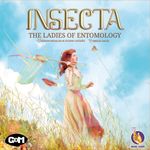
Welcome to the designer diary for Insecta: The Ladies of Entomology, a game designed by Eugeni Castaño and Ferran Renalias and illustrated by Amelia Sales that’s the second game in the natural history series published by Mont Tàber following 2019’s On the Origin of Species.
This pattern building game for 2-4 players is a tribute to women who contribute to entomology by beeing brave, irreducible, and tenacious in their passion for insects.
Starting Point: A Picture Is Worth a Thousand Words
There are many starting points for a game: a theme, a mechanism, a feeling, components… In the case of Insecta, the game started with an image.
One day, a couple of years ago, Ferran saw the cover of the book On the Origin of Species, which featured a large collection of insects. At that moment he thought: “Here’s a game!” The idea of building a collection of insects on the table during the game could be very cool.
At that time, we were developing our first joint game, Fun with Flags (TBR 2023), and we took the challenge of starting a game to fit a final image as our next future project.
/pic7066564.jpg)
Naming the Game
Without having a clear idea of the game — without having developed practically anything — we posted a survey on Twitter to see whether we could generate interest in the theme.
We explained what the game would be about and proposed different names for people to vote on: “Insectario”, “Insecta”, and “Entomon”. “Insecta” received the most votes, along with a multitude of comments from people who showed their curiosity about the game and wanted to know more. It looked good — all we had to do now was “simply” build a game for that beautiful name…
/pic7066565.jpg)
The survey results
Mechanical Development
The good reception for our proposal encouraged us to start working immediately. Eugeni took full responsibility for developing the initial idea. We wanted a simple and effective concept, and perhaps by means of a kind of checkerboard, insects could be combined with objectives adjacent to them.
/pic7066566.jpg)
Tiles in the first prototype
Once the main concepts were defined, Eugeni began to develop a first version of the game in which we defined insects of different classes, sizes, and origins. We liked to play with features that were prime numbers, e.g., five classes, three origins, and two sizes, to give a specific flavor to each feature, along with distinct distribution.
All of this was linked with a simple and fast mechanism for quick turns: You could choose two of four tiles of insects and objectives in order to develop your insect collection in a preset-sized box.
/pic7066567.jpg)
First internal playtests of the game
Readapting the Theme
From the beginning, we thought that the game would fit Mont Tàber’s historical-scientific line, on which Ferran had previously worked with On the Origin of Species, so we looked for a specific theme that could make sense. We adapted the prototype to Darwin’s travels through Australia during 1836, using the locations he visited: Sydney, Hobart, and King George’s Sound.
At this stage we shared the project with José María Bellostas, editor of Mont Tàber, and on May 2021 we signed the game knowing that there was still a long way to go.
The first change proposed was the setting in order to adapt it to different entomologists and researchers who contributed to the development of science during the last centuries of the first millennium. To help, the publisher brought Xavier Sistach, a passionate writer and expert in this field, to the project.
/pic7066570.jpg)
Xavier Sistach’s book
Traveling around the World
In the joint development with the publisher, we decided to increase the game’s depth and enhance your decisions in it.
We changed the main mechanism by switching to action selection, swapping between the left and right action boards. The main decision would be to choose between gaining power in the actions or initiative for next turn. This reduced the multi-solitaire game feeling, adding a layer of struggle and interaction between players.
Additionally we introduced two new elements. First, we incorporated a game map of the world through which we should move continuously to introduce a new layer of management in your collection of insects. Second, we added different medals over which we would fight individually for the recognition of research work.
/pic7066571.jpg)
One of the first versions with the world map
At this stage, we also worked with Steve Schlepphorst and his team at Genius Games. We shared with them the progress of the project and obtained valuable feedback. We learned a lot about different aspects of design, like the arc of the game or the restriction vs freedom of rules.
Many people also tested the game during the various stages of our development process, and it grew due to their contributions. We would like to thank all of them!
/pic7066573.jpg)
The game in its final stage
Working with Mont Tàber
As the game grew, we began to turn our attention to the female researchers, the true protagonists of this story. We wanted the game to allow us to get to know them better. First, based on the biographies of the five researchers, we selected specific insects that should be part of the game.
Later, we developed personal abilities for each character. Our intention was to have players discover to the personality, knowledge, and experiences of each one of them, based on their character actions.
/pic7067141.png)
The five entomologists of the game
Mont Tàber chose Amelia Sales to illustrate the game, and she drew amazing illustrations of historical themes.
She started with the 25 insects represented in the game, continuing later with a world map with aged tones, then an evocative image for rulebook cover as well as many other illustrations that make Insecta a real art piece. Finally, she created the cover design, an illustration that made us fall in love at first sight.
/pic7067142.png)
Insect tiles
/pic7067140.png)
Correspondence tiles
/pic7067653.png)
The main board
We suggest that if you can play the game, don’t miss the opportunity to flip the board the other way. Maybe in the back there is something absolutely beautiful… Who knows?
/pic7066589.jpg)
Eugeni and Ferran
Tell us how can we improve this post?