
/pic8400919.jpg)
It all started, as so many great ideas do, while walking our dog in the park during the summer of 2018. We were chatting about game mechanics (because, obviously, that’s what normal people talk about on dog walks) and stumbled upon a concept: a set collection system where tiles could serve multiple purposes. Instead of needing specific pieces for a set, players could use a mix-and-match approach. And what theme fits better than paleontology? After all, scientists have been creatively(!) assembling dinosaur bones for centuries. Case in point: Elasmosaurus, which had 71 cervical vertebrae – more than any other known animal – confused paleontologist Edward Cope so much that he placed the skull on the dinosaur’s tail. Whoops.
/pic9423246.jpg)
Back to the game: We began designing fossils composed of 1, 2, 4, or 6 tiles, spread across three excavation site variants. We also categorized fossils into three types: terrestrial, aquatic, and botanical. Interestingly, despite all the iterations and big changes, these core elements remained unchanged throughout development.
The next step was deciding where players would exhibit their fossils. The obvious answer? A museum. This led us to a grid-based display system where rows and columns were linked to fossil types. At first, matching a fossil to the correct row or column provided a placement bonus, but we
later switched this to an income system – because: who doesn’t love a good engine-building mechanic?
/pic9423247.jpg)
Looking back, it’s fascinating how the initial prototype felt both very different and surprisingly similar to the final version. The main actions were already there but instead of a shared action board, players had individual action slots on their boards. Excavations originally involved hiring paleontologists, which sounded fun until it became clear they were causing chaos. It was never clear where they were digging, and players had little incentive to hire more than one or two. So, we did what game designers must sometimes do with their darlings: we mercilessly cut them. In a chat with designer Mandela Fernandez-Graydon, we had a eureka moment: linking worker placement directly to excavation. Now, where you place your workers determines where you dig next. Bonus: Other players’ workers unintentionally help you, increasing the number of tiles you can draw. Cooperation through competition!
/pic9423226.jpg)
Fast forward to September 2021. We were confident we had nailed the mechanics and were ready to focus on production. However, one playtest changed everything. A comment that stuck with us was: “Where are the visitors?” Museums need visitors, yet our design focused solely on management and exhibition. Thus, our editor Rico pushed us to introduce visitors, which in turn created interesting new mechanics. Players now gain visitors whenever they complete a fossil, because, in real life, unveiling a new fossil would surely attract a crowd!
/pic9423227.jpg)
This change also allowed for more refined balancing: instead of directly awarding victory points, players now receive visitors, which later convert into points at a 2:1 ratio. It also led to our personal favourite: a visitor queue. Instead of a dull counter, players physically extend a queue track, making it clear just how popular their museum is. After these major changes in 2021, both we and our editor quickly realized that everything had fallen into place. It finally felt like the complete game, allowing us to shift focus to final touches and production management.
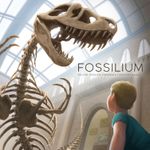
We specifically requested a female illustrator and fell in love with April Borchelt’s art style. We were thrilled when she accepted the job. Her fossil illustrations are stunning, and she provided several cover drafts before settling on the final version – a dynamic, eye-catching piece that immediately draws players into the game.
Rico had an early idea to include standees for completed large fossils. Not only do they look fantastic on the table, but they also serve as clear visual indicators of scoring potential. Alongside April, Dennis Lohausen worked on the icons and standee designs, while Gaston handled everything else: boards, rulebook, characters, and more.
/pic9423228.jpg)
Simultaneously, we collaborated with the Natural History Museum of Berlin for scientific accuracy. Despite extensive research, we made numerous mistakes when placing species in the correct time periods or scaling fossil sizes accurately. Dr. Luthardt, Dr. Schwarz, and Dr. Neumann were instrumental in refining these details and contributed fascinating fun facts found in the final rulebook. Dr. Luthardt, in particular, provided invaluable insights into paleo-botany – a field we found unexpectedly captivating. Check out the story behind Wollemia in the game!
/pic9423230.jpg)
Final fun fact: Our dog Jordie is in the game! Look out for the tiny brown puppy with one ear up, one ear down. He’s been with us when we first had the idea and through all the highs and lows, so naturally, he earned his spot.
Looking back, we couldn’t be happier with the journey and where it led us. Fossilium turned into a beautifully crafted, accessible strategy game with high replayability and rich thematic depth. Our fabulous editors Chantal and Rico made sure that even the smallest detail – balancing, icons, rulebook, material, etc. – is addressed with meticulous care. The artwork, components, and table presence are stunning. And, of course, there are dinosaurs. What more could a board game designer wish for? (Okay, maybe a pet dinosaur. But until then, this will do.)
/pic9423229.jpg)
/pic8756644.jpg)
/pic9424037.jpg)
Tell us how can we improve this post?