
by Felix Sonne
/pic8941751.jpg)
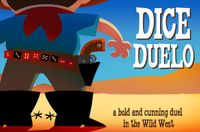
Dice Duelo is a semi-abstract, two-player dice-placement game set in the Wild West. You are playing as a gambler-duelist — it’s the Wild West, what do you expect? — who will duel to the death on a poker table…with dice.
The premise of the game is that each duelist’s revolver has six bullets, which are their dice. They take turns loading their bullets, one by one into the cylinders, then they “shoot” their opponent by forming a poker combination on the game board. The catch? You want to shoot quickly, but you also need to shoot with the best combination to ensure you can hit your opponent.
1) The Theme: Wild West
There is endless discussion of whether a game should be designed top-down (i.e., starting from the theme, then figuring out suitable mechanisms) or bottom-up (setting up good mechanisms, then applying a suitable theme afterwards). I come from the school of thought of “theme first”…which then creates the challenge of answering the question “What theme should we work on?” The possibilities are vast. It is like standing on a frontier.
There must be a directional point for otherwise we would be lost, and ours was: We know it is going to be a two-player game, it will be competitive and will likely be (very) mean (that is just how we play our games); it will involve dice rolling; and we know it should be simple and accessible for as many people as possible.
It took us quite some time for this first step. We ran through the whole list of themes, and nothing seemed to fit the bill. We bounced ideas between us until we hit the most rudimentary form: “What is a fight between two people? A duel. What do you associate with the word ‘duel’? A cowboy. That’s it! It’s the Wild West!” We tried some preliminary ideas, and they worked almost immediately.
2) The Design: Hairy Shooter and the Chambers of Sixes
As an unintended consequence of having the Wild West theme, everything revolves around the number 6 because that is the number of bullets in a revolver. Therefore, each player has six dice! And they will be d6s! The game is played in six rounds! A player will have sixty seconds to return fire! The rules shall be explainable in six minutes!
As you can see, things went into a barely controlled chaos from there onwards, but it was exactly this crazed ideation process that kept us excited and stuck to the process.
I do not want to talk too much about the details of how we settled on key mechanisms as that would be relevant only once you’ve played the game. When that time comes, you can read about the (obviously) six “Eureka” moments that shaped the design of Dice Duelo.
/pic9006236.jpg)
3) The X-Factor: Perfectly Balanced as All Things Should Be
My co-designer Ronny Jr and I are two very different people, but we are united by the love of games. I am a happy-go-lucky dice roller, and he is a good (really good) brainy abstract game player. I want something happy-go-lucky, he likes it deep. I want randomness, he prefers calculated moves.
Despite our differences, we focused on our common objective: We want a “simple mean fun” game. This brought another unintended consequence: Dice Duelo turned out to be a well-balanced game.
There is enough randomness with dice rolls, but the randomness is limited since you roll them only once. You can calculate the probability, but it is not deterministic since you do not know what your opponent rolls. There is enough thinking because you get to use your opponent’s dice…and your opponent may use yours.
In essence, there is enough of a luck factor for a newbie to beat a pro if they are bold enough — and enough skill factor for a pro player to win more than half the time. The game is intense since a lot of times you win with a close margin, but not nerve wrecking since the game has multiple rounds.
/pic9006238.jpg)
4) The Direction: The Path Less Traveled
For a compact game, Dice Duelo includes a handful of things: dice placement, card counting (well, dice counting in this case), spatial manipulation, and bluffing. As a thematic player, game mechanics like these are not the end by themselves. As a thematic designer, my task is criss-crossing these numerous possible paths in my intended direction to the final destination.
At the beginning of the design process, it is tempting to follow a safe known path, a proven formula. For example, when we started, we observed that games were getting unnecessarily complex, many experienced “component bloat”, and some mechanisms like trick-taking or deck-building were getting into everything. I am sure my co-designer can make a big deck-building or trick-taking game with a Wild West theme, but that did not fit our design direction. We wanted “simple mean fun”, and we stuck to it. In a gold rush, miners flock to the latest known hot spots, but sometimes you follow the path less traveled because that is where the adventure is.
5) The Name: The Good, The Short, and The Catchy
Eventually after the mechanisms are done, you need to name your game, which feels like naming your children. Naming is important because it creates a first impression that people are going to judge.
After playtesting sessions (probably around six), we know the game will involve dice rolling, poker combinations (pairs, straights, etc.), and shared dice on the board, like Texas Hold’em Poker. That is when it clicked: “I got it! Let’s call it ‘Texas Roll’em’! Get it? Because it is Texas Hold’em Poker, and we roll dice. It’s genius!” I quickly checked BGG entries and found two entries of “Texas Roll’em” from 2005 and 2020. My disappointment was immeasurable, and my day was ruined.
The 2005 game was designed by Richard Borg, yes THAT Richard Borg, one of my all-time favorite designers who made the Commands & Colors system. The 2020 version was published by Steve Jackson Games, one of my favorite board game companies. Research showed those games were quite different, so my disappointment dissipated as quickly as it arose. We press on! Walking in the footprints of these two giants, we are determined that we are on the right path.
Initially we settled for the name “Poker Revolver”. It is short, descriptive, and straightforward — until it was “upgraded” to the better, catchier name of Dice Duelo because YOLO — you only launch once!
6) The Bounty: A Pinchful of Dollars
When we started out designing games, we dreamed of making a million dollars or selling a million copies. Dice Duelo is not the first game that we designed, but it marked a shift in our design philosophy. We are no longer chasing fame or fortune; for us, our numero uno objective in publishing Dice Duelo is spreading joy.
Even though the game is now published, Ameba games has been kind enough to let the print-and-play version stay available for free for you to try out. The published version is, of course, better with its nicer components, prettier artwork, and complete “tricks” cards. It is also great because you then can support the publisher to continue in their good work.
/pic9006237.jpg)
Post-Launch Update: New Frontier
Since its launch, Dice Duelo has appeared in a number of Asian boardgame conventions such as Taiwan Original Boardgame Expo, Bangkok International Boardgame Festival, and Tablecon Quest in Singapore.
The game is yet to be sold on six continents, but it cannot be a true Wild West-themed game if it’s not present in North America. Hold on to your cowboy hat as Dice Duelo is coming to the United States, land of the free, home of the Wild West. Look for it on Amazon…
This journey has been as romantic as riding into the sunset. We hope the game will bring joy to you and your family and friends as you shoot each other!
Tell us how can we improve this post?