
by Jacopo Sarli
/pic8857192.jpg)
Monopoly, Risk, Scrabble — these were the board games I knew when I decided to create my own. Inspiring, right?
The idea came to me one morning when I woke up remembering something that happened to me in primary school.
I was eight years old, and there were a couple of classmates who spent a lot of their time playing some sort of Age of Empires game with pencil and paper. My dad had taught me how to play video games when I was young, and Age of Empires was my favorite. I was a shy kid — very shy.
After some time, I finally gathered the courage to talk to them. “I’d love to play with you,” I said. “How do you play? What are the rules?”
One of the kids answered: “There are no real rules. We just draw stuff and attack each other.”
I vividly remember my disappointment. How could there be a game without rules? What’s the fun in that?
Fourteen years later, when I was 22, I randomly remembered that long-forgotten episode and thought: Wouldn’t it be cool to create a board game? My brain thinks pretty random things sometimes — or most of the time, ha ha.
So again — Monopoly, Risk, Scrabble. That was the extent of my knowledge. There had to be something else out there, I thought. Well, I wasn’t prepared for what the modern board game world had been cooking up in the meantime.
I’m a curious person and love researching things I don’t know. I googled “top board games of all time”, and one of the first results was a video featuring a man with a strange hat. I remember my excitement; he was talking about so many incredible games I’d never heard of. That’s how I discovered The Dice Tower. (Who would’ve thought?!) That’s how my journey began.
Prologue
It has been an enormous journey, as you can imagine. While designing this game, I was also discovering hundreds of other board games, reading countless articles on BGG, watching what feels like a billion YouTube videos, listening to design podcasts, and even working on other designs along the way.
It would be impossible to write a design diary that covers all the iterations Children of the Colossi has gone through over the years, so instead I thought I’d walk you through its main core design ideas.
/pic9072502.jpg)
Prototype of a version close to the final one (Image: Piotr Wojtasiak)
Children of the Colossi is a dudes-on-a-map game built on strong Eurogame foundations. The game is roundless; players keep taking turns until the endgame is triggered when someone reaches 10 points. It’s a hybrid design that combines the strategic decisions, strong sense of progression, and combo-building of Eurogames with thematic immersion and strong interaction through battles.
Players represent tribes struggling to survive in a harsh wasteland where resources are scarce and every choice matters. Towering above this barren land are the Colossi: ancient, mysterious, and enormous beings that wander endlessly. On the backs of these creatures grow magical cities. No one built them: not us, nor any known civilization. Instead, when a Colossus is born, a city begins to sprout and develop as the creature matures.
/pic8922584.png)
From egg to newborn, and from newborn to Colossus: the journey that defines this world
The cities of the “grown-up” Colossi are already inhabited by other tribes; we may visit and explore them, but we cannot claim them as our own. Our objective lies elsewhere: to tame the newborn Colossi. If we succeed, then one day, when they are fully grown, our people will finally be able to live prosperous lives on the back of a Colossus of our own.
Dynamic Map
I really like small maps, maps without too many regions or too much dispersion. Tight maps force players to be close to one another, avoiding that feeling of being spread too thin, while allowing for constant maneuvering and interaction across the board.
That’s why the map in Children of the Colossi is made up of only eight regions.
/pic9138236.png)
A few map designs in chronological order
Blood Rage is one of my favorite games in this genre. I love how Ragnarok reshapes the map by destroying entire regions. I wanted to capture something similar, then the idea struck me: What if each region could change dynamically over the course of the game? What if regions slowly built up tension, only to release it in a climactic battle?
That’s when the Colossi and their eggs clicked perfectly. Eggs would serve as the battle trigger. Once a region accumulates enough eggs, a battle erupts. This aligned beautifully with my goal of designing a game in which battles happen without players being forced to attack one another. Instead, the game itself would trigger battles as inevitable events, leaving players to strategically plan around them.
A key piece of the puzzle was deciding that eggs should also cover spark vents, the game’s main resource. In theory, every region starts identical: each has a set number of open vents, with each of them depicting a spark icon. The more open vents a region has, the more spark can be harvested there. This created a second layer of tension: as eggs accumulate in a region, it edges closer to triggering a battle — but at the same time, fewer vents remain open for harvesting spark.
/pic9135247.jpg)
In the image above, the “white” region has no eggs yet. That makes it an excellent region for harvesting since all its vents are still open and full of spark. You’ll want plenty of units there to maximize your gains.
The “blue” region, on the other hand, is already filling up with eggs. That makes it weak for harvesting, but dangerously close to a battle trigger (which happens automatically once all vents are full). You’ll want plenty of units there, too. This time to prepare for the upcoming fight. Two regions, two different incentives — where will you commit your strength?
Later, I decided that battle rewards should also be dynamic rather than pre-established and fixed on the board as in many area-majority games. The map doesn’t just change as eggs are placed; it also evolves through the rewards it offers. Eggs themselves are the battle rewards! After all, players are fighting to tame the newborns inside them. This way, the value of each region and the reasons why you might commit to one battle over another shift dynamically throughout the game, according to where and when players decide to place new eggs.
Eggs come in different types, each with their own reward, which can be easily identified from the illustrations. At the end of each turn, the active player moves a Colossus figure into an adjacent region, then draws a random egg from the bag and places it on the first available vent in that region.
Turn after turn, this system ensures regions evolve — not just in harvesting potential or proximity to battle, but also in the kinds of newborns waiting to be claimed. One region might build toward a high VP payoff, while another could become the source of rare, powerful abilities.
/pic9135240.jpg)
Yellow eggs hatch into newborns that are immediately worth VP; colored eggs hatch into special units with unique powers or passive abilities that you’ll recruit for the rest of the game
The final piece of the puzzle was creating dynamism on the map through the Colossi figures themselves. At the end of each player’s turn, the active player must move one Colossus figure into an adjacent region. Their position matters since they act as both the “spawn point” for units and the gateway to the Colossi cities. To add new units to the map, you must glide them down from the Colossus into the region where its figure currently stands. Likewise, to send units up to the Colossi boards, you must lift them from a region of the map containing that Colossus figure. These two mirrored spawn points keep shifting from turn to turn.
No regions are inherently “weak” because every region is always valuable in some way. Some are better for harvesting resources, while others are better for preparing for battle. Some have better battle rewards, while others act like a “spawn point”. This balance constantly shifts throughout the game, shaped by players’ decisions.
Create Combos with Units, Not Cubes
I love combos. I love chaining actions together to create cool sequences. I’m the type of player who will spend turns setting up the perfect combo (even if it’s inefficient and costs me the game). The payoff and satisfaction are so good that I’ll do it anyway.
What I don’t love is how combos are often done in a lot of games: resource conversion. Gain a red cube, turn it into a blue cube, turn that into a green cube, and finally spend the green cube for 1 VP. Not my cup of coffee. I don’t even drink coffee. Whatever.
I wanted something different. Since I was designing a dudes-on-a-map game, the idea struck me instantly: “This game has Euro foundations, so what about a Eurogame in which instead of juggling multiple resources, you have only one main resource, and that resource is your units themselves. And if units are the resource, then they must also be the key to creating combos.”
That thought became a mantra: a core design pillar I built the rest of the game around. I loved it because it felt more thematic. These combos make me feel like I’m doing something in a living world, not just solving an abstract formula that turns cubes into points.
/pic9138241.png)
A sketch showing how different actions can chain together into combos
I created a system of simple actions that are deeply interconnected, and they had to be simple as otherwise big turns would become too complex. A lot of the game’s depth already comes from interaction on the map, not to mention the additional complexity of the Colossi boards.
A basic combo could be as simple as deploying a unit onto the map, moving it into a harvestable region, then harvesting to gain energy. A slightly more advanced combo might be to take a unit already on the map, move it into a Colossus region, hook it onto the Colossus city, and immediately use that unit to perform an extra action on the Colossus board. (This probably doesn’t make sense if you haven’t played the game yet, but trust me, it works.)
Units as a Resource
Beyond enabling combos, units also needed to feel like the main resource of the game, so I designed everything around that idea. Your units are the key to literally anything you want to accomplish. Since you have a limited number, you need to be careful about how you use them.
• Want to perform actions? You need to place units on the Colossi boards in worker-placement spaces.
• Want to harvest energy? You need to send units into the wasteland and maneuver them properly.
And so on.
This aligned perfectly with another core pillar of the game. One thing I always loved in Rising Sun is how you can send units onto the Shrine tiles to gain rewards. I wanted to take that idea and blow it up into something much bigger, something absolutely central to the game, so I built a system in which you have only one type of unit, but you use them for both taking actions and fighting on the map.
The game has two worlds:
• The Wasteland board, which represents the map where players fight for newborns and resources.
• The Colossi city boards, where players take actions.
Your units are the key resource for both. You constantly have to juggle: how many do you want active in the Colossi city to fuel your actions, and how many do you need in the Wasteland to contest battles?
The more units you commit to the Colossi boards, the more actions you can perform on your turn, but the more units you deploy onto the map, the greater your chances of winning battles. How you distribute them — and especially when you decide to pivot from one focus to the other — is one of the most important decisions in the game.
/pic9139340.png)
Two different but connected worlds: the Colossi cities above and the barren Wastelands below…with your units as the living bridge between them
During development, we kept noticing that the deploy action (the classic “take units from your reserve and place them on the map”) was always seen as the boring action. Players used it often because it was necessary, but it never felt exciting or satisfying.
So we started asking: “What if we removed it entirely?”
At first, that idea was terrifying. How could a dudes-on-a-map game possibly work without a deploy action? But then…everything clicked, and it wasn’t just viable — it was way better.
Now, there is no reserve. All units start already in play. They’re either in the Wasteland (fighting for eggs and resources) or on the Colossi boards (taking actions).
• If you want more units on the Colossi boards to fuel your actions, you need to take them from the map and use the lift action in a region with a Colossus figure.
• If you want more units on the map, you need to perform the glide action with units that are still in the city. (Take them from the Colossi board and fly them down into the Wastelands board.)
/pic9135254.png)
/pic9135253.png)
Lift…and glide
This system creates a beautiful push-and-pull. Your pieces are never idle, and every move feels like a meaningful redistribution of your limited resource.
/pic9138245.png)
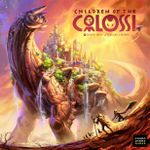
Even the cover art shows a fearless envoy gliding down into the Wastes. Personally, I’m afraid of heights, so I don’t think I’d survive long in such a harsh world…
Before this change, the cost of participating in battle was the same as in most games of this genre: your units would simply return to your reserve. I have always liked how Dune: Imperium approached casualties in battle: every unit that participates in battle dies, no matter who wins or loses. That felt thematic and tense…so I went with something similar. But since we had just eliminated the idea of a reserve, I needed a new system. That’s when the idea of resting units was born.
Now, after every battle, the units that fought are laid down to show that they are resting. Resting units can’t fight or harvest, but they can still be moved across the map. To “heal” a resting unit, you need to move it into a region with a Colossus figure and perform a lift action, placing it back onto the Colossus board.
Thematically, this clicked perfectly. The Wastelands are barren and empty, so the only way to restore your people is by visiting the healing tents of the Colossi cities. This created what I like to call the “circle of life”:
1) You have units on the Colossi board. You could keep them there to perform more actions, but you choose to send them down (using the glide action) to the Wasteland to fight.
2) After the battle, they rest.
3) To heal them, you lift them back up into the Colossi cities.
4) Once healed, you must decide again — keep them in the city for actions, or send them back down to the Wasteland.
The cycle is complete.
/pic9135242.jpg)
The original circle of life
It’s a natural, cyclical rhythm that ties together the two worlds of the game and reinforces the core idea that your units are your only resource.
The Colossi Boards
Children of the Colossi always featured Colossi boards, but they went through many, many forms over the years.
At first, they were designed as the main way to score VP and ultimately win the game. The system worked, being dramatic and tense, but in practice it felt a little too “gamey”.
So I pivoted. I transformed the Colossi boards into common battle boards where players could send their units to fight in order to gain special battle actions. Suddenly, they weren’t just point generators; they were active spaces of conflict and opportunity.
This also opened the door for modularity. Each game, you would select a different set of Colossi, which meant a different mix of powers and strategies. The Colossi became more than just thematic dressing; they became the heart of the game’s variability and replayability.
/pic9135427.jpg)
Colossi boards when they were the battle mechanism. Players would use worker-placement spaces depicted on their cards to take battle actions.
After Cosmodrome Games picked up the project, they brought in Dann May and Brenna Noonan to help me finish development — and they did something truly amazing.
From the beginning, my game featured strong faction asymmetry. Each player had a clear identity that made them feel different from one another. Think Root, but way simpler and lighter. I didn’t want players to have to “learn a whole new game” every time they sat down playing a different faction. At the same time, I was worried that, as my first design, I couldn’t really pull it off at the level needed. I knew I wasn’t (and still am not!) as good as Cole Wehrle.
/pic9135405.jpg)
Design of the asymmetric player boards
Dann and Brenna made a bold decision: They stripped away the asymmetry from the player factions and instead shifted it into the Colossi. The Colossi boards stopped being “battle boards” and instead became the main way to gain new units, unlock special actions, and acquire ongoing abilities. Each Colossus carried the theme of what once might have been a faction identity.
• The Builder Colossus let you construct houses in the wastelands.
• The Golem Colossus gave you access to powerful neutral units to fight over.
And so on…
In other words, your “faction identity” now depended on which Colossi you chose to interact with during the game. Instead of being locked into a single asymmetric role from the start, you developed your identity organically based on your decisions.
/pic9135409.jpg)
The first draft of the new Colossi boards
This system went through countless iterations, but it always felt too complex. Right from the start of the game, players had to learn a pile of new rules depending on which Colossi were in play.
Another big issue: I wanted the Colossi to be central, not just a convenient way to gain powers. Players needed to interact with them as much as possible.
I experimented with all kinds of action systems, some more clever than others, but they all ran into the same problem: distraction. Players spent too much time looking at their own boards or managing their hand of cards instead of focusing on the Colossi boards and the map, which were supposed to be the heart of the game.
After a long time (and a lot of false starts), I finally made the hard call: scrap everything and merge the action system directly into the Colossi boards. That way, the Colossi weren’t just “there” in the world; they were the game’s central mechanism.
/pic9138319.png)
Chronological iterations of the action system, often featuring a player board or a hand of cards — until the final version, which required neither
I was so glad I took this step. Suddenly, players weren’t distracted anymore. The game became incredibly focused. Everything was centered on the map and the Colossi, with nothing else pulling attention away. The system was simple. You had units on the Colossi boards, and you decided how to use them. Each Colossus board represented the magical city on the creature’s back, full of wonder and unique places to explore.
Mechanically, this came to life through worker-placement spaces, each representing a different building or landmark in the city. The connections between the spaces acted like roads, showing the paths your tribe would travel to move from one part of the city to the next.
/pic9138143.png)
Different Colossi board iterations at various stages of design. There was a lot of back and forth, so it’s impossible to place them in a strict chronological order of evolution.
This change allowed me to make each Colossus board distinct. At set-up, you randomly select three Colossi to use for the rest of the game. From that moment, the entire play experience shifts depending on which ones are in play. Their impact comes from four key factors:
1. Theme and unique actions. Each Colossus has a strong identity. For example, Strovo is the Colossus of spark, while Romather is the Colossus of Newborns. Their boards feature two or three unique actions tied directly to their theme: Strovo lets you gain and spend spark in unusual ways, while Romather offers special methods to gain newborns outside of battles.
2. Unique newborns. Each Colossus brings its own set of newborns, added to the bag at set-up alongside a pool of VP eggs. These newborns provide passive abilities or units with special powers, always tied to that Colossus’s theme. Since newborns are one of the main ways players grow stronger, which sets are in play radically changes what’s possible on the map.
3. Action economy. The game has four basic actions (such as moving units or harvesting energy), but each Colossus board is missing one of them. That absence reshapes the entire puzzle. For example, if Orlyth is in play, you’ll have plenty of opportunities to glide down to the map or lift back up into the city — but no way to move your units across the map. You’ll need to find that capability somewhere else.
4. Banner cards. Each Colossus has a set of six unique banner cards. During set-up, you randomly select a number equal to the player count and remove the rest. When a player reaches the top of a Colossus city, they look at the available banner cards and choose one to keep. A banner card grants a powerful one-shot action. Once used, it is flipped face down, but when that player reaches the top space again, they not only choose another banner card, they also refresh all their previously used ones — creating a mini-engine of recurring, powerful benefits.
Together, the three chosen Colossi create a unique experience every time you play, not only through their themes, newborns, and action mix, but also through other countless smaller details.
Both Dann and I are avid Magic: The Gathering players, and we often thought of the Colossi as working like colors in Magic. By mixing different Colossi, you mix their personalities and strategies, reshaping the game each time — just like building a deck from different colors.
/pic9072509.jpg)
Picture of a prototype in a late stage of development (Image: Piotr Wojtasiak)
Battles as Interaction…But Not in a Destructive Way
One thing that never changed was my vision for what battles should represent: the culminating point of interaction — moments of tension, bluffing, and tactical opportunity.
From the first prototype, I wanted battles to be free-for-all contests. Players coexist peacefully in regions until a battle is triggered. No one ever says, “I attack you.” There are no feel-bad moments of being singled out, no ganging up on the leader, no turtling, no king-making.
Equally important, there is no destructive interaction. You can’t kill your opponents’ units or tear down what they’ve built. There’s no take-that. Instead, you win by being prepared, out-maneuvering, bluffing, and reading your opponents’ intentions.
That vision has been constant. What did change — many, many times — was the mechanism that makes it happen. I won’t bore you with the dozens of different battle systems I tested over the years, but I can say this: Designing a battle system that feels fair, tense, and rewarding is one of the hardest challenges a designer can face (in my opinion).
/pic9138370.png)
A few examples of different systems I tried over the years…
The final battle system is deceptively simple. Every player has the same small set of battle cards. At the start of a battle, everyone chooses one card simultaneously…but players don’t reveal them all at once. Instead, they reveal them in reverse turn order, one at a time, resolving the effects of their chosen card and any other battle actions they’ve set up (like newborn powers and banner cards). Each player gets only one turn, and when all turns are done, the player with the highest strength wins.
Strength itself comes almost entirely from your units on the map. Each unit is worth one strength, with only a handful of special effects that might tweak that number. Cards don’t directly give you strength; they shape how you fight, when you fight, and what tricks you can pull off to outmaneuver your opponents.
The core inspiration for the card mechanism came from the brilliant Concordia. After you play a card, it goes into your discard pile, out of reach, until you play a specific “refresh” card that lets you return your discards to your hand — but when you refresh, you also perform a movement action for every card you pick up. If you’ve timed it right, waiting until you’ve spent a lot of your cards, you can turn that refresh into a massive, game-shifting move. It’s not a dead turn; it’s an opportunity.
Of course, there’s a downside. The longer you wait to refresh, the more limited your options become, and since your discarded cards stay face-up in front of you, your opponents know exactly what you’ve already spent. The fewer cards left in your hand, the more predictable you become. Suddenly, bluffing, timing, and reading the table become just as important as raw strength.
/pic9212561.png)
Final version of three battle cards
To spice things up and create more tense and unpredictable battles, I introduced ambush cards. Each player has six battle cards: half are normal battle cards, the other half are ambush cards. Unlike normal cards, ambush cards aren’t revealed during your battle turn. Instead, they are flipped simultaneously at the end of the battle, after every other action has been resolved.
Ambush cards are high-risk, high-reward. If you were the only player to play a particular ambush card, you get to unleash its powerful effect, like moving units at the last moment, potentially swinging the entire battle. But if another player chose the same ambush card, neither of you gets the effect. Instead, you both return the card to your hand as a small consolation prize.
This creates a double-edged sword: Ambush cards are game-changing when you pull them off, but if you misread the table, you waste your chance. Timing and bluffing become essential. Do you risk it all for the perfect ambush, or play it safe and keep your strategy steady?
/pic9212560.png)
Final version of the three battle cards that feature “ambush” powers
We (I) All Stand on the Shoulders of Collosi (Giants)
As the tribes in my game stand on the backs of the Colossi, so do we stand on the shoulders of giants, giants who inspired us, taught us everything we know, and most importantly, sparked the passion for what we do in life.
I would like to thank some of the designers who inspired and guided the design of this game, whether they know it or not. They probably won’t ever read this diary, but this is the least I could do. I don’t know any of them personally (yet!), but I hope to change that sooner rather than later.
In no particular order:
• Jamey Stegmaier — Your articles and videos have taught me so much. You are probably the main reason why I’m even here today, writing this diary!
• Eric Lang — You designed some of my all-time favorite games, several of which heavily inspired Children of the Colossi. From you, I learned how to build tension using just a few but meaningful key pieces. You are truly a master of that craft.
• Ivan Lashin — Thank you for being the first one to believe in this project and convincing Cosmodrome to take it! I’ll be forever gratefull!!
• Paul Dennen — Dune: Imperium is a masterpiece. It showed me how tense, meaningful battles can be woven seamlessly into a Eurogame. That lesson shaped my design more than you know.
• Richard Garfield — You inspired entire genres of games. I really believe modern gaming would not be the same without Magic. I’ll be eternally grateful for that spark.
• Geoff Engelstein, Ryan Sturm, and Mike Fitzgerald — thank you for the Ludology podcast! When I was starting out, it was such great teaching tool that could be easily digested with my headphones wherever I was.
• Hideo Kojima — Even though you’re not a board game designer, your vision for games has drastically shaped how I think about design and how I see games as a whole.
I’m also deeply thankful to Cosmodrome Games, who believed in me and in this project from the beginning. You have become like a second family to me.
And I have to mention Pauliina Linjama, whose artwork perfectly captured the world we created together. This game wouldn’t be the same without you!
A final, and the biggest, thank you goes to Dann May. Dann was incredible — he accompanied me on the journey of my first published game. Thank you for being there through the ups and downs, and for your endless patience in dealing with someone who’s a perfectionist and never truly satisfied with anything he does. You began as the game developer, art director, and graphic designer, and ended up as a friend I will never forget. I truly hope I’ll have the chance to work with you again!
/pic9136429.jpg)
Me holding the first final copy ever produced
Tell us how can we improve this post?