
/pic9137990.png)
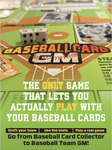
In Baseball Card GM, players use the baseball cards they already own to simulate a real game. They draft their team from real baseball cards in their collections, use the stats on the back of the cards (batter and pitcher) to weigh the odds of each 2d6 roll, and play out each plate appearance over a 9-inning game. The “GM” stands for “General Manager” – in real baseball that is the person who picks the players that make up the team – which here indicates the real “game” is in how well you build/draft your team around those stats/probabilities of each player.
Below is a designer diary for this game, however it is not mine – I did not invent BCGM, my 8yr old son Garrett did and I am just the publisher.
IDENTIFYING A PAIN POINT
The story goes that Richard Garfield had several ideas for games, but it was not until Wizards of the Coast CEO Peter Adkison mentioned what people needed was a quick portable D&D themed game, which could be played during their downtime between longer role-playing sessions, that Magic: the Gathering was born. What they had identified, so coined in the startup space (usually in tech), was a “pain point” – ie an underlying problem/behavior people need solving that they otherwise fix in unsatisfactory ways.
Garrett not only identified our first target pain point, he felt it himself – he could not actually PLAY with his baseball cards. He was constantly sorting and resorting his cards into various teams and lineups, but there was no way to test out how that roster might actually perform. This was not just HIS behavior either – we knew so many kids who did this, and frankly as a kid I did it too!
“How can I actually play with my baseball cards?” was his question. The problem was that nothing existed – and we looked all throughout the spring of 2024 for anything that did it. In fact that is how we even learned about Board Game Geek in the first place, searching for games that use your real baseball cards, and do it in the way Garrett knew each stat SHOULD be used: players with more homeruns or doubles or walks ON-CARD should get more homeruns or doubles or walks IN-GAME (and in roughly the same proportion). It seemed so obvious, how could it not exist?
In the summer of 2024, Garrett decided he would make one himself.
/pic9248081.jpg)
JUST A DINING-ROOM TABLE PROJECT
So Baseball Card GM started with a designer with no design experience (Garrett), a publisher with no deep game knowledge (me), a play-tester who was just learning to read (Garrett’s 5yr old brother Simon) and none of us intending to actually create a game to sell. It was just supposed to be something to do at our dining-room table with the baseball cards Garrett had collected from what I had bought him at Philadelphia Phillies games and card shops and my old collection from the 80’s and 90’s (called the “junk wax” era because of their over-production and under-value) which I was slowly parceling out to him.
If we were going to use cards that already existed, we first needed to figure out what stats are on as many brands and years of cards as possible. The more all-inclusive of cards that can be used the more joy! Baseball cards have been around for over 100 years, but they are far from consistent. In fact we discovered it was in 1981, through a Topps vs Fleer lawsuit that broke the monopoly with MLB, that the stats became standard on all Topps and Fleer (shortly followed by Donruss, Upper Deck, Leaf, Bowman, etc.) cards: the SEVEN key stats for batters being HR, 3B, 2B, Avg, Hits, BB, and RBI. Though of course you can use other or older cards for BCGM, just occasionally you need to look up a stat or two.
We then needed the nature of the dice roll mechanic, for which he chose the simplest – a 2d6 of the same color because it results in 21-unique combinations. As we had seven stats, each stat could be a column in a 3×7 grid (though the number of rows would eventually change, more on that below). While those were the inputs at our disposal, we needed to match them to every possible output of a plate appearance. The initial thinking was that a higher number in each stat would lead to a better outcome (homerun, triple, double, single, walk) whereas a lower number would generally lead to a worse one (strikeout, ground-out, pop-out, and fly-out).
/pic9462114.jpg)
That grid was essentially the entire game for six months – and it went through 15-18 different iterations as we play-tested ideas out. Garrett and I and Simon would try out an idea, I would amend the grid, print out the new version, and try it again.
Some cases were obvious (HR stats dictate homeruns, 3B dictate triples, 2B dictate doubles, BB dictate walks) whereas others were not (ex there are no singles stats on cards, strikeouts stopped being a stat on cards in 2014, and you cannot roll an RBI you need to do some other outcome to cause a score). So Garrett fiddled to come up with some clever narratives to pair the stats and outcomes – ex walks and pop-outs are paired implying batters don’t walk because they swing at pitches outside of the zone which results in pop-ups, or to make RBIs important he made them a proxy for hitting fly-outs (which over time will result in sac flies that bring in runners whereas a ground-out may lead to an inning ending double play and no RBI). Rolling for batting average is not an outcome either, so we linked it to singles that would in fact increase your batting average IN-GAME, and as there are no strikeouts on all cards we paired them as the negative of fewer hits, and eventually as the negative against triples as well because as strikeouts in MLB have increased in the last 45yrs triples have greatly decreased.
PLAY-TESTING UNTIL THE BOX SCORES LOOKED RIGHT
When inventing a new game with entirely new rules, it is (I imagine) tough to know if the end-result is coming out “right” – but we had it easy because we already knew if the game mechanic was working properly it would result in a typical box score for a real baseball game. Garrett would often go to his room and play out a game while keeping the entire score card for both sides, come back and show that there were say too many runs being scored or too many strikeouts happening or too many triples, etc.
That led to our big breakthrough, that admittedly even a novice tabletop sports simulator player would recognize right away, that the odds inherent in the 21-dice combos actually mattered. Each dice roll was a plate appearance, and ON-CARD a full season (which you would want to have the best chance to max out on the stats) was say 630-720 plate appearances. So each instance of that 2d6 was really 18-20 (1/36 with a double roll) or 35-40 (1/18 if a non-double roll) of each stat happening IN-GAME over a like season of rolls. If we wanted realistic results, we needed to reweigh the grid to match those – home runs could only appear in two cells as historically 60 would be the most we might ever have to meet, whereas triples could only appear in one cell, doubles in two, walks in just four (as 120 walks is historically very tops), singles in six cells, etc.
So our grid would not be a 3×7 rectangle at all, rather something with the same seven columns but different numbers of rows in each. And as we set the cut-offs right… eureka! By November 2024 the box scores Garrett was keeping for his solo-games started to look very real!
The other additions to the MVP (“minimum viable product” – the essentials to make it playable and testable) were also discovered by Garrett while play-testing:
(1) The cards ARE the pieces – As the cards were moving around the bases, we needed to codify what happens to those runners in certain instances of hits or ground-balls or fly-outs or pop-ups. Turns out we only needed three rules to ensure all situations were covered (Garrett was on his local Little Leagues 8u travel team at that point and things like running on contact with two outs to score from second on a single were exactly what was already being drilled into him).
(2) The pitchers needed to matter too – This was also just Garrett being a baseball nerd. He had seen enough baseball in his life to know the lefty-lefty or righty-righty match-ups are worse for the batter, so he decided to build that into the game. If we were using an above-below stat check to determine a plate appearance outcome, then it was logical for the tougher pitcher match-ups to move that stat line up (ie make it harder for some batters to meet the threshold). And if you have pitchers matter, well how much they can pitch in the game matters too, so we limited them to their actual innings pitched on their card.
/pic9462116.jpg)
All these nuances, along with stealing bases and the ever-changing main mechanic, became part of a new hand-drawn board Garrett drew to contain the game and the two line-ups (along with benches and bull-pens). We had our first working proto-type of BCGM by December 2024.
WAIT, DID WE ACCIDENTALLY MAKE SOMETHING KINDA GOOD?
When you invite friends and family to play your game, you expect praise. They are going to be polite and uncritical, probably not the best play-testers. At the time we did not have access to, nor would we have even known to seek, genuine board game enthusiast play-testers that we have now learned can be found in clubs just about anywhere. And yet, even with that caveat, as Garrett’s school friends or baseball teammates tried the game (and their parents watched on), even on our rapidly deteriorating paper prototype, we started to think we had something here.
/pic9462115.jpg)
There was enough positivity at least for me (dad, now publisher) to step back in and get a graphic designer who I have worked with for years to put together all the pieces into a visually simple product. And of course give it a name. By January we had a design of newly minted Baseball Card GM to print out at our local print shop.
It looked great, but immediately Garrett knew CARDBOARD was not what his game wanted to be – though he did not play Pokemon, his friends did and they had a playmat for their cards. The cards would not slide, the surface made it easier to pick them up, and most importantly a playmat went where the cards went (in a backpack, folded into a binder, etc.). In feel, BCGM wanted to be more like a TCG and that meant a NEOPRENE surface. It also meant we could avoid many of the things I (as a parent, not yet a board game publisher) really struggled with for games in our home – bulky boxes that take up room and get destroyed, excessive pieces that get lost, instructions that get torn or frankly largely ignored. OUR USE CASE was keep everything (ie all mechanics, all rules, etc.) on one playmat so that it could go to a school, youth baseball tournament, friend’s house, or restaurant/bar with no box/pieces/instructions needed.
/pic9137991.jpg)
By February 2025 we had our first neoprene prototype and March-April our first true samples from the eventual manufacturer overseas.
THEN THE SECOND GUESSING KICKS IN
I was always prepared to order at least 50, just to give away to friends and family and schoolmates and teammates, but if we were going to take this further (and order an additional 500 say, enough to get a good sample set of users to validate our assumptions that anyone would like this idea other than us) I started to bring up to Garrett the OTHER things we could be doing with it. There were MANY ways to add to the “baseball-ness of the game” or “game-ness of the baseball,” and as we had time and all could be easily done to a neoprene design all options came up.
Ultimately, though never written down explicitly, we had an agreed upon criteria for addressing new ideas for the game:
(1) Does it relate to a specific stat on a card? There were many fielding components that are fun, like errors or wild pitches or plays at the plate, but those are not stats on cards.
(2) Does it involve an actual baseball type action? There were ways to disrupt an opponent’s turn by forcing re-rolls or changing their roll, and those are a board game mechanic but not a justified baseball one.
(3) Does it have potential for overuse that slows down gameplay? There were ways to make more pitcher’s stats impactful and more often, but those would take constant checking against cards and make games take far longer.
(4) Does it “blow-up” the board with too much text or new pieces? Many new ideas involved longer explanations or additional cards, but those did not “fit” in our playmat only mission and “the cards are the only pieces” focus.
As a side note, what I have really come to appreciate about the BGG community is that many have taken it upon themselves to add these nuances to satisfy what more they want from the game: new rules suggested in forums, additional cards designed and left in files, etc. Garrett loves hearing the new ways people play and we both welcome and celebrate them all – the fact that BCGM can be so modular is a plus in our minds!
The big internal debate was deciding between laying out the dice combos SEQUENTIALLY across that dice grid (starts 1&1, 1&2, going across to 5&6, 6&6) or placing the doubles (1&1, 6&6, etc.) in more particular spots that breaks that flow but hits the necessary cells correctly. You will see right now some hitting outcomes are statistically overrepresented (in the 630-720 plate appearance rule-of-thumb) compared to historic outcomes because when in order a few of the rolls land on the wrong stat cells.
But this was a publisher’s worry – designer Garrett decided that fast and easy play was more important, so chose the speed of finding your roll in the grid (which is a bottleneck) over the stat “precision” because he was still got very normal “baseball looking” box scores in his solo-play. Besides, we had created a system even a 5yr old (Simon) could follow so why break it?
/pic9462113.jpg)
With that decided, I pulled the trigger on the additional 500 units – it of course took MONTHS of painful waiting for them to arrive from overseas, so it was not until October/November 2025 that we could really introduce it to the world. We had always driven by PAXU every year (the Philadelphia Convention Center was on Garrett’s way to school) but never knew what it was. I signed us up for UnPub and we did play-testing with folks we could arrange through BGG – the response was largely “I can’t believe no one has ever thought of this before!”
DESIGN IS MORE THAN JUST THE PRODUCT, IT IS POSITIONING
Coming from the outside of the gaming world, we were new to all the terminology and categories (“What is a meeple? What is a heavy Euro?”). But I knew that if this game was going to be a thing, it had to pass the smell test of the most discerning noses. We would take our lumps on BGG and with reviewers, learn what the game is, and what it isn’t, and really lean into the parts that are unique and special.
Youtube Video
Baseball Card GM will never be Strat-o-Matic Baseball or APBA Pro Baseball to true tabletop simulator fanatics. But that is ok, some very respected people in that space called it a “gateway-simulator” that can get kids introduced to that hobby. Baseball Card GM will never be as delightfully gamified as Baseball Highlight: 2045 for true board game aficionados. But that is fine, as it was Dan King (The [user=dkingnu]Game Boy Geek[/user]) who first gave BCGM a label of “deck-construction auto-battler” (not terms we knew) and really placed it in context: the GAME is in knowing the cards and building the rosters, while playing it out is thus a quick – and to be often re-iterated – process. And isn’t that exactly the itch that Garrett was trying to scratch in the first place?
It was also Dan King who showed us that HOW you teach someone the game ends up influencing WHAT they ultimately appreciate about it. Our rules sheet taught the main mechanic, the rest was just baseball, but by including a short sheet walking players through steps to learn over a few games – progressively more complicated stats picking, progressively more strategic drafting methods, and progressively more complex gameplay – we could help accelerate the realization of what is so fun about BCGM.
IN CONCLUSION: “INNOVATION ALWAYS LOOKS OBVIOUS IN HINDSIGHT”
/pic9137992.jpg)
At least that is how the saying goes. Replicating the game of baseball is by no means innovative, but using already existing and traditionally non-gaming items which many already own and treasure may just be exactly BECAUSE it looks so obvious a solution when you actually see the end product done. And yes, it took the mind of 8yr old Garrett to ask the question “How can I actually play with my baseball cards?” and the persistence to not take “You cannot” for an answer.
Our vision for the future is to impact the sports card space more than the gaming one – with wide ranging value propositions. For baseball fans like Garrett, they get to play with their cards like they always wanted to. For adults who used to be collectors, they get to experience the nostalgia of their youth by re-engaging with their old cards. And for the industry in general, it is creating NEW value from the bulk common cards that are otherwise monetarily worthless (this is a TCG “democratized” as the best cards in the game are in fact NOT the most rare or expensive at all, often just the opposite).
Sports cards and Pokemon/MTG are so often sold in the same places, with the sports folks in the front never understanding the TCG folks in the back (and vice-versa). Wouldn’t it be cool if those two worlds could find more common ground in your LGS/LCS?
Tell us how can we improve this post?