
by Paul Schulz
Over the last five years, six trivia games of my design were published — and even more are on the way, with many more ideas still in my head. It’s time to take a breath and reflect: How did I make the games, what went wrong, and what did I learn?
This is part two of a designer diary that covers all six games, and if you want to read about Scope, Quiziko and Fake Check, see part one! As an opportunity to rest during the long read, you can answer trivia questions after each diary…in the style of the respective game, of course.
Today I’ll write about:
▪️ Lost in Translation — a game about idioms for anyone interested in language(s)
▪️ Quiz Challenge Europa — the questions change, but the answers stay the same
▪️ Quiz-o-Meter — giving answers with a toy factor, inspired by graphs and baby books
Let’s start.
•••
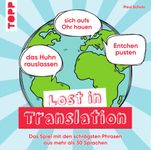
Lost in Translation
/pic8157873.jpg)
This is a favorite among my own games! I have always been interested in languages. Luckily, during university years I was able to spend time abroad and made friends from many different places. Sometimes in conversation, idioms from our native languages came up. We would accidentally translate them literally, then had to explain what we actually meant. I was fascinated. I started collecting these idioms, first in my head, later in Microsoft Excel.
An idiom is a combination of words that means something different than the words alone. An English example is “beating around the bush”. It means “avoiding talking about something”, not “hitting the ground surrounding vegetation”. You see, when you’re not used to the metaphorical meaning, it can be comical. Some examples:
• The German idiom “To hit yourself on your ears”? [o]It means “going to bed.”[/o]
• How about the Polish idiom “Thinking of blue almonds”? [o]It means “to daydream”[/o]
• Or the Turkish idiom “Don’t be a parsley!” [o]It means “Mind your own business!”[/o]
I had a good collection of idioms to start with, and I knew there was a great game in there — but I also knew there would be difficulties. It’s a niche topic and requires a lot of research. That’s why I wanted help in development and pitching, so I showed it to White Castle Games Agency, which was immediately on board.
At that point, my draft wasn’t a trivia game, but a creative party game. Players had to come up with a meaning to a literally translated idiom, but we didn’t want to reduce player creativity to a competition by choosing a “best” answer. Instead, after every player read their meaning, everyone gave out badges, little tokens that said things like “Cute”, “Clever!”, “Hilarious”, or “Actually correct!” At game’s end, you didn’t get points, and you didn’t win or lose; you just had those badges to look at. I still love this idea of a literally pointless game, and I have the tokens on my shelf. I hope I or someone else will make a game one day that suits this idea.
/pic9234163.jpg)
Prototype version, with original drawings from my friend Swantje
Anyway, we made two observations time and again: First, this creative task was very (or too) hard for some players. Second, the reveal of the real meaning and the subsequent table talk were the best part, so we focused on that. It was clear the game needed to be co-operative because that’s what got people discussing the idioms with one another, and just like that, the design became a co-operative trivia game.
Although I must say, the design doesn’t feel trivia-like in any way. Now it works like this: Seven cards are on the table, with the literal translation face up. Someone shuffles the cards secretly, reads the real meaning of one of those cards, then shuffles them and again places them literal translation face up. The players discuss which idiom has the spoken meaning, then flips a card over. If they’re wrong, they keep discussing, then flip another card, then another… If they’re right, they fill the table to seven cards, then start a new round. After ten cards have been flipped, the game ends.
With these rules, White Castle found TOPP as a publisher and Hilko Drude, who I had known for years from his designer days, became the developer. That was a streak of luck because it turns out Hilko is an absolute language freak! He is a former language teacher, has studied many languages, has translators and interpreters in his immediate family, and has friends around the globe.
That was great for our next step: Collecting as many idioms as we could. We talked to everyone we knew, made contacts in language-loving Facebook groups, and asked around to find as many idioms as possible. We found a few lists on the internet, but they weren’t always reliable and we wanted everything to be confirmed firsthand. I tried sending the information of what we needed through different channels, but I found interviewing people in person would get the best results. People found it hard to think of idioms because you automatically think of the metaphorical meaning. It’s strange to think about your own language from an outside viewpoint, but those interviews were also fun because people, especially expats, love talking and teaching about their culture and language — and I love learning!
/pic9234161.jpg)
The final product
Yeah, it was fun, but it was also a huge undertaking. I have joked that this might be the game on which the most people have worked for the entire history of game design. This might actually be true as we talked to everyone and their grandparents. Literally, people would call their grandparents to check exact meanings or post the idioms in their family messenger groups.
Lost in Translation has become the most diverse collection of idioms I know of. I mean, we were looking for good lists and books to help our research, but we didn’t find any…so maybe we should write that book? We wish we had included more non-European languages, but in the end we had limited resources for research.
After collecting many hundreds of idioms, as in any content-based game, we had to cull. First, we removed all idioms that included references to race, ethnicity, religion, and so on. Stereotypes are part of many languages. The game, though, is not supposed to be a scientific review of the languages, but to be fun for everyone. Next, we removed everything that was to easy. (“Drunk as a sailor” means…very drunk, that’s clear.) Then, we rated how interesting the idioms were, and based on that we made the final selection.
Also, we wanted each meaning to be represented only once, which made for tough choices! It turns out every single language has amazing idioms for masturbating, dying, and taking a shit.
Lastly, we needed a second native speaker to check every single idiom, its translation, and meaning. This was another massive effort, even harder because idioms change with time, they may be regional, they may have slightly different meanings to different people who speak the same language. In the end, we included idioms from more than thirty languages.
/pic9234164.jpg)
The “Thank You” page on the right didn’t have nearly enough space to list all the people who helped us. These are just a fraction of the names.
The release of Lost in Translation at SPIEL Essen 24 was a success, with the game selling out at the fair. We noticed a rather annoying misprint, but it wasn’t too bad.
However, a big problem arose at the 2025 Toy Fair in Nuremberg: The game didn’t arrive there. Nuremberg is an important fair to get into German book shops, and this is very much a book shop game — but since the game was missing, it wasn’t shown. It was not any specific person’s fault, but an annoying mistake. It’s hard to tell how much it hurt the game.
Anyways, Lost in Translation still got great feedback, especially from non-gamers. For example, I know there is a bar in Vienna where the barkeeper plays it with you if you don’t distract him by ordering more beer.
I am so proud of this game! I still hope we find more publishers to localize it since it’s available outside of the German language for direct licensing and the vast amount of work is already done. I hear a lot of publishers like it personally, but find it too intellectual. Let me tell you, though: I wouldn’t underestimate the players. From my board game café experience, it is an easy recommendation for anyone who finds the topic interesting, and I feel like most people do.
Now you try to guess. Which of the following idioms has the meaning “to be a liar”? You can click on the spoilers until you find the correct one.
/pic9234488.jpg)
1. [o]”to keep something secret so you don’t get accused of it”[/o]
2. [o]”to be very lucky”[/o]
3. [o]”to constantly switch sides”[/o]
4. [o]CORRECT! This means “being a liar”[/o]
5. [o]”to refrain from doing something bad”[/o]
6. [o]”having to poop”[/o]
7. [o]”to thwart a plan”[/o]
•••
Quiz Challenge — with Arno Steinwender
/pic8561634.png)
I once watched an interview with Rob Daviau about how he came up with the legacy concept. As I faintly remember, he wrote down everything about how a generic board game works. Importantly, he included all the implicit rules that usually “go without saying”. He came to the end of a game and wrote down that everything is put back into the box as before, and he thought, “What if that didn’t happen?” Answer: Legacy.
When I was in the mood to design a new trivia game, I thought of that exercise and started writing down the implicit rules for a generic trivia game: “You get a question with possible answers. Each player takes a guess […] You get a new question with new possible answers.” Wait! What if that last part didn’t happen? What if you get a new question but keep the same possible answers?
I rang Arno because it was time to start a new project together.
/pic9234167.jpg)
The first prototype used farmyard animals because we aimed it to be a trivia game for kids. The question was “Who lays eggs?”
The basic idea worked from the start: We placed ten answer cards featuring different animals on the table. A statement like “Has more then 20 teeth” or “Can be found in Europe” is read aloud. Then each player takes one turn. They take an animal card from the middle if they think the statement applies to it, or they pass, then the question card is flipped to reveal the answer. Every player who correctly chose a card gets a point. Also, every player who has no cards in front of them gets a point IF no correct card has been left in the middle. Easy and quick.
The starting player rotates, so sometimes you have the chance to grab the most obvious answer with low risk, and sometimes you’ll have to take a guess on whether to pass or not.
It was necessary to really think about the topic of the game because if you don’t change the answers you need to be able to write many interesting questions about the same topic and players should be interested in learning about it. Animals are a good start because animals are always cool. (Fact!) For the pitch, we prepared other options, such as countries, women of history, and football clubs.
/pic9234168.jpg)
What a nice production, with separate boxes for different sets as well as printed wooden victory points
We found HABA as a publisher, and they even wanted to do two versions, starting with European countries, then later animals.
We decided to put three sets of different countries in the box so that we can keep the questions fresh and have difficulty levels. The easiest set includes Germany, its neighbors, and a few bigger countries in Europe. The hardest set contains smaller countries further away from Germany, so the average player might not have visited them and know less about them. For the animal edition, we have already prepared four sets with different themes.
Unfortunately, the Europe version didn’t take off, so it is questionable whether the animal edition is still going to happen. I have no insight into why it didn’t sell; I just know that when I explain the game at work in the board game café, groups always play more than one round. Maybe it would have been better to start with animals? Wasn’t my decision, though. But that’s part of game design — you can’t foresee what works on the market.
Your turn! Which of those countries is a monarchy? (Multiple answers can be correct)
/pic9234239.jpg)
Solution: [o]Only Denmark, the Netherlands, and Spain[/o]
•••
QUIZ-O-METER
/pic9279185.jpg)
When I became an uncle for the first time, I showed more interest in the baby departments of game and book stores. Babies really have the coolest books with all kinds of shenanigans, such as holes to stick your fingers through, little flaps hiding parts of the pictures, feeling patches with different textures, and sliding elements to change the pictures. Those sliding elements are built like this: The book page is triple layered. The bottom is a whole page. The middle layer consists of a grid that’s glued to the bottom and top layer, but within the grid are movable elements. The top layer is glued to the grid with the sliding elements in place, but has holes big enough that you can move them.
You could say that by changing the sliding elements, you change the state of the page — and that could be a way to log your answers in a trivia game! My first idea was using a slider element on a scale to choose a number, and that is indeed the first part of QUIZ-O-METER, but moving only one element is boring. As in good baby books, I wanted many things to happen on the same page, so I expanded on different ways to record numerical answers and decided to use graphs to answer questions. Of course, these graphs should all look different, move somewhat differently, and inspire different types of questions.
/pic9234604.jpg)
Prototype material of QUIZ-O-METER
I tried different options and came up with four types of diagrams, starting with the original single-bar chart for answering questions with a number from 1 to 50. Then I made another bar chart with three bars with which you have to figure out the relation, i.e., which is the highest, middle, and lowest bar. I made a pie chart, with which you guess percentages. That took a while, but I figured out how to build it so that it opens and closes smoothly.
Finally, I added a Venn diagram, which didn’t work with sliding elements but with magnets! You had to sort five elements into two circles or their overlap. Each player gets a tableau like this, and everyone answers all four question types in a round. For each question, you can earn up to 5 points — but before scoring at the end of each round, players can use jokers: a “copycat” to peek at another player and use their answer, and a “10 or 0” that doubles your points, but only if you get the maximum score; in any other case, you get 0 points. After four rounds, that is, sixteen questions, the game ends.
Youtube VideoThe evolution of the answer tableau from prototype. (Also an ASMR video.)
It was easy to find a publisher — moses. Verlag again. I believe they did have a difficult time getting the production right.
In the end, the magnets were too much, so instead we use marker pens to draw the elements on our Venn diagrams. Other than that the layout of the board looks pretty much the same as in the prototype. Figuring out the name took a while. My prototype was called “Charts”, but that could be confused with a music game. Also, the game board looks very mathy with the different charts, but the design is not a math game; it’s a trivia/guessing game, so we landed on QUIZ-O-METER.
/pic9234190.jpg)
Me presenting the game at SPIEL Essen 25
QUIZ-O-METER debuted at SPIEL Essen 25, and I had the chance to play a big game with the crowd. That was fun and went well! I was happy, the publisher was happy, the crowd was happy.
As you’ve seen in the other diaries, it’s hard to find localization partners for trivia games. It’s a lot of translation work, I understand, but QUIZ-O-METER is something special with the answer tableau! I hope that makes a difference. The first reprint was already ordered before SPIEL, so I know the sales had a good start as well. I’m really happy with the game. I would have loved if the question cards were a bit bigger, but that wouldn’t have fit in the box.
Wanna try? How would you answer these QUIZ-O-METER questions?
/pic9234601.jpg)
/pic9234600.jpg)
Solutions
• 1 to 50 — [o]A human hand consists of 27 bones[/o]
• In relation — [o]1. Saturn (146 moons), 2. Neptune (16 moons), 3. Mars (2 moons)[/o]
• Pie chart — [o]A hippo eats about 2% of its body weight per day[/o]
• Venn diagramm — [o]German: Wanderung, Fitness-Studio. English: Newsflash. Both: Zugzwang, Schadenfreude[/o]
•••
What’s Next?
There’s another trivia game coming, hopefully with several editions at once, including local editions. I saw a draft of the graphic design in Essen, and it looked amazing! Other than that I’ve been focusing on contract game design and puzzles in the last months, so it’ll take a while until my next classic board game will be published…but who knows as sometimes things happen very quickly.
If you are interested in updates or the occasional insight in what I am playing, find me on Instagram. Please get in touch with anything you want to talk about…or leave comments here!
Tell us how can we improve this post?