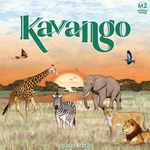

by Mazaza Games

New to Kavango? Kavango is an award-winning, beautiful, strategic and fast-paced board game. You’ll play as a conservation expert rewilding your own unique landscape in southern Africa. With over 200 hand-drawn illustrations, Kavango creates an immersive experience. Simultaneous turns, satisfying tableau-building and tough strategy decisions create a dynamic and rewarding gameplay experience.
Hi everyone!
We started designing Kavango in 2020 while living and working on conservation in Botswana. We were inspired by real-life conservation success stories all around us and wanted to capture the beauty of the southern African wilderness and tell a positive story about nature conservation.
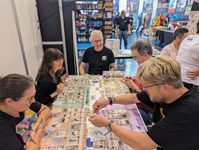
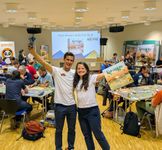
Fast forward to a couple of weeks ago at SPIEL Essen 2026, and we found ourselves watching Kavango being played by hundreds of people at Europe Masters, having been selected as one of just four games featured in this year’s international tournament. It was an incredible moment for us.
For anyone unfamiliar with Europe Masters, it’s an annual international board game tournament held at SPIEL Essen. This year was the biggest yet, with 39 teams, totalling 156 players representing 17 countries.
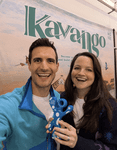
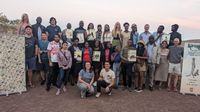
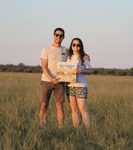
Kavango was selected alongside Rebirth, Wispwood and Endeavor Deep Sea. We’re incredibly honoured to now be included in the Europe Masters Hall of Fame (see the picture of us below holding Gioco, the mascot of Europe Masters!).
It was a wonderful full-circle moment since we launched Kavango on Kickstarter during SPIEL Essen just three years ago.
Lots of you have asked us where Kavango came from, how we developed the idea and how our experiences in conservation influenced the game. So we thought it was about time we shared the story!
1. Where it all began: From Life on Earth to Kavango
Our original game was called ‘Life on Earth’ and had a global focus. Players were rewilding in four global regions: the Himalayas, the Congo Basin, the Kalahari and the Arctic Tundra. In this version of the game, there were event cards and bad things could happen that would reduce protection levels for players and potentially remove species from their ecosystems – we removed this pretty quickly after a couple of games where we lost our Polar Bears! Way too sad.
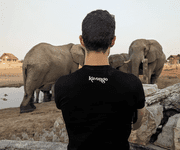
Then we moved to Botswana and we knew almost immediately that this was where our game needed to be rooted. We were spending so much time outdoors, exploring the incredible landscape, encountering wildlife and meeting people who had devoted their lives to restoring nature and protecting wildlife.
What struck us most was that their efforts were working. We were seeing real examples of nature recovering and thriving because of the dedication of individuals and communities.
Here was a story of optimism and hope that we felt the climate and nature world so badly needed.
We had both spent much of our professional lives working on environmental challenges. Zara had been working on combating the illegal wildlife trade, while Matt was working in sustainable civil and structural engineering. We were both passionate about protecting the natural world, but sometimes found it difficult to maintain a sense of optimism.
So much of the conversation around climate and nature focuses on what we’re losing, what we’re destroying and what needs to be stopped. These are incredibly important issues, but we couldn’t shake the feeling that there needed to be more balance. We wanted to create something that celebrated the people working to restore nature and showed what was possible when we invest in protecting it.
Over the next three years, we built out the gameplay and artwork for Kavango and it became deeply rooted in our lived experience and love for the region and people we’ve met along the way.
2. Bringing the Real World to the Table
One of our favourite things about Kavango is how much of the real world has made its way into the game.
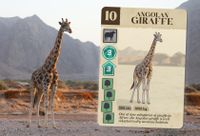
Matt’s hand-drawn animal illustrations are largely based on our photographs of wildlife we’ve encountered ourselves.

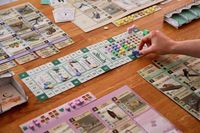
Each of the player boards represents a real place in Botswana that we’ve visited regularly. The green board is Chobe National Park, blue is the Okavango Delta, yellow is the Central Kalahari, purple is the Makgadikgadi Salt Pans, orange is the Kalahari Transfrontier Park. These landscapes all have their own distinctive characteristics, and we captured that in the asymmetric starting resources on each board. The background artwork is based on our photos in those places.
We spent a lot of time thinking about whether to include player boards. They take up quite a bit of table space, and we were conscious of keeping the game accessible. However, our play testing consistently showed us that players felt more immersed and enjoyed the experience more when they had their own boards. So, we kept them!
The conservation experts in the game are inspired by real-life conservation heroes we’ve met and who have inspired us. They are designed to tell a story of all the different people required to make conservation a success.
3. Turning Conservation Into a Board Game
One of our biggest design challenges was working out how to translate real-world conservation methods into balanced, fun and strategic gameplay. We’re proud that our mechanics are designed around principles of sustainable conservation rather than the other way around.
An important starting point is that as a player, you are a world-class conservationist. Every decision you make is ultimately successful and you are always growing and building your reserve. Any animal you introduce represents a sustainable population of that species, and to safely release it into your reserve, you need to ensure that the right food and protection are in place for it to survive. We did a lot of play testing with the University of Botswana and their support was so encouraging and valuable as we finalised the game.
Several of the game’s core mechanics are taken directly from real life:
The Sanctuary Spaces
The sanctuary mechanic was inspired by our experience of rhino conservation when we were in southern Africa. Due to a high poaching threat, many rhinos were relocated out of wild areas and into protected environments until they could be safely released.
In the game, the sanctuary allows you to collect animals before meeting all the requirements to introduce them into your reserve. This massively enhances the card drafting mechanic, allowing players to play more conservative or high risk strategies depending on how they use their sanctuary spaces.
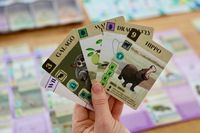
Food requirements and animal classifications
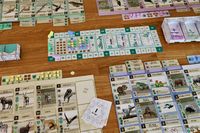
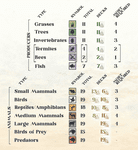
One of the key design challenges was categorising the animals into different types and accurately representing the food requirements of the different species across different rungs of the food chain. We wanted these classifications to be ecologically realistic while also creating a balanced and interesting game.
We aimed for a roughly even distribution of animals in each of the seven animal categories, i.e. there are roughly the same number of small mammals as there are birds of prey. In a real-life ecosystem the distribution would be much more skewed to the bottom of the food chain, which is why trophic levels are often explained graphically using a triangle or a pyramid. We designed the animal food requirements around achieving this flat distribution because it is ultimately more fun to have a wide range of biodiversity, including at the top of the food chain, in your nature reserve at the end of the game.
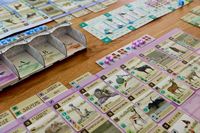
This took quite a bit of playtesting. Some animals were reclassified as the game developed, as we worked out how best to represent their ecological characteristics and feeding preferences and ensure the different paths to victory remained viable.
One design element which took a lot of iterations was the special invertebrate subcategories: bees and termites.
It would have been easier to design the game without these specific subcategories, but doing so would have compromised the ecological realism of the game. Termites and bees are completely fundamental to the Kavango ecosystems and many animals have highly specialised diets and have evolved specifically to eat them.
We wanted to capture this level of ecological detail, and think it adds another dimension to the gameplay strategy.
Research Tasks
The research tasks that change each round were inspired by the challenges conservation organisations face when adapting to different funding priorities.
In real life, conservation projects often depend on specific grants and funding pots, each with its own objectives. We wanted to capture some of that uncertainty and challenge in the game, with players having to adapt their strategies as the research priorities change and get harder every round.
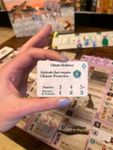
Protection Levels
Increasing protection in your reserve comes at a cost. This was a deliberate design decision, reflecting the reality that effective conservation requires significant resources and investment.
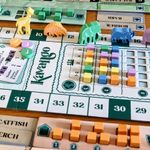
Variable Difficulty Depending on Player Experience
One of our key aims in designing Kavango was to make the game fun and easy to learn for people who are new to the hobby while providing a strategic challenge for more experienced gamers. We designed the game so you can alter the difficulty level based on your experience by changing the money that each player starts with. For beginners, we recommend starting with $3m, intermediate starts with $2m and expert with $1m – when we play, we start with $0!
Starting with different amounts of money allows players of different experience levels to play together. This works well for teaching new players and giving a handicap to the more experienced ones so that the scores can be balanced at the end.
Long-term Goals
We also wanted players to have the opportunity to develop particular specialisms. Our goal cards encourage you to focus on animals with shared characteristics, such as being nocturnal, migratory or scavengers.
These goals help anchor your drafting strategy while subtly introducing players to some of the fascinating characteristics of the animals themselves.
Ultimately, the conservation theme is integral to the gameplay and mechanics rather than simply a thematic choice. The strategic decisions should make sense within the world you’re creating.
With asymmetric player boards, conservation character cards and over 200 species cards, there are also plenty of different combinations to explore, giving Kavango lots of replayability.
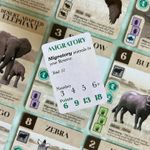
Note: the goal cards have been updated to now include icons that correspond with the characteristic
4. Designing a Sustainable Product
Sustainability has always been a priority for us, not just in the subject matter of our games but in the physical products themselves.
When we started designing Kavango, we wanted to avoid compromising on either the quality of the product or the price for consumers. That meant spending considerably more time working through the design and manufacturing process to find alternatives to conventional components.
Two examples we’re particularly pleased with are the card trays and the box sleeve. Both were designed as sustainable alternatives to components that would traditionally be made from plastic.
Getting these right took a lot of iteration and teamwork with our manufacturer, Panda. We wanted components that worked beautifully, looked great and were practical for players, while also reducing the environmental impact of the game. We’re really proud of the result.
Kavango uses no plastic in its production and is made from 65% recycled card and paper. The card trays also double up as a helpful box organiser!
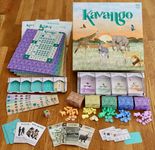
We’re delighted that our approach was recognised in 2026, when Kavango received the Green Games Guide Award for Sustainable Product Design, alongside recognition through the Origins and Game Manufacturers Association Sustainability Award.
For us, the principle is simple: sustainable products need to compete directly with conventional alternatives in both cost and quality. Only then will we start to shift the powerful systems driving our consumption patterns.
We’re always looking for ways to improve, and it’s exciting to see how much further we can take these ideas with our newer games.
Our latest game, Scavengers, uses the same sustainable production principles as Kavango, but takes things a step further:
– Made from 80% recycled materials
– Manufactured in Spain using solar power
– No plastics
We hope that by continuing to experiment with materials and manufacturing methods, we can demonstrate that beautiful, high-quality board games don’t need to come at the expense of the planet.
5. Growing the Kavango World
As Kavango developed, we always had ideas for ways to expand the experience. But we were conscious that the original game needed to remain accessible and relatively light.
This led to two quite different projects: Kavango Lodges Expansion and Let’s Go Kavango.
Kavango Lodges Expansion: Adding Puzzly Placement Mechanics
We always had an idea to include a spatial element in Kavango which is another reason we wanted to keep the boards in the base game. However, we decided to hold back from including it in the original game because we wanted to keep the core experience streamlined.
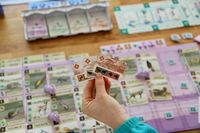
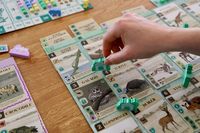
The Lodges expansion introduces ecotourism into your nature reserve, allowing players to build lodges within their reserves. These attract tourism providing additional victory points and, if you play on the hardest level, extra money to invest in growing your reserve.
Each Lodge requires a particular combination of surrounding animals placed in a 2×2 grid. This creates a satisfying spatial puzzle alongside the existing card-drafting mechanics.
You’ll choose lodge cards at the beginning of the game, so you’ll be planning out what animals you want to draft and where you want to place them from the start of the game.
Lodges adds another layer of strategic depth and introduces a conservation narrative we were keen to explore: the role that responsible ecotourism can play in supporting wildlife conservation.
The expansion is modular, allowing you to vary the difficulty. For seasoned gamers, we recommend playing with the full difficulty and the community protection module. With the community protection, the placement and timing of building your lodges is vital. You need sustainable income in order to continue expanding your nature reserve. This is designed to show how important it is that communities living alongside wildlife see the economic benefits of ecotourism for conservation to succeed and be sustainable.
Let’s Go Kavango: the Travel Version of Kavango
At the other end of the spectrum, we created Let’s Go Kavango.
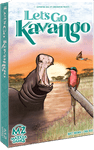
We wanted to explore whether we could take the essence of Kavango and translate it into a smaller, streamlined card game. The result is a travel-friendly version that retains all the wildlife and strategy of the original just in a smaller box. We’ve also introduced a child-friendly variant for ages 6+ to inspire budding conservationists!
It’s designed to slide into your backpack and be taken with you on adventurous game nights anywhere.
We initially developed Let’s Go Kavango because we wanted to update the card decks in Kavango for our original Kickstarter backers (we’d changed some things for the retail version). But we didn’t want their old Kavango cards to go to waste. So we designed a way of giving new and exciting life to existing Kavango cards, while updating the base-game decks for our wonderful supporters.
The result was a great card-only version of Kavango which is a very satisfying stand-alone game in its own right. All the wildlife. All the strategy. Just in a smaller box.
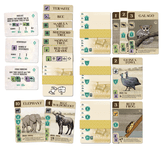
More Wildlife!
We’ve also released booster packs featuring additional animals.
We absolutely love researching and illustrating new species, and it’s been wonderful to see the enthusiasm for these releases. There are so many fascinating animals out there, and we love hearing from people about their favourites, it always makes us laugh at how much love the sausage tree gets!
6. Behind the Ccenes: How We Design Our Games
Our design process tends to revolve around four interconnected elements: telling a story, developing the game mechanics, creating the artwork and physically producing and bringing the game to market.
We each have different areas of expertise, and that’s one of the things that makes working together so enjoyable.
Matt: Mechanics, engineering and artwork Matt’s background is in engineering and sustainability. He leads the development of the game mechanics and balance, as well as overseeing the product design and manufacturing process. He’s also our in-house artist and graphic designer. His hand-drawn illustrations are a huge part of what gives Kavango its identity, bringing the wildlife and landscapes to life on the table.We love the fact that the artistic and technical sides of the design come together like this!
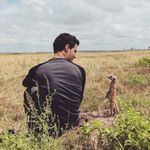
Zara: Conservation and storytelling Zara has spent much of her career working in conservation, across southern Africa on combating the illegal wildlife trade and globally on protecting our oceans and seas. She’s also a trustee of the Beaver Trust in the UK. As our in-house conservation expert, Zara makes sure that our games tell a realistic story about conservation and reflect the ecological relationships and challenges found in the real world. She’s our storyteller in chief, keeping the design grounded in our wider purpose and ensuring that the experience feels authentic.
Working Together Although we tend to take the lead on different aspects of the process, the games really come together through collaboration and playtesting. An idea for a game always starts with a story we want to tell about nature. From there, we work through the concept together, testing, refining and occasionally going back to the drawing board! It’s a process that can take years, but that’s part of what we love about it.
7. What’s Next?
Kavango was our first game and we’re so happy that we’ve been able to keep working on games to tell positive stories about our natural world.
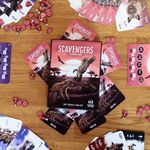
We launched our latest game in the Kavango world, Scavengers, at SPIEL Essen 2026. We came up with the idea for Scavengers when we were visiting one of our charity partners, Vulpro, in South Africa in January 2026. We heard from them the importance of vultures to African ecosystems as a vital clean-up crew to stop the spread of disease. But they are difficult to conserve and protect because they have a PR issue. So we decided to make a game about vultures and other scavengers to showcase the beauty, power and importance of these animals.
It’s designed for 2-5 players, ages 8+, with a playtime of around 20-30 minutes. It’s an easy-to-learn, small-box, quick-playing card game in the same genre as games like SCOUT, Skull King, Flip 7 and Perudo… but with the bonus of some beautiful animals! It is a lot of fun and has high player interaction, making it perfect for group game night or family holidays!
We’re also working on our next big project: Beaver: Born to Rewild.
This one is particularly close to our hearts. Zara’s work as a trustee of the Beaver Trust has given us a real insight into the incredible potential of beavers to transform landscapes and restore ecosystems across Britain.
You’ll play as a family of beavers reintroduced into the Scottish Highlands. Your mission is to rewild and restore a wetland habitat.
As you gather resources to build and grow your dam, you’ll engineer a new wetland ecosystem and strategically create habitats for a range of native animals. Gain cascading rewards as your wetland ecosystem grows, earn points each time you introduce a new species, and win big if you can build an abundance of food for Scotland’s most iconic and endangered predators.
The beaver family with the most points at the end of the game wins.
We’re working towards launching this on Kickstarter in mid-2027 and are having a lot of fun playtesting it at the moment.
8. Our Commitment to Conservation
Everything we do at Mazaza Games is driven by one purpose: inspiring people around the world to protect our planet’s biodiversity.
Living and working in Botswana inspired us to create Kavango, and we’re committed to supporting the conservation organisations working to protect the region’s extraordinary wildlife.
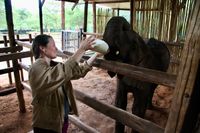
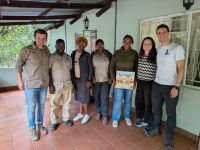
We donate 50% of our profits to conservation charities working on the front line of the climate and nature crises. Here we are with one of our partners, The Ecoexist Trust, who work on human-elephant co-existance in Northern Botswana.
For us, making games is about more than creating something fun to play. It’s about sharing the places, wildlife and people that have inspired us, and hopefully encouraging others to take an interest in protecting the natural world.
We hope that when you sit down to play Kavango, you enjoy the strategy, the wildlife and the challenge of building a thriving reserve. But we also hope that it leaves you feeling a little more connected to the natural world and optimistic about what we can achieve to protect it.
Thank you to everyone who has supported Kavango along the way. From those who backed us on Kickstarter, to the people who have played, reviewed, and recommended Kavango to others, we are incredibly grateful.
And thank you to everyone who is helping us bring more nature to the board game table. If you want to hear more from us and keep up to date on our new projects then you can sign up to our newsletter on our website.
Happy gaming!
Matt & Zara
Mazaza Games
Tell us how can we improve this post?