

by Ryan Boucher

Or, Hardy Plants Need Hardy Designers
Gretchen’s Garden is a tableau builder for 2-4 players (aged 10+, around 30-45 minutes) about collecting, potting and propagating succulents. It was designed by Jay Bendixen and me, Ryan Boucher, and is published by Lookout Games. This is the story of how a house slowly filling up with succulents turned into a game.
First Ideas
Gretchen’s Garden began life as an observation that many of the people in my life were slowly collecting succulents. Even in my house would these hardy little beasts manifest. So yes, I have my partner Jess and the other women in my life to thank for the origin of this game.
I started to read the succulent books that were on the shelf at home and was impressed by the variety. I began to realise that to many people, succulents and indoor plants are different things. People who liked succulent plants didn’t necessarily care for indoor plants.
I decided I would design a game with this theme and this audience in mind. It started off as a single card from the game. I made a mock up and used this to gauge interest. “Given a card that looked a bit like this, would you be interested in playing this game?” Naturally, the people I asked were also board gamers.
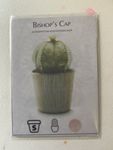
No one could tell if the game was good from a single card. That was fine. What I wanted to know was whether the theme was enough to capture attention.
And then Verdant launched on Kickstarter and I paused the game. I know, I said it was a different audience but I was worried the market would be overgrown. It did affect us when pitching, with some publishers worried about competing against Verdant or had already localised it.
Collaboration
Skip forward to mid-to-late 2022 and I’m on the TGDA (Tabletop Game Designers of Australia) Discord, I’ve self-published some sport-related board games and I’m play testing a game called Surf’s Up by Jay Bendixen (my co-designer) and I’m considering publishing it. That never happened, but what most impressed me about Jay was his work ethic and how he approached iteration and testing.
I suggested we try co-designing something together and we talked about how that could work. One of my key takeaways from this phase was how we approached co-design, and how important it was for both of us to own the design.
It would have been easy for me to say: “Let’s work on succulents, here is my design” but there would always be this tension of Jay pulling the design away from where it started and who had the final say.
So before we started we proposed that we would pitch the other person three designs. I would then take Jay’s three games and spend a couple of weeks on them. Jay would do the same with mine. We would then pitch back our own version of the other person’s game.
We held this design review and picked our favourite design to work on. That game ended up being “Sidewalk Succulents”, Jay’s version of my original succulent design.
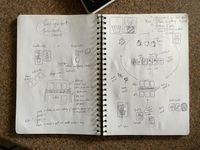
Our first combined version has changed a fair bit since that day, and yet some things remain the same. Flowers still go in the centre of the cards, we combine pot and plant cards but it stopped being a card stacking game pretty early on as we leant into different plant types and used tokens for leaves.
Remote Co-Design
It’s always a challenge working with another person, it’s harder again when you’re 2,000km apart and on the other side of the planet from publishers. The benefit we had was that 2,000km was roughly along the same longitude and so we’re in the same time zone most of the year.
We split our testing into two modes, we would use online play testing groups like the TGDA discord in Australia as well as Protospiel Online (although that often resulted in some very late nights or very early mornings). Then we’d do semi-regular physical tests independently. The physical tests were mostly looking at in-person affordances. It can be easy to get lost in a digital design and forget that at the end of the day, upkeep, scoring and mechanisms need to be intuitive when the game is on the table. So we used these sessions to check whether the mechanics worked. Did water and leaf conversion work? Is the cutting supply visible and intuitive?
Propagation
The cutting mechanic ended up being core to the design for us. We loved how it leant into the theme of propagating succulents. We wanted to stay away from take-that as it didn’t suit the game. The original cutting mechanic was push-your-luck based. We had aphids on the plants and you could take a cutting but you weren’t sure if the leaf had an aphid on it. I think there was a ladybug too (they eat aphids). That ladybug became the first player token (the ladybug of initiative) before being replaced with a cactus in the final version. Fun fact: cacti are succulents but most succulents are not cacti.
To know whether the game was working for us, we recorded the number of times the cutting action was taken per game. If the number was too low, then we would find ways to bump the numbers. We wanted it to feel like a natural choice without forcing players to use it. So we looked at altering the market, adding plants that encouraged cutting, etc.
We would go back to testing and see whether the changes were making a difference. Jay and I are big on play testing to settle decisions and I’m big on tracking the things that matter. So we generally knew whether a change was having the desired effect.
Plant Powers & Multiple Decks
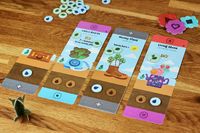
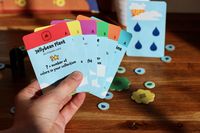
We spent time researching different succulents and seeing how they could be used to pull the game and the player decisions in different directions. We ended up with so many plants to choose from that we had the opportunity to create multiple decks of plants and then organise them loosely around the colours. Green and blue were non-scoring plants, yellow were designed to encourage propagation.
If you’ve played Timber Town, you’ll know that I’m a big fan of swappable scoring conditions. But we’re also sensitive to the cognitive load of which plants we choose when we play. This is where the A deck and B deck came in. Those two decks have natural affinities and if you don’t want to think about it, pick deck A or deck B. If you want to mix it up you can but there is a natural path to variability without front-loading it onto new players.
Flowering and End-Game Tension
Here is an old message from a chat with Jay from late-2022.
The game didn’t end up that way, because play testing told us it wasn’t right. The end game tension, which we really liked, came back in flower scarcity. There is only one of each flower and because it stops a plant from growing, you need to push that as far as you can but not so far that others flower before you. The single flower action meant that players were naturally limited by actions on flowering. There is so much you want to do but only 12 seasons to get it done.
Visual Design
This was a design where we had a perspective on the look and feel before we pitched it. We had this sense of light, joyous succulent plant designs, and that stuck. Lookout’s art direction build on our pitch, and the illustrators, Carrie Cantwell and Nele Diel brought it to life.
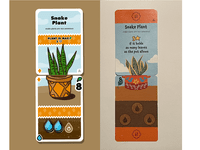
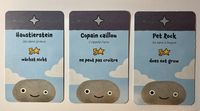
One of my favourite parts of the final design was how our pet rock, Dwayne, got renamed. In the German version he got renamed to Kevin. A solid name for a solid plant buddy. In French, he became Pierre. I like to think that, independently, two translators looked at Dwayne and thought “nope, that’s never gonna work” and set about finding a better name for a rock.
Pitching (and Pitching, and Pitching)
Lookout was the 39th publisher we pitched Gretchen’s Garden to. Succulents are hardy plants: they survive neglect and drought and keep going. So did this pitch, through many publishers before Lookout said yes. If there’s one thing I’d want another designer to take from this diary, it’s that: keep growing, I mean keep going.
We and the game benefited from all these rejections. We had very interested publishers along the way who would take the time to give us feedback and help us refine the game, often helping us make it lighter. Even if they didn’t end up signing the game, we often kept their changes because they did make it better.
And even when they weren’t interested, we would extract everything we could get out of that rejection. If we sensed a publisher had mis-interpreted the rules, we would adjust our pitch to be clearer next time. Every rejection gave us an opportunity to refine the pitch.
Along the way, Gretchen’s Garden was a finalist in the TGDA Take My Money Award in 2023 and a finalist in the ION Awards in 2024. These little events gave us confidence we were heading in the right direction.
Publisher Development
By the time Lookout signed it, the game was in good shape. When a game goes through almost 40 publishers, many of whom were interested enough to iterate on it, it’s in a pretty good place. But Lookout still changed a few things and we think for the better. One of these is the pot scoring, giving players an out on the final turn as they try to maximise their score. We had pot scoring a long time ago, but it was based on the pot and plant colour matching, something that moved over to flower scoring.
End Game
In Gretchen’s Garden, there is so much you want to do but only 12 seasons to get it done. Designing it felt a bit like that too. After a few false starts, the game flowered with Lookout. We’re very happy with Lookout’s final production. The little box to store the tokens in is a nice touch to replace plastic baggies. We love their approach to eco-friendly games which is very fitting for a game about plants. Gretchen’s Garden is out now at your local board game store.
Thanks for reading, and thank you to everyone who sat down at a table, real or virtual, to help this game grow. If you’ve ever brought home “just one more” succulent, I hope Gretchen’s Garden feels a little familiar. Hardy plants, it turns out, need hardy designers.

Thanks for reading,
Ryan Boucher
Tell us how can we improve this post?