

Origins
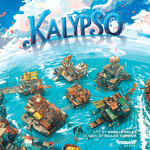
Hi, my name is Gilles, and I’m excited to share the story behind Kalypso, published by Inside Up Games.
The idea for Kalypso grew out of my lifelong connection with the ocean. Having grown up on an island, water has always been part of my identity, so the thought of building a floating city felt almost inevitable. Of course, the movie Waterworld left its mark on my imagination, but I wanted to steer the theme in a brighter, more optimistic direction—less diesel and grime, more greenery and hope. My vision leaned closer to Solarpunk or Ecopunk, where creativity and sustainability shape a better future.
From Notebooks to Prototypes
In the summer of 2020, my first sketches already hinted at what Kalypso might become: buildings, palisades, and resource tiles spread across a floating city.
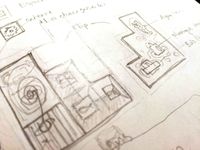
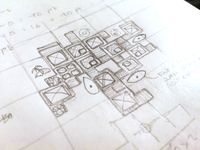
I’ve always kept notebooks for my ideas—sometimes it’s a mechanic, other times it’s just a theme that pops into my head. Over the years, I’ve filled nearly a dozen of them. They’re indispensable, because there’s no way I could remember every detail otherwise. And whenever I need inspiration, I can flip through the pages and instantly reconnect with old ideas waiting to be rediscovered.
Finding the Core Mechanic
In the earliest prototypes, floating buildings carried resources on their reverse side. When a player collected a tile, they first gained its resources from the supply, then flipped the tile to reveal a building that could be constructed if they had the right materials.
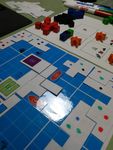
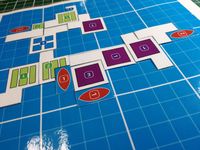
It worked—but I’ve never been fond of games that rely on constant resource juggling: taking tokens from the supply when you gain them, only to put them back when you spend them. I wanted something cleaner, simpler, more elegant.
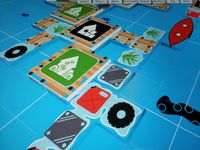
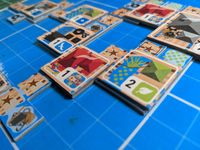
The breakthrough came when I asked myself: What if buildings were constructed directly on top of resource tiles? That single idea reshaped the game and gave it a clear identity. From there, two distinct tile types emerged: resource tiles (double-sided for flexibility) and building tiles (also double-sided, each offering different powers).
Resources and Buildings
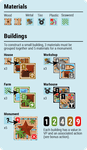
The game revolves around five types of resources, but I wanted plastic to feel undesirable. In the earliest versions, players lost points for every piece of plastic still visible at the end of the game. Even after I removed that penalty, plastic (red) remained the “bad” resource: unlike wood (yellow), rubber (black), seaweed (green), or metal (gray), it couldn’t be used to construct the four core building types.
Each building type required just one resource, making the rules easier to learn and the board state clearer. Since the game is played on a grid, constructing a building means forming a group of three matching resources in a 2×2 square, then placing the building tile on top. I also wanted Kalypso to be full of combos, so players would feel a sense of accomplishment every turn. The very first building I designed gave players an extra T-shaped tile with 5 resources to place immediately. Because that effect was powerful, I balanced it with a lower victory point value. In general, every building was designed with this tradeoff between power and points.
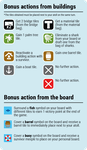
In the end, I settled on four main types of buildings: houses (yellow), workshops (gray), farms (green), and warehouses (black). The color of the building is also associated with the color of the resource required for that building. And since tiles are double-sided, I gave each building type two possible abilities, letting players choose which side to build.
Later, I introduced monuments—larger buildings that require a 3×3 area with at least five matching resources. Early versions also had oversized buildings for each type, but I streamlined everything into this single “big build.”
Shaping the Tiles and Player Experience
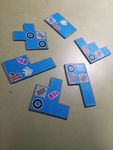
During playtesting, I noticed that players often tried to “fill in” gaps as if they were playing Tetris. To break that predictable pattern, I switched to a more chaotic shape—the T-piece—which immediately gave the game its own character.
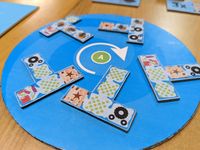
I also wanted to eliminate downtime. Since the mechanics allowed it, I opted for simultaneous play. Combined with tile drafting, this created a lively dynamic: players would pass along less useful tiles to their neighbors, almost like dumping garbage. That imagery fit the theme perfectly and inspired the name of the shared drafting board—the “garbage vortex” that moves around the table.
In an early version of the game, players could send sharks to opponents each round, blocking certain spaces and forcing everyone to adapt while continuing to expand their floating city. Over the months of development, the shared objectives evolved as well. They shifted from a competitive race into a system where every player could pursue goals at their own pace, earning points only at the end if they succeeded.
Playtesting and Recognition
In the beginning, most of the testing took place within my circle of fellow designers, which we call the LAB. Because the game involved hundreds of tiles, online playtesting quickly became a lifesaver—it spared me from endless hours with an X-Acto knife and saved my arms from serious strain. Once I was confident in the results of the digital tests, though, there was no escaping it: I rolled up my sleeves and cut out hundreds of tiles for the physical prototype.
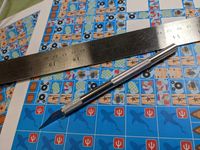
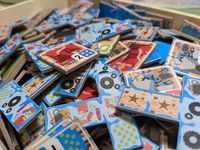
By October 2021, I had a polished prototype ready to bring to public events around Québec City. The feedback was encouraging, so I entered two regional design contests. Kalypso became a finalist in one and won gold in the other.
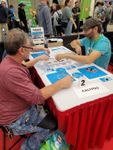
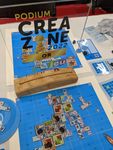
Buoyed by this success, I began pitching the game to publishers. In the fall of 2022, I reached out to several french companies, but received no positive responses. Winning contests is never a guarantee—every publisher has their own vision and priorities. I decided to try my luck in English instead, which meant translating all of my pitch materials, even though it isn’t my first language.
Signing with Inside Up Games
I only sent one email submission in English. My first step was to email Inside Up in early 2023. About a month later, they got back to me and suggested an online playtest. Over the following weeks, we ran several more sessions—I think Conor McGoey wanted full team approval before moving forward.
I’ll never forget my very first test with Conor. He was traveling through Europe with his family, and despite a long day of travel, he stayed up late to play Kalypso. It was around midnight, his family asleep, and there he was on his laptop, testing my game. At first, I wondered if it was really a good idea to play under those conditions, but Conor proved to be incredibly kind, generous, and enthusiastic.
Finally, in September 2023, the game was officially signed.
Small Tweaks, Big Impact
When Conor suggested adding a cooperative mode, I approached it cautiously. I didn’t want Kalypso to lose its identity or force players to relearn the game entirely—cooperative variants can sometimes feel like a completely different game. Fortunately, the team’s changes were subtle and thoughtful, refining the experience rather than overhauling it. The foundation I had built remained solid, and at its core, Kalypso was still the game I had envisioned from the start. I had experimented with a cooperative mode before, but I was never fully satisfied with it. Inside Up’s version, which even included a solo option, was far superior—streamlined, elegant, and much closer to what the game could truly be.
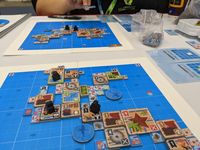
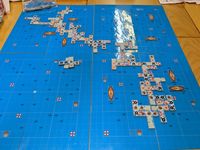
Another major shift in the game was replacing the shark mechanic with Forecast cards. This change added a whole new layer of player interactivity, as each card introduced unique challenges that forced players to think strategically about how to build their floating city. Beyond the mechanical impact, the Forecast cards brought thematic richness to the game, introducing events that reflected environmental shifts and challenges in the world of Kalypso. They also greatly increased replayability, ensuring that no two games would ever feel exactly the same. I was immediately drawn to this new direction, as it brought both depth and narrative flavor to the gameplay in a way that the shark mechanic never could.
When it came to the look and feel of the game, the first glimpse I had was a teaser of the cover art. That alone was exciting, but seeing the full set of components later—the Forecast cards, the objectives, the tiles—was even more special. Amelia Sales’s illustrations bring the world of Kalypso to life in such a vibrant way. Every image reinforces the theme and makes the floating city feel real, colorful, and alive.

A few months later, I learned that the team was working on a custom component designed to keep tiles from sliding around during play. It might sound like a small detail, but it really spoke to the level of care and craftsmanship Inside Up brings to their projects. That dedication reassured me that Kalypso was in the best possible hands.
After the success of the Kickstarter campaign last year, I’m really looking forward to seeing this game make its way into homes and stores. Thank you for following along with my journey in creating Kalypso. I hope you’ll find as much joy in building your own floating city as I did in designing it. Dive in, explore, and make the experience uniquely yours!
Tell us how can we improve this post?