
/pic9753407.jpg)
Editor’s note: a designer diary for Kano was published at the same time, which you can read HERE.
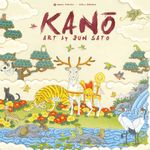
Jun Sato first connected with Matagot via an Instagram DM. That short message revealed possibilities in an industry still unknown to us. At the same time, however, based on my past experience, I was convinced that the task would be extremely difficult for him. The reason for this is that, particularly over the past few years, he has focused his activities exclusively on creating purely original works rather than commercial illustrations.I was worried that having to follow specific color schemes or draw prescribed characters and buildings might stifle his creativity.
After a long discussion with Jun Sato, he expressed a strong determination to see this project through to completion. Accomplishing the task required an assistant―much like Sherlock’s Watson and although he already had several professional partners, he concluded that I was the ideal choice for this role, given my expertise in both painting and traditional Japanese styles. Initially, I suggested that he create the artwork digitally to facilitate the workflow, but he strongly preferred to paint on paper. When using an illustration drawn on paper for commercial purposes, the biggest issue is color specification.
With digital data, colors are assigned numbers, making them easy to recognize. It required some ingenuity to ensure that the colors drawn on paper were perceived accurately by both the workshop in Kyoto, Japan, and the company Matagot in Bordeaux, France.
/pic9798515.png)
In the early stages of illustration production, communication with Matagot was not yet fully established. However, it was necessary to align our understanding regarding the game’s primary color palette.I painted candidate colors onto a paper board and shared them with Matagot through numerous videos and images. Maxime, who handled my case, was very polite, prompt, and kind in our email exchanges, which put me completely at ease. The creation of art always remains within Jun Sato in a mysterious form, never to be revealed to the outside world. However, in this job, I had to share information accurately and in a way that was easy for others to understand. Jun Sato kept notes to accurately track every color used in the illustration, but the volume of these notes eventually became enormous. The work proceeded with him recording the specific color mixtures and quantities of paint used in handwritten notes.
/pic9798508.png)
Another concern was grasping the rules of the game. We weren’t very familiar with board games, so we felt uneasy about not knowing the rules. However, there was a wonderful opportunity to put those concerns to rest. Arnaud Charpentier, the CEO of Matagot, visited Japan and gave us the chance to play a demo version of the game. It was highly significant that Jun Sato met Mr. Arnaud Charpentier in person at that time. For an artist like Jun Sato, who creates original artwork, a dialogue with a client not only stimulates his creativity but also serves as a catalyst for pouring even deeper passion
into his work.
Grasping the game’s rules was also a great help to him in shaping his ideas for the designs of the characters―such as the animals and people―that appear in the game, as well as for the design of the main animal. The puzzle pieces included “T” and “L” shapes, which gave Jun Sato a great deal of trouble. However, because he was accustomed to creating original works, he was able to devise and propose a way to harmonize them. He was particularly particular about the lines of the clouds. He paid meticulous attention to ensuring that the clouds in the background connected seamlessly.
In traditional Japanese painting, clouds represent time and space. In a game, even if you place a randomly acquired graphic element in a location that might seem unnatural at first glance, separating it with clouds allows the entire composition to come together as a unified painting.
In his original works, he consistently depicts a world where biodiversity is preserved and all forms of life pursue happiness together, cooperating with and understanding one another. Ultimately, in creating the illustrations for KANO, we succeeded in bringing to life a world where humans and nature coexist a defining characteristic of Jun Sato’s work. I feel as though each of those pieces is a small miracle.
/pic9798510.png)
While Matagot (France) and Jun Sato (Japan) differ significantly in their values―stemming from the distinction between Western and Eastern perspectives―they were able to share a common goal for this project: giving form to themes of greater significance to humanity, such as humanity itself, nature, creativity, and sensibility. In artistic collaborations, it is rare to reach a state of mutual understanding that transcends nationality and identity. We are grateful for this valuable opportunity.
/pic9798513.png)
Furthermore, I have deeply moving memories associated with this project. After finishing the illustration work, Jun Sato and I reunited with Arnaud Charpentier at Tokyo Game Market and shared the joy of holding the completed KANO in our hands. After that, we traveled to Bordeaux, France, and visited Matagot, where we had the opportunity to interact with Maxime and the people involved in this project. An autograph session for Jun Sato was held in Bordeaux, where he was able to meet people who had been eagerly awaiting KANO. And the trip to Paris after Bordeaux became an unforgettable memory.
In his twenties, Jun Sato visited Paris repeatedly while dreaming of becoming an artist. Holding an autograph session for KANO in that city he had long admired gave him a wonderful opportunity to reflect on his original aspirations. Through this project, I was able to discover a new and different side of the artist Jun Sato. Jun Sato’s existing fans likely feel the same way. A work of handmade art has transcended time (time zones) and space (national borders) to become a finished board game.
It is truly wonderful that people who play this game can enhance their sensitivity and enrich their hearts through the creative experiences it offers. We hope that many people will play KANO again and again, savoring the joy of collecting and arranging pieces each one a small miracle in itself.
JUN SATO Office
Art Director
TOMOKO SATO
Tell us how can we improve this post?