
/pic9098763.jpg)
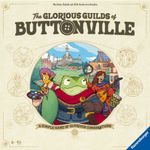
This designer diary will tell the story on how The Glorious Guilds of Buttonville came to be.
We, Christian Kudahl and Erik Andersson Sundén, started to explore joint designs less than four years ago. Erik had played Mindbug and loved it. Christian had heard of Erik from his adventures at Fastaval and Whirling Witchcraft and was curious. So we started to talk. Relatively soon we both agreed to try to make a game together.
We seem to thrive when we work intensely! So we tried a few ideas and shot them down after a few iterations. Especially Christian pushed the idea of abandoning things quickly if they didn’t show great promise already in the first test (as he can really be quite lazy). This can feel quite tough as you still may think “but I can fix it”, but exploring new ideas is just a lot more fun. We wanted a game that was immediately really fun, so that our job polishing the last few edges would be super easy.
And so one day we stumbled over the concept of Buttonville. We agreed to create the simplest of systems so the game rules were something like this:
1. Draw cards.
2. Play as many cards as you want from a set and trigger the ability of that set.
Each set has a cool ability which sometimes even gets more powerful the more cards you play. This was the core of the game and already from the first test, we saw something showing a ton of promise. We knew we had to continue down this rabbit hole to see what the game had to offer. It’s fun when you make games, you can yourself be surprised at the experiences they throw back at you. It is a bit like having a kid.
We saw that the system was simple enough to not get in the way, so the heart of the game was really the cards. Depending on what you put on those, the game could be a breezy experience playable with families or a brainburning puzzly hellhole that would make even heavy eurogamers quit in frustration. We aimed for a happy medium.
We made the game modular, so each game you select some number of stacks that are used in that game. (A stack consists of multiple copies of the same card). This gives a lot of variety between games and leaves new combinations to be discovered each play. This idea is certainly not new, and Dominionprovided some inspiration here. Not for the gameplay, as Glorious Guilds of Buttonville is not a deck builder, but for having a big box with stacks of cards, only some of which are used in every game. Other inspirations include Guildhall and Ethnos having abilities increasing in power based on the number of cards played.
And all of a sudden things exploded. We went into hyperspeed mode and more than 50 cards were created in less than a day. Erik loves to brainstorm ideas and just throw them out there, no thoughts of consequences and no sorting of good or bad effects. Page up and page down. Christian is great at finding the gold nuggets among those ideas and polishing them to crispy unique (and well-worded) effects. Christian even suggested that our rapid work pace made him think of us as he listened to MacGyver by They Might Be Giants.
/pic9644096.png)
Playtest at the lunch break of the division of applied nuclear physics at Uppsala University
After working on the game for what feels like only about a month, Erik proposed sending it to Thorsten Gimmler at Ravensburger. Usually it is a good idea to make your idea really refined before showing it to a publisher – if they don’t like it, they might not want to see a more polished version again later. On the other hand, we are both quite impatient (especially Erik), so we decided to send it away. And then we waited. What did we learn from the waiting? Erik is WAY less relaxed in a waiting state. He probably checked his mail every 5th minute. Christian was much more Zen.
Thorsten: ”From the very first test game, I was captivated by the game. Many games have extensive rules that ensure complexity and replayability. Buttonville, however, has such simple and few rules, yet the combinations of cards ensure that the game remains exciting. Since the games don’t take long, I played three games in a row during my first test. Further tests quickly followed, especially since it was easy to find test players for the game, as everyone wanted to test it again and again. So it quickly became clear to us that we definitely wanted to make the game.”
/pic9652028.png)
An early playtest of the prototype at Ravensburger in June 2024
Thorsten came back to us and started by saying. “This game sure has a LOT of cards in it! I can’t believe that I spent so much time crafting this first prototype, but I’m glad I did! Because I REALLY like the game!” and a few months later a contract was signed.
We had a great development process with Ravensburger. Thorsten proposed that instead of picking the card sets completely random, we could group them into sets of similar effects, for example drawing, getting currency, spending currency etc. This was a great call and allowed us some freedom in designing cards. If a card for example rewards you for spending coins, you really need there to be another card giving you coins or that first card will just be a dead draw.
Erik and Christian (especially Erik) created well over 100 more card stacks. Some were super simple and some more advanced (Christian even used the expression “crazy mess” now and then). We playtested the cards and sorted them back and forth in good and bad, simple and hard. Together with our editorial team at Ravensburger, we decided to mostly focus on the simple and easy to understand card effects, and only one or two of the crazy messes snuck their way into the final game (You know who you are, Slimebob!).
/pic9189110.jpg)
Photo Credit: [user=W Eric Martin][/user]
Thorsten: “Working with Christian and Erik was really great and a lot of fun. We coordinated with each other regularly and discussed our test results in video calls. It was great that we always had the same vision for the game. It just worked really well. We made small improvements again and again, replacing some cards with new ones or simply improving and adjusting others slightly. We also made a big leap forward by designing the entire system to be modular. This allows everyone to freely assemble their own set. Of course, this also had the practical benefit of not having to test each set multiple times. 😉 But this means you are not limited to previously tested sets. You can keep putting together new sets and be sure that they will work!
/pic9643866.jpg)
/pic9644429.jpg)
The signing event at SPIEL 2025.
The game premiered at SPIEL Essen 2025. We were happy to be assigned a signing slot at the booth of Ravensburger. We had a decent number of visitors who wanted a signed copy, a fair amount were happy designer friends who congratulated us. We had a great time! And then! As the time was getting close to the end, something started to happen. A huge queue started to build up and we started to get excited. Did the hype spread to the entire convention already? Christian, the more observant of the two of us, noticed that every single one in the queue was also carrying a green box… hmm.. As we turn around Stefan Feld is standing behind us: “I will take over from here.” (Just kidding, Stefan was super friendly and congratulated us on our game.)
Almost a year has passed, and now it is time for the game to be presented at Gen Con! We look forward to its American reception!
/pic9643867.jpg)
From the left: Erik Andersson Sundén, Thorsten Gimmler, and Christian Kudahl
Tell us how can we improve this post?