
/pic9349843.png)
It’s not often that you get a chance to revisit one of your old published games, and reimagine it for a new audience. Elysium, designed with Brett J. Gilbert, and published by Space Cowboys in 2015, is one of the games I am the most proud of in my ludography. There are a lot of fond memories I have about working on the game, developing it with the team at Space Cowboys, and my first trip to Berlin for the SdJ ceremony when it was nominated for the Kennerspiel des Jahres (even if we didn’t win!). The game has a lot of fans even to this day, and is a type of game that I personally really enjoy playing.
So back in 2022 when Space Cowboys asked Brett and I whether we would be interested in working on a new streamlined and simplified version of Elysium, we jumped at the chance to work on the game again. Repos had recently released 7 Wonders: Architects in 2021, a more accessible version of 7 Wonders, and it provided a useful signpost for thinking about how to approach our task.
The core gameplay of Elysium, while light on rules, is quite taxing for players – they have to manage their four different coloured columns to navigate taking three cards from a display that can start each round with as many as 13 cards, all the while having to keep an eye on what their opponents are doing so they don’t get screwed over by the cards they take. There are many cards with a huge variety of abilities, organised into eight different families, of which five are used in any game. Players also have to manage their cards and gold in order to move cards into their Elysium at the end of each round, where the family and level of a card become important in forming Legends (or sets) or cards which score points at the end of the game. In short, there’s a lot to think about!
/pic2386017.jpg)
A lot going on!
So the problem was how to distill the magic of Elysium while inevitably stripping out parts of the game to reduce the overall mental gymnastics required of players. I would love to say that we then embarked on a multi-year journey, trialling many many different versions of a new game, before finally reaching the end goal…but in reality we were much more fortunate, in two key ways.
The first was that I had a very good idea about how to streamline the game in an elegant way, almost at the start of the process. In the original version of Elysium, players have four turns each round, three turns they take a card from the central display, and one turn they claim a Quest which determines their income, how many cards they can transfer to their Elysium, and turn order for the next round. What if there was a way to remove all this round structure, and simply have a game where players on their turn either take a card, or transfer some cards to their Elysium? Then the game would have a lot less upkeep, have a better flow, and could present new interesting choices for players as to what to do on their turn while keeping the actual number of options manageable.
The answer lay in reimagining the columns from the original game. Formerly, you would spend one column after each of your turns, and then regain all four columns at the end of the round. As your turns went on, you had fewer columns available to you, tightening your options. But in this new game, what if you could choose to get back your columns at any time? And if we did this, you could tie that action, to regain your columns, to the action of moving cards to your Elysium.
But there is one problem – if we did this then the game loses all the tension from the former version, with players allowed to keep refreshing their columns and never having to experience being down to one or two columns and having few good options. The answer in the end was pretty simple: make the rewards you get – your income and the number of transfers – tied to the number of columns you get back when you refresh. That way, you can either keep refreshing one or two columns, maximizing your options but having minimal income. Or you could do the reverse, taking more turns before you refresh, having worse options as you go along, but in turn you are rewarded with more income and transfers when you do refresh. And thus the rule became when you refreshed your columns you gained one gold or transferred one card for every column you returned.
The second piece of good fortune isn’t really about luck, but rather about sheer design brilliance. Even with this new structure in place, there was still a lot of work – hundreds of cards and effects to reimagine, streamline and reorganise. And furthermore, I was in the middle of moving around the world from the Czech Republic to Australia, and didn’t really have much time to work on the project. I leave the project for a few weeks after discussing it with Brett, and when I land in Australia, an email is awaiting for me from Brett – which has a complete prototype with all the cards designed and ready to go! With Brett’s game design blitz the game is ready to be shown to Space Cowboys…and they love it!
/pic9566194.png)
A small sample of Brett’s initial complete prototype of First Giants, still using the theme of Elysium
From this point on we continue to work with the team at Space Cowboys, refining the cards and rules. There were several important developments, even at this late stage, that further cemented First Giants as its own ‘beast’ (or dinosaur?), rather than simply an offshoot of Elysium. The central display became four different dig sites with two cards available in each, and players would simply place their marker on a dig site to take a card there. But, they could only go to a Dig Site that didn’t already have one of their markers – this both increased the tension for players, and provided a really clear visual marker of what players were capable of on their turn, a definite upgrade from the columns in Elysium. Exhibits utilized tokens to mark your increasing score, that could then be flipped once you completed your exhibition to both mark a bonus and the fact you had completed it. Small improvements like this greatly aided the ergonomy of the game, helping to achieve that elusive sense of flow in gameplay.
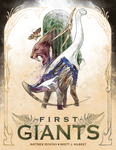
This was also the time to think about production and theming. Space Cowboys had an amazing idea for a new setting to place the game in – imagining the cards as Dinosaurs you are researching when you take the cards, and then are displayed in your museum when they are transferred. Jessica Cognard came on board the project to handle the illustrations of the many cards, and Maud Chalmel did an amazing job with the cover, evoking a touch of art deco to the overall museum and dinosaur theme. And Space Cowboys flexed their production prowess in managing to fit in a truly remarkable amount of material – the cards, glass beads for amber (the new currency in place of gold), wooden printed pieces and more – in a box less than half the size of the original game.
Finally I am able to hold a copy of First Giants in my hands, and I am as excited and thrilled as I was holding my first copy of Elysium more than a decade ago. I hope you will all get to enjoy the game that Brett and I were just grateful to get to spend a little more time in.
/pic9577936.jpg)
/pic9577935.jpg)
/pic9577934.jpg)
The evolution from our initial prototype, to the first iteration of a dinosaur theme, to the final published version of First Giants.
Tell us how can we improve this post?