
/pic8807429.png)
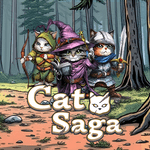
“Cat Saga is a cooperative, story-driven adventure game. Explore the world together and make decisions that impact your unique saga.”
In this Designer Diary, I will take you on the journey of creating Cat Saga. We have worked on this game for over four years and are very proud of the result. Hopefully, the design lessons will help other aspiring designers bring their games to life.
How the Game Works
Before we dive into the journey of creating Cat Saga, let’s briefly talk about how the game plays. As a team, you will make decisions that impact the story, engage in combat, and use your abilities to overcome danger. You will create a wonderful saga together attempt epic actions, get into fights, find valuable items, and level up.
There are no turns; players simply move through the story together, with different paths leading to different endings. To overcome obstacles, players must complete a Try or Fight, using dice, abilities, and items to achieve a good result.
The Vision (4 Years Ago)
I have always wanted to create a story-driven game. As a young kid, my dream was to become a writer first and a game designer second. It felt great to combine the two crafts. The idea started when I realized I couldn’t find a good story-driven game or RPG that my wife and son would enjoy.
We began working on different concepts for a game that mixed TTRPG and board game mechanics. Quickly, we struck a balance of complexity that we enjoyed and started the in-depth development. A key goal was to make a game that would also play well solo and allow the “forever DM” to experience a campaign as one of the players. So there is no DM in this game, but we still wanted an exciting story with different paths to explore.
From the start, I wanted a game that plays quickly (under one hour) and carries your progress over to the next chapter. We began by designing something as rules-light as possible while still capturing the feeling of a fantasy adventure game.
It really helps to define your vision and target audience up front. For example, it made sense to keep combat simple and limited, given the targets I had set and the family-friendly nature I wanted to achieve. There are plenty of games with a heavy focus on combat; there was no need for this game to try to be everything for everyone.
/pic9461042.png)
Setting
We decided to make a family friendly light-hearted game. And we wanted a twist on the classic fantasy tropes. As a family we were discussing at the time to bring a cat into our home. That is when the theme was decided. Cats are cute and loved by many. This was before we called games “cozy” but looking back, this was a decision to make the game look the way it plays: simple, accesible and friendly.
Early Prototyping
It was clear that this was going to be a very accessible game, so we decided to only use paper, pencils, and dice. Since dice are the randomizer, it was important to decide how they would be used. In one early prototype, we used classic RPG dice: 1d4, 1d6, 1d8, etc. But to differentiate from well-known games and keep the system accessible, we decided to use only the familiar d6.
Adding the numbers on the dice to reach a certain threshold felt familiar, but it did not offer enough options to mitigate the dice. After some testing, we landed on a system where each number is represented by a trait. This means that rolling a 6 is not always good, it might be great for a Strength Try, but useless for another type of challenge.
/pic9461047.png)
For players, this allowed us to add options like flipping a die, adding or subtracting one, and, of course, re-rolling. Testing showed that re-rolling abilities were far more fun. They added a push-your-luck element to the game. Will you use that potion now, or save it for later? When you don’t know the exact outcome, the decision becomes much more interesting.
Development & Artwork (2 Years Ago)
The game was in a good state, and we decided to commit to creating artwork. In the meantime, we focused on intensive online testing. Shortly after the art was completed, Lucky joined our family as a cute little kitten.
/pic9461048.jpg)
“When we took these photos two years ago, the game was 90% finished. We have now finished the other 90%, and after the campaign we will complete the final 90%.”
Looking back, I remember thinking the game was almost done and that it was time to create the artwork and start more blind testing. But during that phase, an enormous amount of work was still ahead of us. And I know that even after the Kickstarter campaign there will still be plenty left to do.
At this stage we hired an editor. I am not a native English speaker and wrote most of the stories myself, so it was important to have them reviewed and improved. The artwork also grew beyond our initial scope, and we eventually hired several artists to create all the pieces for the game. And we moved into heavy blind-testing. Besides regular playtesting sessions where people played at the same time, we also did a lot of “play-by-post.” We used RoleGate and attracted many blind playtesters from the RPG side of the hobby. Since there are no turns in the game, it flows very well online players don’t all need to be active at the same time.
/pic9461052.png)
Now (2026)
Lucky is more than two years old and no longer a small kitten. As much as she matured, so did the game. And now it is finally time to share it with the world!
/pic9461053.png)
Lessons
– Create something YOU are missing in the market. A game you would love to play. Ultimately a lot of hours will go into a design, make sure you will enjoy it.
– Start with a clear vision for your game. Whenever you are unsure on which decision to make, going back to the vision and target audience will help you decide. Stating this up front is not a marketing method, it makes sure you end up with a game that hits the targets you set out to achieve.
– Tap into other communities. RoleGate was a great way of testing for this game. Perhaps the gameplay or theme can help you find new groups of playtesters.
– Games are never finished, but at one point they are printed. Yes be a perfectionist, but also work towards completing a project.
Tell us how can we improve this post?