
by Fat Francis
/pic8966878.jpg)
Michael Rieneck
Franz Vohwinkel
Deep Print Games
Editor’s Note – Michael Rieneck and Franz Vohwinkel wrote a designers’ diary about the development of Skybridge, published on Feb 3rd, 2026. This diary is a compliment to that piece, but from the perspective of developing the artwork.
Artist Diary: Skybridge
There are moments in life when paths open up that you didn’t know existed at first.
15 years ago I surprisingly received an unusual assignment: design three fantasy puzzles, including a box design, for a new jigsaw puzzle series. Unknowingly, I had embarked on a long journey that has not yet come to an end.
September 2010
/pic9362447.jpg)
When I made this sketch for the first of a series of puzzles, I had no idea that I would write about it today. At that time the drakhes were still dragons, there were still visible sunbeams in Thraen (at that time simply called “Downworld”) and apart from the Queen, Adlem and the inhabitants of the “Skyworld”, Thraen, and Beeledhans Eye were still completely unknown to me.
Although I have discovered so much in Thraen since then, those three original illustrations laid the foundation for what Skybridge turned into today.
From my current point of view, the first puzzle was certainly the most important of the three, because it already contains all the essential elements of the story: the dry, hollow world on the outside, the lush and heavenly world inside, and the tower that will become a bridge, connecting both worlds.
The motif of the construction site from the second puzzle can be seen as “standing” or “hanging” depending on how one wants to view it. Here, the idea of weightlessness is displayed for the first time: In the hollow world, gravity pulls outwards (for us “down”), while the gravity of the central world pulls inward towards its center (for us “up”). In the middle between both worlds, the two gravitational forces cancel each other out.
A heavily revised version of the first puzzle became the cover of the prototype and a reduced version of the second puzzle can still be seen on the cards “Bridge”.
/pic9362448.jpg)
Only the third puzzle has fallen out of the storyline over time. Too much has changed, or looks completely different today: A peaceful encounter of characters from both worlds in a central room of the Skybridge is now completely impossible.
The Work on the Board Game Started
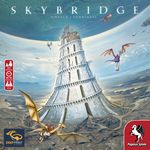
One of the first tasks was to completely revise the cover to match the current state of the worlds. The Skybridge now gleams in hopeful white and Beeledhans Eye is much more visible. The whole image seems much lighter, almost like a vision. The publisher contributed some good ideas like the slightly slanted point of view and the drakhe flying towards the viewer in the foreground.
/pic9362449.jpg)
The Five Main Characters
In addition to the cover, I first developed the five main characters, as they are important for the visual representation of the five ethnic groups on the player boards and the starting cards. Some of the maps of Skybridge were originally created in 2017, as well as this version of Queen Urcela, who always triggered the comment “She looks like Tilda Swinton”.
/pic9362450.jpg)
True. I think Tilda Swinton’s face is wonderful.
To avoid this similarity, I made a new illustration of the queen, which was quite challenging for me as I liked the original illustration so much.
/pic9362451.jpg)
In the new illustration Urcela is now seen wearing the Crown of Agony, which in the meantime had become an important detail of the story.
– In a first step, I revised the original sketch and drew a new face.
– Parts of the background and dress from the original illustration were preserved during the revision.
– Underneath the layer with the sketch I colored and modeled the face.
– Then I worked the sketch into the background with various blending brushes and added textures and details layer by layer afterwards. Finally, light color corrections completed the image.
/pic9362452.jpg)
I must admit that I like the new “Guinn” better than the original version.
While the game mechanics were still being developed feverishly, the illustration of the Skybridge was created. The bridge would no longer appear on its own game board, but was to be designed as a series of large individual cardboard tiles, laid out next to the game board.
This original sketch dates back to 2017. At that time, the bridge still consisted of 12 parts.
/pic9362453.jpg)
The player boards were more complex, because the elements on them changed several times in the course of further development. The background illustrations of the player boards had to be adapted accordingly. At this point, the illustrations of the five main characters were already finished.
/pic9362454.jpg)
In addition, I had to make sure that there were not too many contrasting details behind the game elements. The areas behind the text and at the bottom would be faded later on, but in this case, less was more.
The game board was a challenge as well, as it consists of many individual parts that had to be combined to form a whole. While I was already working on the illustration, a completely new area of the game board was created, which would not have existed without Moritz Bornkast and Peter Eggert of Deep Print Games: the desert map, where rebels and legions move towards each other. However, before we got to this point, we had to overcome a whole series of more or less usable versions, none of which fit particularly well into the board.
/pic9362455.jpg)
In order to keep the game producible and affordable while reducing the amount of different “game-locations”, the actual game board was brought to the format of a double-folded board the size of the box. The original game board for the Skybridge was scrapped and the desert map was merged with the game board.
/pic9362456.jpg)
The idea of depicting a part of the desert of the Sea of Winds was the breakthrough. In the story, rebels gather in Salthras Deen and try to make their way to the Skybridge, while the legions protecting the construction site move to meet them. At the same time, a storage area for the game components on the board was reintroduced. One space for a discard pile was removed and the other two were rotated to make room. The illustration of the game board consisted of individual parts that were illustrated and assembled largely independently of each other: the illustrations of the symbols for the game components, the map of Thraen, the desert map and the forts.
(By the way, the small skull that marks the discard pile represents the Realm of the Dead, the “Unseth”. All cards – countries, cities and characters, that end up here never come back. And so Thraen dies a little more each round.)
Most of the work on Skybridge was, of course, the many cards that really bring both worlds to life. The story of the Skybridge takes place in a fantastic world, completely impossible by our laws of nature. How can gravity in Thraen act outwards in all directions, while at the same time acting inward on Beeledhans Eye? Why is every day seemingly arbitrarily different in length? Where does the light come from? It’s magic! Of course, this is not entirely true: The people in Thraen believe godhs have created the world according to their wishes.
There is no magic in Thraen. There are no spellcasting wizards, just as there are no magic swords or heroes. Even the Drakhes are not magical beings, but animals that are captured by humans, tamed and used for their purposes.
/pic9401098.jpg)
The inhabitants of Thraen are simply humans, with all their faults and shortcomings. What would humanity do, if it could see paradise in the sky at any time? What if, in addition, life became more difficult to bear with each passing day?
/pic9362457.jpg)
Unfortunately, it was not possible to keep the short text passages from our prototype cards. The additional effort for production and translation would have been too high.
In order to be able to convey the worlds of Skybridge as originally designed in the prototype, I wanted to create the cards with a range of different realistic styles. It was important to me to show as many details as possible to make the peoples and their stories seem believable.
A little trick that provides increased detail is the size of the illustration. I created the card illustrations with the required resolution more than doubled. For printing, I then built the illustrations into the card frames scaled down considerably. Of course, some details are lost in the process, but the viewer still “feels” that they were there: Everything seems finer, more real, than in “regular” resolution. A pleasant side effect of this approach is also that the illustrations can later be displayed in larger formats as well.
Here are a few examples:
Vinad
/pic9362458.jpg)
In this important scene, Vinad, architect of the Utreng and Adlems main supporter, discovers that the construction of the Skybridge has been sabotaged.
/pic9362459.jpg)
Painting in Corel Painter, I used some of my own texture brushes, which I use to draw any kind of detailed patterned textiles with ease. I created a whole collection of them over the years, which I mix and paint over as needed. I affectionately call them my “wallpaper” brushes.
Min Vallesk
/pic9362460.jpg)
When a Serath greets someone with the word “Min” followed by his name, that person knows that the remainder of his life has just changed irrevocably.
/pic9362461.jpg)
Another type of textile details can be found in this image. Of course, each nation speaks its own language and thus also uses its own characters. On Min Vallesk’s headgear, two characters of the Selessem are recognizable in the pattern.
Usehet Tuin
/pic9362462.jpg)
Only the nomads of the Great Plains know of Usehet Tuin, the hidden valley in the Sea of Winds, where the ghosts of their ancestors are at home.
The Enebe Ghres only dare to come here when the situation is desperate and hopeless enough, to justify a plea for the help of the spirits.
/pic9362463.jpg)
The camp at the foot of the bridge
/pic9362464.jpg)
A key moment happens when the rebels find the camp of the workers at the foot of the Skybridge. The high price that ordinary folks have paid for the construction of the bridge is revealed.
/pic9362465.jpg)
The concept for the artwork of the Godh cards differs from the other cards in one essential point: They represent art that contains information about the different cultures of Thraens inhabitants. This is another, deeper level behind the obvious motif.
“The medium is the message” means here that different peoples also depict their Godhs using different mediums and styles. The Utreng for example like to carve their sacred images in wood, because wood is difficult to obtain in the high mountains of the Salthras and is therefore considered to be a valuable material. The Selessem also paint their naive art on wood, but only because they are a poor fishing people. They simply can afford no other surface to paint on.
In the enormous rock cliff on the edge of the Lhaedineer lowlands, the Lhaedineeri have found the ideal place for monumental depictions of their Godhs. The Tarrans, on the other hand, have perfected the fine art of sculpture. The work with precious stone has a tradition in the Reich that goes back to the first people of the White Sea.
/pic9362466.jpg)
In order to portrait this variety of styles convincingly, objects and materials need to be presented as realistically as possible. Only through the contrast of the respective art style and the medium on which it is created, it becomes clear that what looks like a drawing on parchment is also meant as to be seen as a “drawing on parchment”.
Valendha
/pic9362467.jpg)
The cultural contexts of the Godhs shown on the cards also become clearer because, unlike the other cards, almost every depiction of a Godh also shows writing in the respective language. Inscriptions, names and descriptions support the impression that the priests of Valendha want to say something about their Godhess in this carving.
/pic9362468.jpg)
Ephalu
/pic9362469.jpg)
The depictions of the Godhs on the cards are only intended as examples. There are certainly a variety of representations of every Godh in Thraen, some similar, some different, depending on which temple you are visiting.
/pic9362470.jpg)
Although mainly Tarrans believe in Ephalu, there are believers among the Enebe Ghres and the Unshackled People as well.
These peoples would certainly represent the blind Godhess of hope in different styles and mediums than the Tarrans. This is a field of the cultures in Thraen that I would like to explore more deeply in the future.
The worlds of Skybridge, initially described only in writing, now come to life in the illustrations for the game. Working with my own creation as a reference was a strange experience. It was often just as exciting and surprising for me as it was for Michael, who could hardly wait to see more every week. Holding the finished game in my hands now, after such a long time and all the ups and downs we’ve been through, still feels unreal to me.
I am looking forward to seeing Skybridge on the gaming tables and hope that lots of people will enjoy playing our game.
If you would like to see more of the art of Skybridge, you can explore it in greater detail on the website: theskybridge.de. (Currently available in German only, but eventually it will be available in English.)
I will also be posting information about further developments there.
Tell us how can we improve this post?