
by Adam Porter
/pic9133445.jpg)
Following the huge success of Voyages, many designers were keen to replicate Postmark Games’s model of crowdfunded, print-and-play, roll-and-write games. In early 2022, I was approached by an illustrator and graphic designer. He was unknown to me, but clearly talented, and he asked whether I’d like to collaborate on such a project. The arrangement was simple: I would design the rules, he would handle illustration and crowdfunding. There was no contract or firm commitment, but it felt worth exploring.
I immediately knew I wanted to create a flip-and-write game using a standard deck of playing cards. My favourite titles in this genre are Cartographers, Avenue, and Welcome to, so these served as my inspiration. I pulled together a few initial concepts and approached my good friend and frequent collaborator Rob Fisher (co-designer on Qwuzzle, Kompromat,Happy Hoppers, and Emberheart). As often happens, Rob wasn’t keen on my early implementations, but he liked the core idea. He took it away, and a few days later came back with a clear vision: a tower-building game.
That immediately connected with something from our past. Five years earlier, Rob and I had worked on a trick-taking card game about building totem poles. After each trick, players would pick a card and stack it into their own display, forming totem poles. The game was called Trick Pick Totem, describing the sequence of play. We never finished the design. We were uneasy with the theme, and the card play never quite clicked. But one mechanism stayed with us: when stacking numbered cards, values had to descend from bottom to top, while special cards bent the rules and opened up new scoring possibilities. That idea became the foundation of our new design.
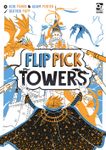
We started referring to the new game as Flip Pick Towers – an evolution of Trick Pick Totem – once again a literal description of the turn structure: flip cards, pick one, draw towers.
Rob’s starting point for our flip-and-write was inspired. With an illustrator already attached, he imagined a game that became more beautiful as you played. Many roll-and-writes have clever systems but unattractive interfaces, like spreadsheets. Others begin with an appealing illustrated sheet that steadily degrades as players cross things out. From the very beginning, we set a guiding principle: the sheet should start relatively plain (framed by a nicely illustrated surround) and become richer and more ornate over the course of play. Players should be able to express themselves through their drawings – but without that being a requirement. Boxes, numbers, letters, or stick figures should work just as well, if players preferred.
I’m a strong believer in identifying a hook early in development. For Flip Pick Towers, it was simple and clear: ‘a flip-and-write game where your player sheet gets more beautiful as you play’.
Two other pillars quickly followed:
1. The game could use only a deck of cards and a sheet of paper.
2. It should be playable virtually, by any number of players (very much a product of our COVID-era mindset).
The earliest version used the numerical cards from a standard deck of playing cards. As in Welcome to, three cards were flipped; and all players chose one to utilise. Numbers represented floors in a growing tower, while suits allowed you to mark spaces in a small grid on your sheet. Completing lines in the grid unlocked decorations – banners, windows, treasure, beanstalks – each scoring in different ways.
/pic9421104.jpg)
Early Sketch. 18th May 2022. At this point, Royal Cards represented different types of roof.
The next step was to find roles for the royal cards. The solution was obvious and intuitive – they would live in the towers. Kings scored if placed in the highest room; Queens scored if royals were grouped together; Jacks scored for the number of banners on their tower.
We pieced together rules for the remaining cards, to maximise the use of a traditional deck. Selecting an Ace granted you a special ability which would allow you to break the tower-building rules in some manner (similar to our special cards in Trick Pick Totem). But what about Jokers? Well… they attracted dragons – fun to draw but they cost you points. What do dragons love? Gold. So we allowed players to discard one of their previously drawn treasures to persuade a dragon to fly on by, avoiding the penalty.
We imagined that players might like to colour and elaborate on their illustrations and share their finished towers online, much as they did with the wonderful map-building game, Cartographers.
/pic9421103.jpg)
21st May 2022. Royals now occupied the towers.
A couple of weeks had passed since the initial proposal by the illustrator, so I dropped him a message to let him know we had a game to show him. And… nothing. No response. Repeated messages went unanswered. And I felt a little deflated. Rob and I were left with a fun little print-and-play game but no collaborator and no obvious route to market. Neither of us was keen to run a crowdfunding campaign ourselves. And I had fallen completely in love with the game. I played it solo over and over. This was some of our best work, and we felt it deserved a full production, with a box and fully-illustrated, dedicated deck of cards.
/pic9421102.jpg)
26th May 2022. First prototype with printed sheets.
As development continued, the limitations of a traditional deck became more obvious. We had clever ideas for roofs and bridges between towers, but they cried out for bespoke cards to make them intuitive. More importantly – inspired by the variable objectives in Cartographers – we could see huge potential in how Kings, Queens, and Jacks might score, but realising that variety required a separate deck of scoring cards.
/pic9421101.jpg)
4th June 2022. Rules continue to develop. In this version, Royals could occupy bridges and roofs and they had fixed scoring, rather than variable objectives.
So we made a pivotal decision: abandon standard playing cards and create a dedicated deck. This allowed us to fine-tune card distribution, deepen thematic immersion, and introduce new options. Jacks became Princesses. Aces became Wizards.
We designed a deck of 30 different scoring objectives. At the start of each game, one objective is assigned to each royal – Queen, King, and Princess – creating an enormous number of possible combinations and dramatically increasing replayability. Queens might score for being adjacent to beanstalks, for each dragon in the same row as them, or for occupying your tallest tower. Kings might score for bridges in the same row, or treasure in the same column, or being adjacent to an empty room. Princesses might score for being above or below windows, or other princesses. I got more and more hooked on solitaire play, and started to think about how to approach the ‘win’ condition when playing alone. I wanted something more engaging than ‘beat your high score’. I’d enjoyed the system in Button Shy’s Sprawlopolis, where multiple objectives each have a target score that combine into a single goal. I borrowed that idea, but added difficulty levels: each objective in Flip Pick Towers has an easy, medium, and hard target. Your chosen difficulty determines your overall target score for the session.
/pic9421105.jpg)
7th June 2022. Rob imagining what a player sheet might look like with a professional illustrator
involved
Osprey Gameswere always our first-choice publisher. I’d pitched to them several times at UK Games Expo without success, but Rob and I admired their catalogue and the care they put into presentation – particularly with the Undaunted series by my friends Trevor Benjamin and David Thompson. I knew my original contact at Osprey had moved on, so I asked David who handled submissions now. His answer was Rhys ap Gwyn, and by sheer coincidence, Rob and I already knew him well. Years earlier, when Rhys was living in Cardiff, he was a regular at our weekly design group. We had playtested many of his prototypes and he’d playtested many of ours. So, our fears of needing to build new bridges with Osprey were unfounded. We just needed to drop Rhys a quick note on Facebook!
/pic9421124.jpg)
11th February 2023. Moving away from traditional deck. Now with icons for different resources, and special cards for roofs and bridges.
I showed Flip Pick Towers to Rhys at UK Games Expo in June 2023. In September, he told us Osprey wanted to publish it, but not until 2026. Because of the long timeline, he generously encouraged me to show the game to other publishers.
At SPIEL Essen that October, I pitched several designs, but two stood out: a worker placement game which would go on to be released as Emberheart, and Flip Pick Towers. Both games got a reaction unlike any games I had pitched before. Multiple companies were interested in one, or both, games. One publisher phoned me a few hours after I pitched Flip Pick Towers to him, and told me he wanted to publish it. I said, “But you haven’t played it yet”. He said, “That doesn’t matter. If there are elements which need to change, we can change them. But I don’t want you to show the game to anyone else.” The pressure spooked us, and Rob and I declined.
On the flight home, I was sat across the aisle from some other SPIEL Essen convention-goers. I could hear from their conversation that they worked for Osprey. I introduced myself and it turned out they had all played the Flip Pick Towers prototype and loved it. After weighing our options, despite the wait, Rob and I agreed that Osprey still felt like the right home. Enthusiasm counts for a lot. We signed the contract.
A couple of months later, Rhys sent us a selection of images from a handful of different illustrators, and asked our opinion about which might be suitable for the game. Hungarian artist, Beatrix Papp, was our preference because of the simple sketchy appearance of her drawings – they didn’t feel a million miles from the type of drawings players might create on their own sheets. Over the following months, Rhys involved us in every aspect of the visual development of the game, regularly checking in with us with each new batch of images from Beatrix.
We were hugely impressed with the attention to detail in the artist’s brief written for Beatrix, which extended to many pages. Here is an extract:
“Whimsical fantasy. This is aimed at casual gamers and families and will be marked as 14+. However, we are not aiming for elements to be too cute. It would be great to give it a little edge, which is why we’re really excited to have you as an illustrator. Elements need to be simple, to encourage people to draw, rather than intimidate them. As such, we don’t need detailed backgrounds or anything, just little touches to indicate the situations / environment, as with the art that drew us to you. We also love the limited palette.”
/pic9421126.jpg)
Sosban the witch, Welsh for ‘saucepan’.
A challenge at this stage was calibrating complexity. Flip Pick Towers isn’t difficult to learn, but it introduces several unfamiliar systems. Each feature we added increased strategic depth but risked accessibility. We included stars on the player sheets with bonuses if you reached them with your towers. We tried reducing the number of columns. We removed bridges and roofs for a basic introductory game. But all of these changes diminished the game somewhat. Eventually, we accepted that the game needed to be presented in its best, complete form, and trusted players to meet it halfway.
/pic9421127.jpg)
Tall towers look tasty to Mellt the dragon, searching for a nest! Mellt – Welsh for ‘lightning’.
One pivotal design decision was formalising the behaviour of dragons. In the earliest versions of the game, they simply deducted points. In the final version, they arrive unannounced and perch atop your towers, preventing you from building any higher unless you feed them gold. Flip Pick Towers is intentionally low on player interaction. Aside from a few competitive elements – such as rewarding the first player to place roofs, or those with more windows than their opponents – most of the game unfolds independently. This choice ties directly to one of our core design pillars: Flip Pick Towers supports any number of players. However, we also wanted to offer a more interactive variant. Once again, we looked to Cartographers for inspiration, particularly its handling of monster attacks. In Flip Pick Towers’s competitive variant, when a dragon appears, an opponent chooses which of your towers it occupies, adding a sharper edge of player interaction for groups that want it.
At some point in this process, Rhys suggested weaving Welsh references into the game’s backstory. It seemed logical – castles and dragons are a huge part of the Welsh identity. ‘Y Ddraig Goch’, the red dragon, symbolises the country and appears on our national flag. Rob and I have both lived in Wales throughout our entire adult lives, and both of us have children who are Welsh. Rhys is Welsh – his surname ‘ap Gwyn’ means ‘son of Gwyn’ in Welsh, with Gwyn meaning ‘white or fair’). My design-focused YouTube channel is called Adam in Wales. This Welsh connection was a wonderful development, and it helped to make the project feel deeply personal. Wales has a rich history of myths, passed down orally by druids, and recorded in medieval manuscripts.
/pic9421128.jpg)
King Llew, Welsh for ‘lion’.
Our King is called Llew after a hero of Welsh mythology, and the Queen is named Blodwen, a name common in Welsh legends. The dragons carry the names Fflam and Mellt – Welsh for flame and lightning, and featuring the familiar Welsh double-letters. The wizards are now magical creatures: Bwca, the Welsh hobgoblin; Mab, the Queen of the fairies, made famous in Shakespeare’s Romeo and Juliet. We also opted for some more whimsical titles: a centaur named Ji-Ji, a name inspired by a Welsh nursery rhyme about a horse; a witch called Sosban, the Welsh word for Saucepan… just because it amused us! The rules explain that the winner of the game must jump up and down and shout ‘Bendigedig!’ meaning fantastic or marvellous! The rule book contains a guide to the origins (and pronunciation) of these names.
We explored many possible titles for the game, but they all felt generic. We’d grown attached to Flip Pick Towers, and we were delighted when Osprey agreed to keep it.
/pic9421129.png)
With artwork complete, the first half of 2025 was spent refining rules and polishing the rulebook, ensuring clarity without losing the sense of fun and whimsy. Rhys showed me a near-final prototype at UK Games Expo in June 2025. At SPIEL Essen, four months later, a full production copy was available for demo. I loved teaching the game. It’s ideal for learning as you play because, in that first game, every new card flipped introduces a new character – a princess, an imp, a witch, a dragon – or a building feature – a bridge, a roof – and players are always excited to learn what each new element means.
Flip Pick Towers is my twelfth or thirteenth published game (depending on how you count them…) and my fifth co-design with Rob. It is the game where we have had the most direct input at every stage of production, and that has been a real joy, making the project deeply personal for Rob and myself. We hope you love it as much as we do.
/pic9421125.jpg)
Tell us how can we improve this post?