“Masters of Game Design: An Interview Series” – Interview 2 of 8 – Beyond the 1920s: Sandy Petersen on modern Call of Cthulhu


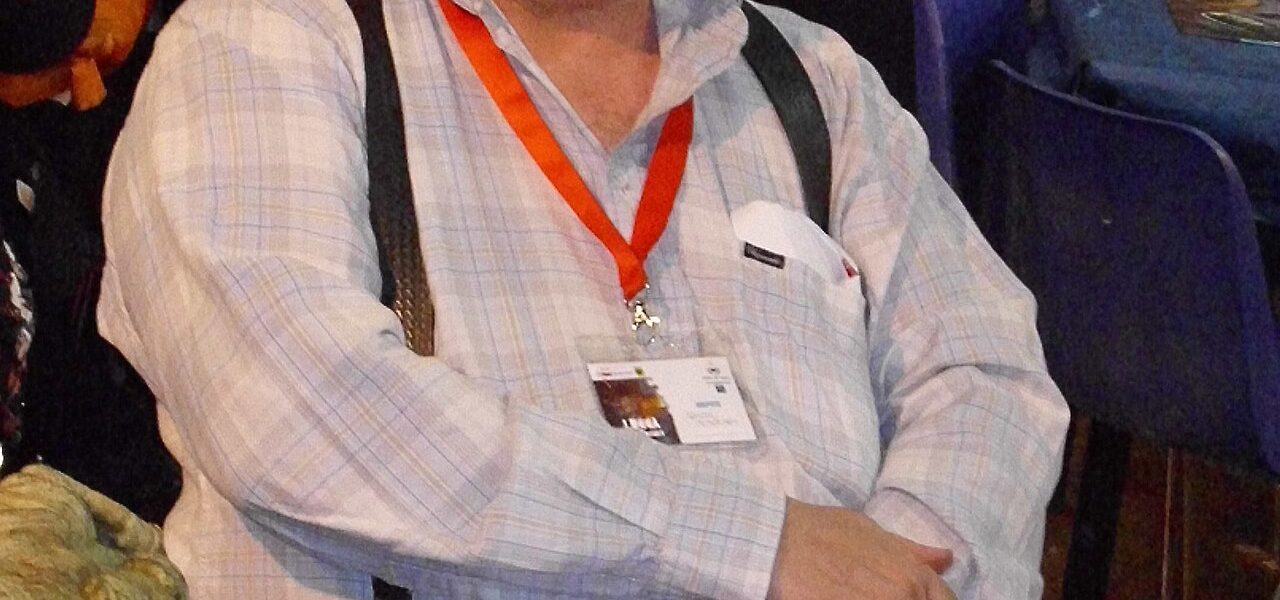
Petersen at Lucca Comics & Games in 2011
Why the creator of gaming’s most famous Horror System prefers contemporary terror
When I asked Sandy Petersen about his upcoming Call of Cthulhu project “Big C,” his enthusiasm was immediate. “It’s in modern times,” he said, “and it’s about a drug selling group that is connected to deep ones.” This isn’t surprising—despite creating the most famous 1920s-set horror RPG in history, Petersen himself has always preferred contemporary Cthulhu gaming.
After 40-plus years of Call of Cthulhu, Sandy Petersen has a confession: he never really liked the 1920s setting that made his game famous. In an exclusive interview, the legendary designer revealed why he believes Lovecraftian horror works better in the modern era—and shared details about his return to contemporary Call of Cthulhu gaming.
The 1920s Were Never Lovecraft’s Point
“Lovecraft didn’t write in the 20s,” Petersen explains, quickly clarifying his meaning. “I mean, he did physically write in the ’20s, but he wasn’t trying to write quaint slices of life in the ’20s. He was doing cutting-edge science. He had air exploration of the Antarctic. He had submarines. He had ultraviolet rays. He had the discovery of Pluto. He was doing the most advanced stuff he could.”
This insight cuts to the heart of a common misunderstanding about Lovecraftian horror. While most people associate Call of Cthulhu with flappers and prohibition, Petersen argues this misses Lovecraft’s actual intent. “I’m trying to follow in his footsteps,” he says. The 1920s setting was actually a compromise, not Petersen’s vision. “Chaosium, without reading Lovecraft, thought he was a hack,” Petersen reveals. “They hired me to write the book because they knew I loved Lovecraft and they knew that if they did it, it would be all snarky and contemptuous.”
To give the project commercial appeal, Chaosium pushed the 1920s angle. “They said, ‘Hey, the 1920s are cool. There’s flappers. There’s prohibition. There’s gangsters. There’s cool old Model T cars. We’ll focus on the 1920s background.'” But Petersen had different priorities. “I never really played it in the ’20s. I mean, I could play in the ’20s, but I didn’t focus on the quaint 20s stuff. I just said, ‘Well, the 1920s have cars and they have telephones and they have guns, so I’ll just run it like a modern game.'”
Why Modern Horror Hits Harder
After decades of gaming, Petersen believes contemporary settings offer distinct advantages over period pieces. “I think the modern times have the advantage that it’s easier to get people into the mindset of it being scary. They don’t have to get through everything’s quaint and old-fashioned before you can get to the scary part.”
The temporal distance creates additional barriers. “When I was doing it in 1980, the ’20s were only about 50 years ago. There were a lot of people alive who had been alive in the ’20s. Now the ’20s are 100 years ago. Now no one remembers the ’20s.” Petersen’s solution is characteristically direct: “If I’d done Cthulhu now, I guess they’d have to set it in the 1980s or 1970s, which is even crazier.” Instead, he advocates for true contemporary gaming. “I want Cthulhu to be scary in the modern times where we live today. This is a really scary time.”
Technology As a Gateway For Horror
Rather than viewing modern technology as an obstacle to Lovecraftian atmosphere, Petersen sees it as an opportunity. “People say, ‘Well, we have guns.’ I said, ‘Well sure, they had guns in the 20s, and plus the cultists have guns and they’re probably better organized than the investigators.'”
Cell phones, often cited as atmosphere-killers, become tools for terror in Petersen’s hands. “Cell phones are such a great way to introduce horror into your life. The ghosts can call you on your phone. I have a whole scenario called ‘A Voice on the Phone’ where Shub-Niggurath contacts you over your phone and is messing with your head.”
He’s particularly excited about other designers’ innovations: “One author, not me sadly, came up with the idea that one of Nyarlathotep’s thousand forms is a computer virus. The phones and the internet and all these connected things—they go two ways, and they let the things come into our lives and give us horror beyond comprehension.”
Big C: A Return to Contemporary Cthulhu
Petersen’s upcoming “Big C” represents his return to modern Call of Cthulhu design. Under a new arrangement with Chaosium, he’s focusing on contemporary scenarios while the company handles 1920s material. “It’s a full campaign. It’s going to be a hardback book, couple hundred pages long with all kinds of adventures and entanglements. The climax is in an unfinished supercollider tunnel complex with terrible horrors within.”
The modern setting allows for more grounded horror: “It’s about a drug-selling group that is connected to deep ones.” This street-level approach exemplifies Petersen’s preference for contemporary gaming—horror that feels immediate and relevant rather than historically distanced.
The Italian Understanding
During our conversation, Petersen reflected on why Call of Cthulhu resonates particularly strongly with Italian players. His observation touches on something profound about cultural approaches to cosmic horror.
“I remember years ago at Lucca Comics, an Italian keeper ran Masks of Nyarlathotep where every player died in the end. They knew they were dying going in, but they spent six hours crafting elaborate death scenes. One player wrote an actual sonnet as his character’s final words.”
This leads to a fascinating cultural insight: “Americans approach it as ‘How do we beat Cthulhu?’ The Italian approach is ‘How do we make our destruction meaningful and beautiful.'” This perspective aligns perfectly with Petersen’s vision for modern Cthulhu gaming—not about escaping cosmic horror, but about confronting it meaningfully in the world we actually inhabit.
Looking Forward: Horror in Our Time
As Call of Cthulhu approaches its fifth decade, Petersen remains convinced that contemporary settings offer the richest possibilities for Lovecraftian gaming. “So Big C is modern times, and Chaosium has said they want me to do the modern times books and they’ll stick with 1920s. So that’s fine with me.”
His reasoning is both practical and philosophical: “It’s easier to get people into the mindset of it being scary” when the setting feels immediate and relevant. Moreover, it honors Lovecraft’s actual approach—using the cutting edge of contemporary knowledge to suggest cosmic possibilities beyond human comprehension.
“This is a really scary time,” Petersen observes about our current era. Rather than retreating into period nostalgia, he advocates for horror that grapples with the fears and possibilities of today. After 40 years, the creator of Call of Cthulhu is still pushing the boundaries of what Lovecraftian gaming can be. By embracing the modern world rather than hiding from it, he’s ensuring that cosmic horror remains as relevant today as it was when he first introduced sanity rules to a startled group of players in a haunted basement.
This interview was conducted for Il Gioco in Tavolo podcast. Full video available at Youtube Video
/pic9381340.jpg)
/pic9393468.jpg)
Tell us how can we improve this post?