
/pic9121246.jpg)
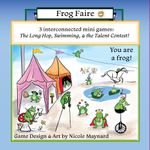
Frog Faire began as a Renaissance Faire/Olympics-themed card game in 2023.
Tapping into the athletic nature of frogs and a fairytale setting like Rebel Princess, I brainstormed a list of Olympic-inspired activities frogs might be good at and activities found at Renaissance Faires. My list included the long jump, swimming, tree climbing, rowing, baking, karaoke (kara-CROAK-e), dancing, and pie eating (fly pies), among others.
I entertained the idea of acquiring skills in the game and researched which would apply to each activity, such as balance, co-ordination, and rhythm. Could equipment factor in: ropes, carabiners, cooking utensils, a microphone? Could all these be boiled down to “agility” or “style”? I was lost.
I shelved the idea for a year and a half. As an artist (a painter), I was new not only to game design but to the modern board game revolution, and didn’t have the necessary skills to move the game forward.
Meanwhile, I did a deep dive into every resource I could find. I read, watched, listened to, played, and playtested, immersing myself in games. As I worked on other game ideas, I came across the concept of mini-games. The frogs were back!
/pic9217561.png)
A fan of efficiency, bento boxes, and minimalism, modularity appealed to me. The design challenge excited me: designing not one but three games, all of which could be played sequentially or independently. This would allow players to learn the game over multiple sessions, which could benefit adults teaching children or encourage players who have just enough time to try something new if it’s quick.
There were big questions to answer: Could I create a welcoming family game and offer interesting decisions to gamers? How would the three games be similar yet different? How could they connect thematically and mechanically? Minimum set-up in between games and game flow were also necessary conditions.
I connected with designers and playtesters from Break My Game and the Princeton Board Game Design Group, and others online. As all designers know, these important people become one’s teachers, and iteration in response to feedback is key to unlocking a game’s potential.
/pic9217547.png)
It started to come together slowly. YOU are a frog, competing in three interconnected mini-games: The Long Hop, Tree Climbing, and The Talent Contest.
I eliminated the first ideas about equipment and the convoluted way I was thinking about skills. Traditional card games with set collection offered a starting point. I decided to work with a deck of cards consisting of only numbers — no suits or red and black cards like in a traditional deck. Jokers became Wild Frogs. Six sets of 1-10 allow the game to be played with up to four players. I created a special deck of “talent cards” to use as goal cards.
/pic9217528.png)
Everyone agreed that Tree Climbing was a dud. It was a shedding game with the winner being the first to get rid of all their cards. It was the least satisfying and most luck-based of the three games, so it had to go.
/pic9216942.jpg)
Swimming took its place. It had to be easy to start playing, so in both The Long Hop and Swimming, you draw two cards and discard one. The goal of each is to hop or swim the farthest by collecting card combinations to score the most points. When you reveal your hand, the cards are laid out on the table in a row, like in the long jump or a swim lane.
To connect the games, players select cards from their hands to use in the next game and prizes from each carry over. The scoring of The Long Hop has similarities to classic card games, such as two-, three-, and four-of-a-kind. The twist is a Reiner Knizia-inspired score of 0 for collecting three-of-a-kind. Hold out for a fourth card in the set, and you will be rewarded with a whopping 6 points.
The push-your-luck effect makes the game fun. Swimming is peculiar in its basis of collecting even- or odd-numbered cards, and it makes you look at your hand of cards differently.
/pic9216969.png)
I learned about games that allowed a player to spend their victory points. Fly pies would serve as points and prizes. I worked to get the point system right so that players could still win if they lost the first two mini-games, but it had to be difficult because the first and second games had to matter. I learned how changing the scoring motivated players in different directions and made those decision trees branch in ways that were equally viable strategies.
The Talent Contest is inspired by drafting cards from a grid, like in Coloretto. The talent cards are set up in combinations that inform the players of which row of cards to take. Thematically, this is a celebration of the arts, the grand finale and performance after the jocks have had their moment in the spotlight. Each numbered card features a talented frog.
/pic9216971.png)
Lastly, a note on the art. Most published games pair an artist with a game designer, and I’m willing to have another artist create the art, should a publisher be interested in Frog Faire. Producing the game in a small edition as an indie designer allowed me to have a version of the game as I envisioned it, and it was important to me to have the frogs be reminiscent of classic children’s book illustrations.
/pic9217546.jpg)
I drew them directly using Procreate on the iPad and did the graphic design in Adobe Illustrator and InDesign. In terms of graphic design, it is important to me to include everyone, so the rulebook and player aid are large in order to use 16-point font for accessibility.
In my work as a painter outside of the game world, I created a series of triptychs, three oil paintings displayed next to each other, often in a row, in which design elements (shapes, lines, and colors) as well as the theme related to one another from canvas to canvas. The visual structure functions as a backbone, like game mechanisms. The format echoes narratives with the three parts suggesting a beginning, middle, and end, as well as the overarching experience of the whole.
If you try Frog Faire, which will debut at the Indie Games Night Market during PAXU 2025, I’d love to know about your experience!
Tell us how can we improve this post?